

Meyu Changkiri
In the late 1990s, during my student days at Eastern Theological College in Jorhat, four of us were sent to sing and minister at the Sümi Baptist Church in Zunheboto. Pastor Shituho was serving there at the time. I travelled with Rev. Terrence Wanshong, Dr. Moody Lyngkhoi, and Rev. Aheto Sema. Though many years have passed, the memory of that first visit still remains fresh in my heart.
More than twenty-five years later, I found myself travelling through Zunheboto once again. This time, my wife accompanied me. Before this journey, we had been engaged in ministry responsibilities at Clark Theological College. Returning directly to Shillong and then travelling again toward Kiphire for another church engagement would have been physically exhausting. I therefore decided to take a few days of casual leave between the schedules.
During that period, I also attended a couple of interviews at the Mokokchung Radio Station on invitation. Later, we travelled through Zunheboto, where I had the opportunity to speak at a government programme for young students undergoing teacher training.
At first, I thought it would only be a brief stop along the journey. Instead, it became something deeply meaningful.
As we travelled through the hills, I found myself reflecting quietly on life and ministry. Sometimes God brings us back to places connected with old memories, friendships, and unexpected blessings.
Upon our arrival, my school and college friend, Zheghuka Assumi, whom I was meeting again after nearly thirty years, personally came to receive us from our place of lodging. He took us to his home for dinner. From the moment we entered the house, his family treated us not as visitors, but as their own.
That evening left a deep impression on us.
The table was filled with carefully prepared dishes. The meal reflected both the richness of Naga tradition and the generosity of the Sümi people. Yet what touched us most was not the food itself. It was the spirit around the table. There was sincerity in the conversations, kindness in every gesture, and joy in simply being together.
True hospitality has a way of removing distance between people.
The following day, my friend arranged for my wife and me to visit one of the largest church buildings in Asia. As we approached the church, I felt a deep sense of admiration. It was not merely because of its impressive structure. It was because of what it represented - faith, sacrifice, unity, and the shared vision of God’s people.
We were graciously received by Pastor Dr. Hutton Sümi, his wife, and the church staff. Their reception was simple and genuine. There was no unnecessary formality. Instead, there was openness, humility, and fellowship.
As we toured different sections of the church premises, we listened to the story and vision behind the ministry. When we reached the terrace, we paused for a moment. Before us stretched the blue mountains and rolling hills surrounding Zunheboto. The view was peaceful and breathtaking.
Standing there, I was reminded that God often speaks gently through His creation. Just as loving parents watch over their homes with care, God watches over His people with quiet faithfulness.
Later, over coffee in the pastor’s office, we shared about ministry, family life, responsibilities, struggles, and the grace of God that sustains us through different seasons of life. It did not feel like an official meeting. It felt like fellowship among brothers and sisters in Christ.
That evening brought another meaningful experience.
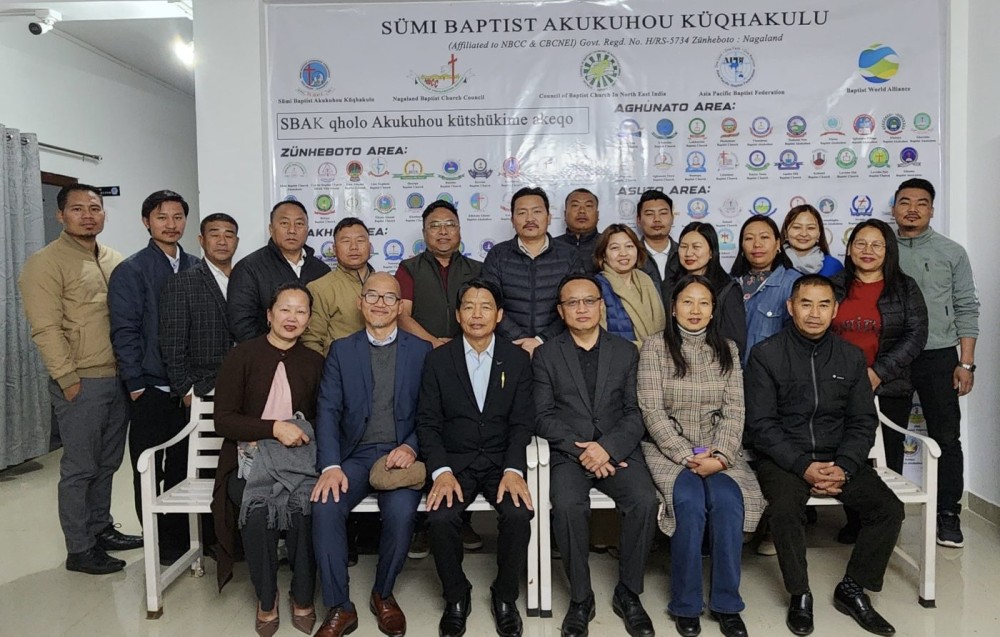
My friend and his wife took us to Sümi Baptist Akhukuhou Küqhakulu (SBAK) at Nito Mount. The Executive Secretary, Rev. Kughato K. Chophi, along with the staff, welcomed us with kindness and honour. Their gracious spirit immediately created a sense of belonging.
Special gifts were presented to both my wife and me. Their value did not lie in material worth. Their value lay in the love and respect behind them.
After sharing words of encouragement, we joined together in prayer. In that moment, there was a beautiful sense of Christian unity. Though we came from different places and carried different responsibilities, we stood together under the same Lord. We shared the same calling and depended on the same grace.
The evening concluded with a dinner prepared in our honour. Conversations flowed naturally. Laughter filled the room. Relationships deepened. It felt less like an official gathering and more like a family reunion.
Throughout the visit, one thing touched me deeply. It was the effort behind everything we experienced.
Hospitality of this kind does not happen by accident. It requires preparation, sacrifice, attentiveness, and willing hearts. Someone must prepare the meal. Someone must arrange the space. Someone must think about the comfort of others before thinking about themselves.
Much of this quiet labour often goes unnoticed.
The Richness of Sümi Hospitality
What we experienced in Zunheboto was not limited to a few individuals. It reflected something much deeper. It reflected the collective spirit of the Sümi brothers and sisters.
Sümi hospitality is rich not merely because of what is offered. It is rich because of the spirit in which it is shared.
Guests are not treated as outsiders. From the moment one arrives, there is a sincere effort to make the person feel accepted, respected, and cared for. Meals are shared generously. Time is given freely. Conversations are never rushed.
People listen attentively. They make space for others.
What stood out most was the naturalness of it all. Nothing felt forced or performed. Hospitality flowed quietly and sincerely from the heart.
In many ways, this reflects the strength of Naga community life itself. Relationships matter deeply. People stand together during both joyful and difficult times. Generosity is viewed not as loss, but as honour.
Whether in homes, churches, or mission centres, we encountered the same gracious spirit repeatedly. That consistency is what makes Sümi hospitality remarkable. It is not occasional. It is a way of life.
Hospitality and Identity
Among many Naga tribes, hospitality is more than a social custom. It is closely connected to identity.
Traditionally, Naga society has always been community-centered. People depended on one another during farming seasons, festivals, village activities, sickness, and times of grief. Homes were not viewed merely as private spaces. They were places where relationships were nurtured and responsibilities were shared.
In such a setting, hospitality became natural.
The way people receive others often reveals the values they carry within themselves. In many Naga homes, guests are treated with dignity regardless of status or background. Food is shared freely. People are given both attention and presence.
In true community life, relationships matter more than convenience.
Today, however, modern life is slowly changing many traditional values. Busy schedules, individualism, and constant distractions can weaken community bonds. People may live physically close to one another while remaining emotionally distant.
That is why genuine hospitality matters even more today.
Hospitality preserves humanity. It reminds us that kindness still matters. Relationships are sacred. Communities grow stronger when people intentionally make room for one another.
For Christians, hospitality is also part of spiritual identity. God Himself welcomes us through Christ. Therefore, when believers welcome others sincerely, they reflect the very heart of God.
Sometimes a warm meal, a listening ear, or a welcoming home can speak more powerfully than many words.
A Reflection on Hospitality
What is hospitality, really? Is it simply offering food, providing a room, or entertaining guests politely?
The Holy Bible teaches us that hospitality is much deeper than social courtesy. It is a spiritual practice. It reflects the character of God. In Hebrews 13:2, believers are reminded not to neglect showing hospitality to strangers. In Romans 12:13, Christians are encouraged to practice hospitality intentionally.
These verses remind us that hospitality is not optional for believers. It is part of Christian living.
Through our experience in Zunheboto, several truths became clear. Before people hear a message, they often experience it through the way they are received. When meals are shared sincerely, strangers become friends, and friends become family. When hospitality is offered with humility and love, it becomes a living testimony of Christ Himself.
Hospitality is not about impressing people. It is about valuing people.
A Final Thought
As we returned from Zunheboto, we carried home more than memories of beautiful landscapes, church buildings, and gatherings. We carried the impact of sincere hospitality.
In the end, people may forget many things we say, but they rarely forget how we made them feel. Perhaps that is the quiet strength of hospitality. It does not seek applause. It does not demand recognition. Yet it leaves lasting marks on human hearts long after the moment has passed.

