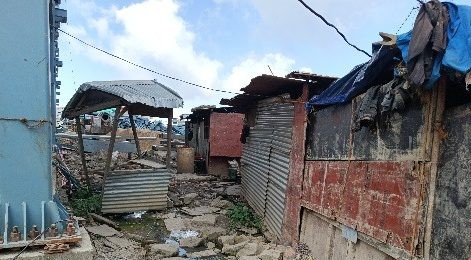
Living conditions of construction workers in the state as documented by the CAG.
Morung Express News
Dimapur | April 12
A performance audit by the Comptroller and Auditor General (CAG) of India has found that the Nagaland Labour Department and the Nagaland Building and Other Construction Workers Welfare Board failed across nearly every statutory obligation toward construction workers in the state over a six-year period, leaving a largely migrant workforce without registration, safety oversight, basic amenities, or welfare benefits.
The audit, tabled as part of the CAG Report for the year ending March 2023, covered the period 2017-18 to 2022-23 and examined the NBOCWWB on five broad areas: registration of workers and establishments, cess assessment and collection, worksite inspections, health and safety conditions, and implementation of the central government's Modified Model Welfare Scheme.
Numbers on paper alone
As of March 2023, 35,080 workers were registered with the welfare board across twelve districts. Kohima led with 9,751 registered workers, followed by Mon (4,632), Mokokchung (4,344), and Dimapur (5,133). Noklak had zero registrations. Against these numbers, the state's own Department of Economics and Statistics recorded 15,527 migrant workers in Nagaland for 2022-23.
When auditors conducted a sample survey of 69 construction workers at active worksites in Kohima and Dimapur — two of the districts with the highest registration counts — not one of them was registered under the NBOCWWB. Sixty-six of those 69 workers, or 96 per cent, were migrant workers.
The CAG noted that "in the absence of a mechanism to ensure that all workers are registered, Audit cannot ascertain the status of registration" and that "there was no effective mechanism to facilitate or make aware the migrant labourers to register with the Welfare Board."
The Labour Department, in its July 2023 reply, said awareness programmes had been organised for migrant workers but that workers often lacked required documents and were reluctant to register given the temporary nature of their stay. It also cited "absence of appropriate manpower" as a reason for the failure. The CAG found the reply "indicative of the fact that there is no effective mechanism to register all the building and other construction workers with the Welfare Board."
Compounding this, the audit found that registrations and renewals had been processed without the documents required under Rule 265 of the NBOCW (RECS) Rules 2010 — proof of employment under a registered establishment or evidence of at least 90 days of construction work in the preceding year. The department said most workers were self-employed seasonal labourers without defined employers, but the CAG rejected that explanation, noting the rules required documentation regardless.
As of the end of 2022-23, 2,892 beneficiaries had lapsed into inactive status due to non-renewal of membership. The audit attributed this partly to limited access to renewal counters at ALC offices across districts.
No establishment registered
Under Section 7 of the BOC (RECS) Act, every employer is required to register their establishment with the welfare board within sixty days of commencement of construction work. The audit found that not a single establishment had been registered under this provision. No registration fees had been collected. No monthly returns on workers employed had been submitted. No records existed of any intimation to the registering officer of changes in ownership, management, or workforce.
The department, while accepting the finding, said that a few establishments had been registered in the initial period of the Act's enforcement but that "the process was discontinued due to the non-cooperation and stiff resistance from the employers." It said it would propose to the state government that registration numbers from the Labour Department be made compulsory in all contracts and tender applications.
The CAG recommended that "registration as an establishment with the Board be made a prerequisite for Contractors and agencies for award of Work Orders."
Cess unremitted for months
The BOC Welfare Cess Act requires cess at one per cent of construction cost to be levied from employers and remitted to the welfare board within thirty days of collection. The audit found that independent assessment of cess through worksite inspection was never undertaken and that remittance by government departments was delayed by months or years.
The office of the Kohima Smart City Development Ltd deducted cess of Rs 64.07 lakh from contractor bills between December 2018 and September 2022 but delayed remitting the amount to the NBOCWWB by between one and 45 months. The Engineering Wing of the Urban Development Department, Kohima, delayed remitting Rs 73.23 lakh collected between 2019-20 and 2021-22 by one to twelve months.
A test check of three divisional offices — PWD (R&B) Dimapur, PWD (R&B) Pfutsero, and Medical Engineering Division Kohima — found that cess of Rs 55.09 lakh for 2020-21 and Rs 75.54 lakh for 2021-22 remained unremitted at the close of their respective financial years.
Because no inspection of worksites or establishments was ever conducted, the department was also never able to independently identify employers liable to pay cess, issue notices for return filing, or impose the two per cent monthly interest penalty mandated under Section 8 of the Cess Act for defaults.
The department's July 2023 reply cited "absence of appropriate manpower in the respective districts" and assured that corrective measures would be initiated.
Safety and living conditions
Chapter VI to XXIV of the NBOCW (RECS) Rules 2010 lay down safety and health norms covering precautions during demolition, handling of explosives, fire safety, safe transport of workers, safety nets, lighting of worksites, and provision of medical facilities. The audit found none of these were being verified. The department had appointed the Joint Labour Commissioner as Chief Inspector and notified Assistant Labour Commissioners and Labour Inspectors as inspectors under the Act — but no inspections of building or construction works were conducted during the entire audit period.
The CAG observed that "instances where the safety and health of BOC workers were compromised as the precautions and facilities guaranteed under the Act were not provided" had been found and that "the Department did not undertake regular assessment of conditions of worksites through inspections to ensure that statutory safeguards were in place."
On conditions of service, Sections 28 to 37 of the Act require employers to provide construction workers with drinking water, latrines, urinals, accommodation, and canteen facilities. The audit found no system existed to check compliance with any of these. There was equally no mechanism to verify adherence to rules on working hours, wages, or compensation. The CAG noted that "the possibility that BOC workers were denied certain minimum standard of working conditions and facilities cannot be ruled out."
Because no inspections were conducted, no penalties were imposed for any violations under Sections 47 to 50 of the Act — which cover contravention of safety provisions, failure to give notice of commencement of construction, and obstruction of inspectors — over the six-year audit period.
Migrant workers without facilities
Despite the construction workforce being predominantly migrant, none of the amenities envisaged under the central government's Modified Model Welfare Scheme had been provided. The scheme requires state welfare boards to proactively facilitate transit accommodation, labour sheds, facilitation centres, and mobile toilets in areas of migrant worker concentration. None were provided.
The department's reply was that migrant workers "do not concentrate in large number in a particular area thereby requiring such facilities" and that provision would be considered if such need arose.
This was— was rejected by the CAG, which noted that "it did not take proactive measures to identify locations where amenities were needed" and that "as the facilities are of a temporary/mobile nature, they should have been provided."
Of 141 construction workers surveyed across Kohima (107) and Dimapur (34), not one was aware of entitlements to paid maternity leave under the scheme, which provides for 90 days to 26 weeks of paid leave for up to two deliveries. The audit found no monitoring mechanism existed to ensure employers were providing this benefit, and the department accepted the finding.
Skill development training, also mandated under the scheme, was found to have been provided to workers selected by training partners who were unregistered. Sample surveys of registered beneficiaries at ALC Kohima and ALC Dimapur, and of 69 construction workers at worksites, found that none had received any skill development training.
Welfare fund spent on vehicles; 2 cr paid without insurance
A central government order under Section 60 of the BOC (RECS) Act bars the use of cess funds for any purpose other than the welfare of construction workers and their families. The audit found that the NBOCWWB spent Rs 1.50 crore from the cess fund on purchasing nine vehicles in contravention of this order. The department said Rs 92.18 lakh had been recouped from the cess account in May 2023 but the CAG noted there is no provision in the Act for vehicle procurement from administrative expenses either way.
On insurance, the Modified Model Welfare Scheme provides for coverage under PMJJBY and PMSBY on a 50:50 cost-sharing basis between the state welfare board and the central government, providing Rs 2 lakh for natural death and Rs 4 lakh for accidental death. Because the welfare board had discontinued its LIC linkage, citing access issues with LIC Jorhat in Assam, it bore the full cost of 100 death claims — Rs 2 crore — entirely from its own welfare fund rather than through the insurance mechanism.
Board without budgets, annual reports, or accounts
The audit found that the welfare board had not prepared or submitted a budget, annual report, or annual statement of accounts to the state government for the entire six-year audit period — all statutory obligations under Sections 25, 26, and 27 of the BOC (RECS) Act. No assessment of staff requirements had been made and service rules for board employees had not been finalised.
The State Advisory Committee, constituted for February 2018 to February 2021, held no meetings during its entire three-year term. Its term expired without a new committee being constituted. The CAG noted that "the State Government and the Welfare Board were deprived of the benefit of advice and guidance on matters arising out of the administration of the Act" as a result.
The CAG has made nine recommendations to the state government: ensure user-friendly registration and renewal procedures for construction workers; make establishment registration a prerequisite for contractors seeking work orders; conduct worksite inspections for cess assessment and timely remittance; take action against DDOs defaulting on cess remittance; strictly enforce health and safety provisions; prepare budgets, annual reports, and accounts; reconstitute the State Advisory Committee; implement the Modified Model Welfare Scheme; and fix responsibility on officials who used the cess fund for vehicle procurement in violation of the central government order.