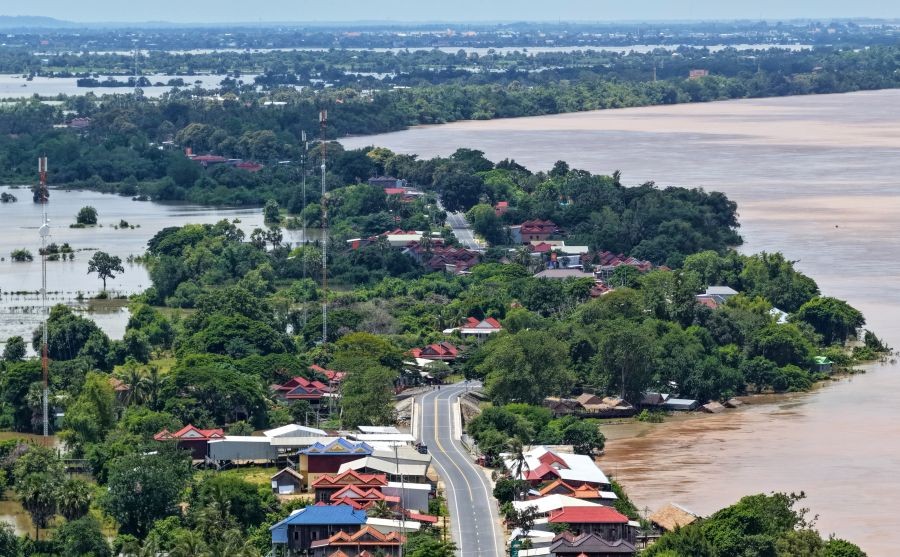
An aerial drone photo taken on Aug. 24, 2026, shows an area affected by the flooding of the Mekong River in Kratie province, Cambodia. The flooding of the Mekong River has affected 13,688 families across four Cambodian provinces, forcing 1,551 families to evacuate to higher ground, a disaster control spokesperson said Tuesday. Soth Kim Kolmony, spokesperson for the National Committee for Disaster Management (NCDM), said Kratie, Tboung Khmum, Stung Treng, and Kampong Cham provinces have faced severe flooding since last Friday, triggered by the aftermath of Typhoon Saudel. (Photo: Xinhua via IANS)
Naypyidaw, October 3 (IANS): China’s unwillingness to fully cooperate with its downstream neighbours has turned the nearly 4,900-km Mekong River into a battleground of geopolitics rather than a symbol of regional cooperation, a report has stated.
Flowing from the Tibetan Plateau through China’s Yunnan province into Southeast Asia, the river is more than a geographical feature, serving as a lifeline for over 60 million people across Laos, Cambodia, Thailand, Vietnam and Myanmar.
Despite its shared importance, the issue is not whether China can cooperate with downstream countries, but why it chooses not to, according to a report in Myanmar media outlet 'Mizzima News'
“China’s behaviour toward upstream nations such as Kazakhstan and Mongolia stands in sharp contrast to its approach on the Mekong. With these northern neighbours, Beijing has signed binding water-sharing agreements and established joint commissions to manage rivers like the Irtysh and the Ili. The difference lies in strategic necessity: Kazakhstan and Mongolia are upstream, or midstream states themselves, and their water disputes directly affect China’s own border provinces, industrial hubs, and domestic stability,” the report detailed.
“Cooperation here is not framed as goodwill but as a matter of self-interest; China needs predictable flows to sustain Xinjiang’s border security, agriculture and industry, and it cannot afford prolonged disputes with countries that share sensitive borders. Thus, treaties and technical coordination become instruments of stability, ensuring China’s own water security while projecting an image of responsible regional leadership,” it added.
By contrast, the Mekong reflects a markedly different strategic calculus, with China occupying the dominant position as the upstream power and facing no existential threat from the downstream nations. Laos, Cambodia, Thailand and Vietnam remain heavily dependent on the river, but their leverage is far weaker than that of countries such as Kazakhstan or Mongolia, the report mentioned.
“Beijing sees little incentive to bind itself to restrictive agreements when unilateral dam operations provide both hydropower benefits and geopolitical leverage. Cooperation is kept voluntary, symbolic, and selective, allowing China to retain maximum control while using water flows as a tool of influence in Southeast Asia. In short, China cooperates where its own security is at stake, as with Kazakhstan and Mongolia, but resists binding commitments where it can dominate, as on the Mekong,” it stated.
Highlighting the far-reaching consequences of China’s selective cooperation, the report warned that Vietnam’s rice bowl and Cambodia’s fisheries could face severe disruption if river flows remain unpredictable. It noted that declining sediment levels are also threatening biodiversity and accelerating erosion.
“Distrust in China’s intentions could destabilise ASEAN-China relations, undermining broader regional integration. With droughts and floods intensifying, unilateral dam operations will exacerbate vulnerabilities. The Mekong is no longer just a river; it is a geopolitical fault line where livelihoods, food security, and regional trust are at stake,” the report stated.