Kamdi Hemant Bhaskar, IFS
It is a lot of fun at the lower hierarchies of the civil services. Everyday socialisation with batchmates, celebrations, eating out, cooking together, calling on each other's relatives, music, wine, festivals, bonfires in winter... life feels cool.
Then everyone gets married, has children, and gets busy with ailing parents and wailing kids. The number of invitations reduces. Barging into someone's house is no longer a pleasant surprise; it can become a mutual embarrassment.
For officers posted in Nagaland without their families, weekends can be terribly boring or superbly exciting, depending on the choice they make.
I always chose the second option.
Long-distance runs and treks became my way of making weekends superbly exciting. We even had a WhatsApp group of like-minded enthusiasts. Some members were permanently threatened by boring weekends, but group treks somehow kept emerging triumphant with the power of mutual motivation over the eternal dilemma of whether to go or not.
The inertia to start, getting up early, walking for long hours, cold winter mornings, rainy weather, imaginary busyness over things that are neither urgent nor important, the feeling (just the feeling) of not being well, Netflix... all become loyal supporters of the hope that, “Next time I will join for sure.”
On one such occasion, I was forced to march to the mountains alone.
Again.
I have always had this fantasy of surviving physical hardship on minimum resources. At its extreme, I wanted to carry no mobile phone, no money and no cards. Just survive by begging, working and hitchhiking. They say it is one of the best ways to overcome the fear of rejection.
I could never gather that much courage.
I also had another fantasy—making records of maximum steps in a day. Fifty thousand-plus was already my personal record, and that too while doing my daily chores. Now I had an entire day free.
To make the day even longer, I planned to start really early.
I decided to climb Mount Japfu, the second-highest mountain in Nagaland, located close to Kohima. Japfu is nearly 10,000 feet high, and almost half of the climb is already above the altitude of Kohima.
Most trekkers drive to the starting point.
I decided not to.
I would start walking right from my government guest house.
On Sunday at 4 a.m., dressed in winter clothing, high-ankle trekking boots, and carrying a backpack with two bottles of water, my mobile phone and headphones, I quietly stepped out of my room.
Unlike summer, winter mornings at four are properly dark.
There were streetlights, and I have always had a strong sense of security from the people of Nagaland.
Dogs are another matter.
They either try to be unnecessarily friendly or unnecessarily aggressive.
I have always felt they somehow identify me from a distance. They ignore the people before me and after me as if they do not exist, but suddenly become alert as soon as I go near them, even in a crowd.
They seem to enjoy scaring the daylights out of me.
My past encounters with them guided my conscience to direct me back to my room.
I spent the next hour meditating and reading, trying to console the coward—or the cautious person—inside me by convincing myself that I had found something productive to compensate for my fear.
I wished the rumour that Nagas had eaten away all the dogs was true.
At 5 a.m., I headed out again.
There was a little more light from the rising sun to add to the streetlights—and to my courage.
The thought of later boasting about a long trek that nobody in my circle had attempted kept me moving.
Unlike villages in this part of the country, which become active before sunrise, there is very little movement on the roads in Kohima at that hour.
When I reached PHQ Square, even the market which used to come alive before the sun was in deep Sunday slumber. Surprisingly, everything gets sold out and the market almost winds up on other days by the time the rest of India takes its first yawn of the morning.
I always used to pass through the market to take a brief look at the unique, common, rare, weird and exotic plants and animals being sold there before heading onto the Imphal Road. This time it betrayed me to get me some supplies for a further journey.
I had my all-time best companion for solo activities—my mobile phone and headphones. I have finished dozens of audiobooks while walking alone.
This time it was a biography of Elon Musk by Walter Isaacson. Such a contradiction. Listening to the biography of the world's richest man while following austerity.
Meanwhile, during the long march, I refilled my water bottles, ate some roasted chana and peanuts, and had a cup of tea at a small shop near the petrol pump close to Kisama Heritage Village. Luckily, it was the only place open on a Sunday where I could replenish my supplies.
It is a long walk of nearly 14 kilometres from the guest house to Japfu Christian College at Kigwema village through the winding road that passes through the outskirts of Kohima, several villages, lush green hills and beautiful forests. Cherry trees in full pink bloom flanked along the road cheerfully welcome visitors during the Christmas period.
There is hardly any traffic in the morning.
And that is exactly how I like it.
From Japfu Christian College, we leave the Imphal Road and head towards Mount Japfu through the cemented road passing the college campus.
And again, a dog starts approaching me.
Nagaland has one of the lowest dog-bite rates in India, but this statistic doesn't give any courage when a dog is actually approaching you. It is intimidating.
Someone once told me that one should simply walk tall, remain unaffected and maintain a normal pace. I tried that. But my direction of walking somehow developed a gentle curvature to avoid intersecting the dog's line of movement.
It is embarrassing—and probably even more risky—to shout or run, especially when everyone, including little kids, is watching the fun.
I always feel like turning back to check whether I am now at a safe distance. But I resist because I have been advised not to turn. Apparently, that encourages the dog.
So I keep my neck movement to the minimum and try to look at the dog only from the corner of my eyes, hoping to outsmart its psychology while pretending to walk tall and fearless.
Meanwhile, my brain remains busy imagining the dog silently coming from behind and burying his teeth into my calf or thigh.
Only after I am comfortably far away does my heartbeat return to normal.
Honestly, jungles feel much safer.
Many large carnivores and even menacing herbivores have unfortunately met their fate over the years.
Dogs, unfortunately, didn't.
I wish those rumours about them had been true.
Soon the village ends and we reach the Pony Farm, from where most trekkers start their climb.
A little ahead, the trail follows a small stream before entering the potato fields.
I remembered eating a very tasty rhizome there during one of my earlier treks. It looked like a sweet potato but was crispier, almost like a pear, and much tastier. I still don't know what it was.
Scattered among the potato fields are small huts where farmers stay during the cultivation season.
Another thing that always catches my attention here is the number of Indian tricolours fluttering outside these huts.
In most parts of India, we notice the national flag mainly on Independence Day or Republic Day.
Here, it flies throughout the year.
Perhaps it is the impact of the Har Ghar Tiranga campaign.
Whatever the reason, it always gives me a pleasant feeling. As someone representing the Government of Nagaland while serving outside, one often gets opportunities to counter stereotypes and outdated perceptions about the State. Seeing the tricolour fluttering proudly in these remote farms quietly says a lot without saying anything.
Beyond the potato fields begins the real climb.
It is long.
It is relentless.
And it makes sure you respect the mountain.
One has to know the trail, use common sense to follow it, or have enough physical and mental strength to explore and return if one takes the wrong path.
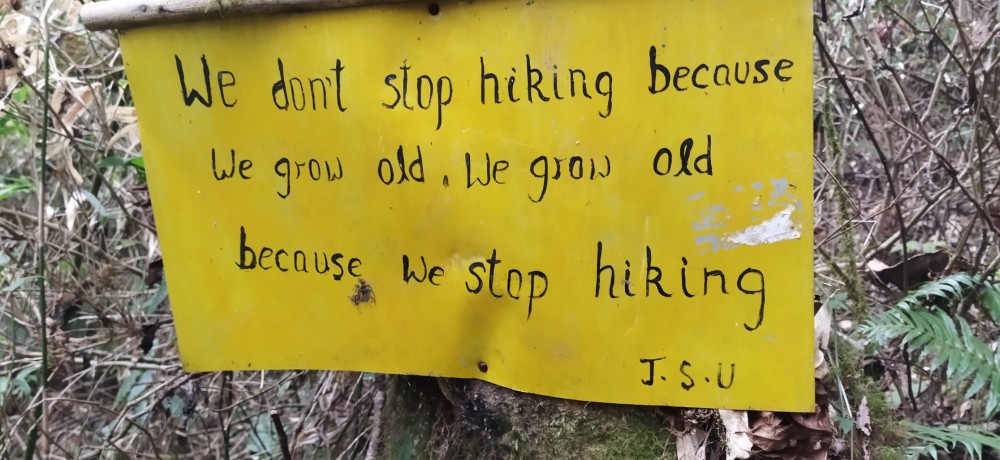
The trail passes through beautiful virgin forests with towering trees of enormous girth. Thick woody climbers hang from them. Every now and then, it passes through a thick network of roots on surface, lovely bamboo tunnels before entering dense evergreen forest again. There are good quotes written about hiking and trekking to keep one motivated.
One such read, “We don’t stop hiking because we grow old, We grow old because we stop hiking”. Certainly, I don’t want to grow old.
Occasionally, a bird flies across the trail.
Once, I even saw a barking deer crossing.
There is a small wooden resting shed on the way. I stopped there for a short break.
Looking around, I wished somebody had opened a tea stall there.
Nothing fancy.
Just tea and Maggi.
I am sure it would do good business.
Trekkers coming down after a night halt at the summit exchanged smiles and greetings.
Like every mountain in the world, everybody had the same answer when I asked how much farther it was.
“Just a little more.”
That “little more” probably has the same meaning in every language.
After a long uphill walk, I finally neared the ridge.
Then came the first surprise.
A long barbed-wire fence.
I stopped.
How did this come here?
What needed to be protected?
Who wanted to protect it?
And from whom?
A few more steps brought an even bigger surprise.
A proper road.
I stood there wondering.
Who built it?
When?
Why?
Later, I learnt that the barbed-wire fencing was probably marking the village boundary or meant to keep Mithuns (the semi-domesticated bovine so closely associated with Nagaland) within limits. The road, I was told, had been constructed by Jotsoma village to encourage tourism.
To be honest, I didn't feel very happy about it.
The beauty of such places is intensified by the hardship required to reach them.
It also protects these pristine places from being flooded by casual tourists simply because access has become easy.
There are already enough places meant for easy tourism.
Some places should remain rewards for those willing to earn them.
Still, I continued walking.
The road certainly made the journey more comfortable.
Comfort, however, was never part of my original plan.
After walking for some time, I noticed patches of snow on the road.
Snow!
It isn't a regular sight here.
One has to be lucky enough to visit during the short window when it appears.
I immediately took out my mobile and recorded a video.
After a little while, there was even more snow.
The first video suddenly looked ordinary.
So I made another one.
Then another.
Each one, obviously, is much better than the previous masterpiece.
Then something made me stop.
Large ochre-red stains splashed across the white snow.
Blood?
For a second, that was my first thought.
Then common sense returned.
It was a generous contribution from a passionate betel nut and tobacco lover.
In most parts of India, chewing tobacco and paan is often associated with socio-economic or educational backwardness. The elites usually have their own sophisticated ways of satisfying nicotine addiction.
Nagaland is different.
Here, tobacco and betel nuts are great equalisers.
The most beautiful lady, the most handsome gentleman, a senior bureaucrat, a minister-politician, or even a beggar—once they smile, equally impressive shades of red may greet you.
The snow had simply become another unwilling canvas like government office walls.
Anyways, I marched ahead. I ran out of water. I started compacting small balls of snow and melting them in my mouth.
The gentle walk along the road came to an end. From there onwards, it was a steep ascent.
Far below, under a gigantic tree, I could see a group of young boys and men having lunch on a huge rock.
The hopeful person inside me immediately woke up.
“Maybe they will ask me to join.”
They didn't.
I slowed down.
Still nothing.
I slowed down a little more.
Still nothing.
I had no option but to pick up my pace and continue climbing.
Hope, unfortunately, doesn't fill the stomach.
The trail became steeper.
Some stretches were comfortable, some were treacherous, and some ran dangerously close to the edge.
A few families were returning from there. They had children with them and had already got more than what they had expected from the trek—snow.
I continued climbing.
I had trekked Japfu several times earlier, but that was almost a decade ago. My memories had become faint.
I remembered that somewhere ahead there was a patch requiring technical climbing. I kept reassuring myself that I had climbed it before, so I would climb it again.
The trail passed through short trees at those windy heights, ground below them carpeted with fresh snow. Walking beneath them on snow was magical. The uneven trail wound around large rocks, crossed twisted roots and occasionally demanded a small jump over boulders.
Then my memory betrayed me.
Or perhaps age had started catching up.
Suddenly, there was a near-vertical rock face.
There were hardly any proper footholds for me. The only support available was a plastic water pipe running along the rock.
My mind simply refused to believe that the pipe was properly anchored.
I stood there staring at it.
Was this really the same trail I had climbed several times before?
There was nobody around to ask.
Without any better option, I started climbing.
My heart was pounding.
My hands were trembling.
My legs were shaking.
They continued to shake even after I had crossed that patch.
Then another frightening thought struck me.
I would have to come down from the same place which is even more difficult than climbing up.
The fellow inside me, well fed on self-help books, immediately came to the rescue.
“Don't think about the way down. Focus on the road ahead.”
So I obeyed.
Sometimes, ignorance is the best climbing strategy.
The trail ahead remained risky but unbelievably beautiful.
Every difficult step was worth it.
Finally, I reached the summit.
The view was simply mesmerising.
Endless lush green mountains stretched in every direction. Beyond them, layer after layer of ridges merged into the horizon, changing from green to bluish green and finally to different darker shades of blue. White clouds rested peacefully inside the valleys, while above them stretched a brilliant blue sky.
I wandered around for some time.
Then I remembered the short bamboo reed thicket on the other side of the peak with trails meandering through where thick snow used to accumulate. I had visited it years ago and wanted to see it again.
It was still as beautiful as I remembered.
After spending some time there, I returned to the summit where the large Holy Cross marks the highest point of Mount Japfu.
A small group of trekkers was sitting near the edge, enjoying the view and having lunch.
Mostly ladies.
My hopeful mind woke up once again.
Maybe they would call me.
Then the practical fellow inside me corrected him.
“They are not going to invite some random man.”
I quietly walked around the summit, pretending to admire the scenery while secretly keeping my ears open.
Why do I always feel that somebody will invite me for food during treks?
Probably because it had happened before.
Not once.
Many times.
Inside Nagaland and outside it.
I had almost completed one final round of the summit when I heard a pleasant voice.
“Brother, please come and have food with us.”
Was it an illusion?
No.
They were looking straight at me.
Going on the very first invitation would have looked greedy.
So I politely replied, “Thank you, Sister. You please have it.”
There was intentionally no “No” in my reply.
I wanted to keep the option open without appearing too eager.
Fortunately, it worked.
The second invitation came.
“Please don't feel shy. We have plenty.”
Now the analytical mind inside me quickly calculated that declining a second invitation might not be a wise decision.
There was no guarantee of a third one.
So, maintaining the required level of formality, I simply asked, “Are you sure?”
In reality, that was my acceptance.
I walked towards them.
They had rice, thick dal and beautifully cooked chicken.
It tasted heavenly.
While eating, we exchanged introductions.
Names.
Native villages.
In Nagaland, asking someone's village is almost an essential part of introducing yourself. The introduction somehow feels incomplete without it.
I remember the lady who first invited me was named Roko from Kigwema village.
She was accompanied by her younger sister, another gentleman and a lady of her age or little more.
All of them welcomed me warmly.
The gentleman looked slightly less enthusiastic about my sudden entry into their lunch party, but he was kind enough to serve me food with his own hands.
They genuinely had plenty of food.
Now that I was comfortable, all hesitation disappeared.
I shamelessly asked for second and third helpings.
Good manners have their limits.
Good chicken doesn't.
I thanked them repeatedly.
After finishing, I followed the gentleman and washed my plate with fresh snow because the available water with them was too precious to wash.
In Nagaland, it is considered good manners to wash your own plate even when you are a guest in somebody's house.
I have always liked that custom.
Not wanting to look as though I had permanently attached myself to the group after lunch, I kept a respectable distance while we started descending together.
After some time, they began throwing snowballs at one another.
I wanted to join.
But our acquaintance was still too fresh.
Throwing the first snowball at strangers, however friendly, seemed slightly risky.
So I quietly watched and secretly hoped someone would throw one at me first.
Thud!
A snowball landed squarely on my back.
Permission granted.
The battle had officially begun.
I threw snowballs till my fingers were swollen with frost.
Conversation had started in English and, somehow, it continued in English, although I am quite fluent in Nagamese.
I enjoyed that feeling of innocent newness among the locals, just like any new relationship. At that point, when love, care and hospitality were being extended to a newcomer to Nagaland, I felt that revealing I was as seasoned as the locals would somehow spoil that feeling.
The sun was slowly setting and we started our descent.
One thought gave me courage.
If these girls could climb down that nightmarish vertical rock, then surely I could too.
Then I reminded myself.
They were Nagas.
Born in the mountains with climbing in their DNA.
Fortunately, I had fellow trekkers around me this time. Watching them negotiate the difficult patches gave me confidence, and wherever required, they guided and supported me. Play
Soon we were back at the base.
We had reached before it became dark.
I thanked them once again and we parted ways.
With whatever strength was left, I confidently started walking back towards Kohima to complete what had now become my longest march.
My confidence lasted exactly as long as there was daylight.
As darkness slowly took over, my old enemies returned to my imagination.
Dogs.
Darkness and curious village dogs are a dangerous combination for someone like me.
I stopped at a small roadside shop.
The original plan was simple.
Wait for some vehicle, hitch a ride if possible, or hire a taxi.
Simple plans don't always work.
Nothing came.
One hour passed.
I remained glued to that little shop.
I could certainly walk the remaining distance.
My legs were willing.
My mind wasn't.
The thought of dogs chasing me through the villages ahead was enough to keep me rooted where I was.
Meanwhile, to pass the time, I narrated the entire day's adventure over the phone to my trek and bike ride buddy and service mate, Prabhat.
He probably enjoyed the story much more than I would have enjoyed walking through those villages in the dark.
I thought it is improper to call my driver and anyways it was going to take some time for him to reach.
Finally, a kind gentleman stopped at the shop.
He agreed to drop me to Kohima at a reasonable taxi fare.
I happily accepted.
At that moment, it felt like being rescued.
While travelling back, I kept looking at the photographs on my phone and reliving the day.
One particular photograph reminded me of my close friend Roko from Kigwema village.
Coincidentally, the lady who had invited me for lunch was also named Roko and from same village.
I sent the photograph to my friend.
Within a few minutes, he replied.
“I know them.”
Then he pointed towards the gentleman in the picture.
“He is my relative... and my colleague.”
The world suddenly became very small.
Without wasting any time, I transferred some money to him through UPI and requested him to buy a few kilograms of pork for the family as a small token of my gratitude.
There are many ways of saying “thank you.”
In Nagaland, pork is one of the better ones.
Pork is not just meat.
It is an emotion.
One has to live in Nagaland, like a Naga, to truly understand it.
Looking back, I don't remember that Sunday because I climbed the second-highest mountain in Nagaland.
I don't remember it because I walked more than fifty thousand steps making a new record.
I don't even remember it because of the snow.
I remember it because complete strangers treated me like family.
A lonely weekend that had started with abandoned trekking plans ended with a meal shared by strangers, a snowball fight with new friends, and pork sent later as a small expression of gratitude.
Not every trek gives you a summit.
Some give you stories.
And those stories keep calling you back to the mountains.
The writer is Conservator of Forest, SDD, Forest Survey of India, MoEF&CC, GoI, Regional Office, Central Zone, CGO Complex, Seminary Hill, Nagpur