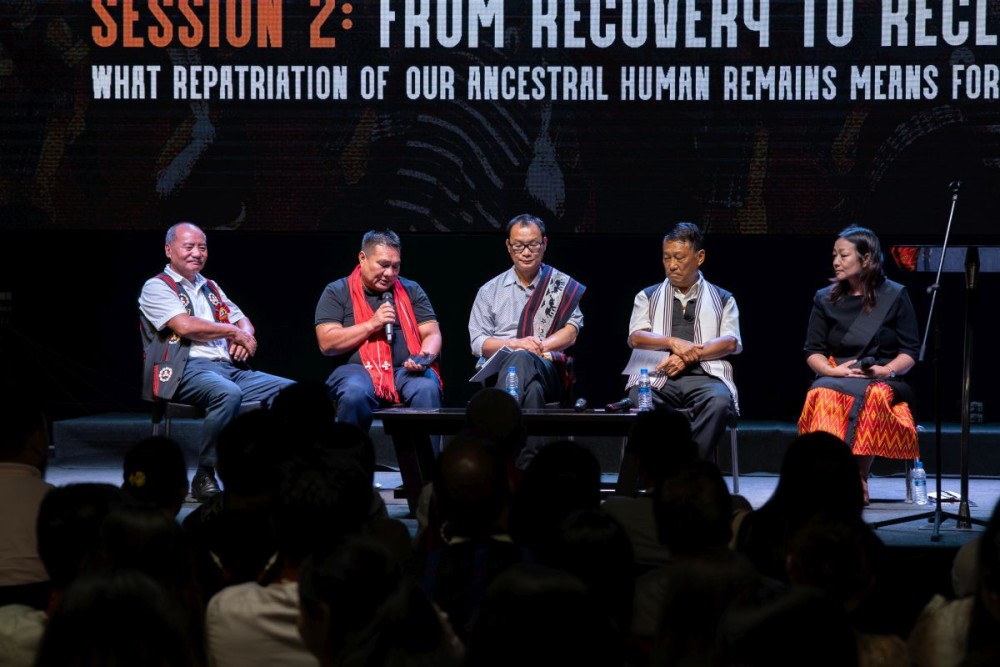
(Left to right) Otova Swu, NT Thamlong Phom, Imtipokyim, Thejao Vihienuo and Rev Dr Ellen Konyak during the September Dialogue 2026 held at The Lighthouse Church, Dimapur on September 5. (Morung Photo)
H Anguvi Chishi
Dimapur | September 6
“…But we know what this moment means for us—it is an act of memory, truth, dignity and healing. We do this so that we may remember truthfully and redemptively, to reclaim our collective memory and resist the forces that seek to erase our story.”
The prayer of blessing, offered with quiet solemnity by Dr Villo Naleo, Secretary for Social Concerns, Nagaland Baptist Church Council (NBCC), set the tone for the third September Dialogue 2026, as the repatriation of Naga ancestral remains moved from a long-sought hope towards tangible certainty.
For over a century, they lay numbered and silent in the glass cases of Oxford University’s Pitt Rivers Museum (PRM)—severed from their hills, classified as anthropological specimens, and displayed as trophies of an empire that labeled their descendants “headhunters and naked savages.”
Now, on the precipice of their long-awaited homecoming, the impending repatriation of Naga ancestral human remains has sparked an inward, sacred reckoning across Nagaland.
At the gathering themed “From Recovery to Reclaiming: What Repatriation of Our Ancestral Human Remains Means for Our People,” apex tribal leaders, scholars, and youth representatives affirmed that reclaiming their dead is neither a bureaucratic exercise nor an academic study.
They located it as an intentional dismantling of colonial subjugation and a historic opportunity to forge lasting unity among a historically fractured people.
Reclaiming personhood from empire
Setting the moral core of the deliberations, Ao Senden General Secretary Imtipokyim stressed that repatriation marks a fundamental shift from colonial objectification to the restoration of human personhood.
“What is coming home is not an object from a museum collection, but someone whose life, death, and memory belong to us Nagas,” he averred.
Urging community-led historical inquiry to recover the voices, clans, and identities erased by colonial ledgers, Imtipokyim firmly opposed re-institutionalising the remains in another museum, insisting they must be committed gently to their native soil with befitting memorials.
Angami Public Organisation (APO) President Thejao Vihienuo framed the homecoming as a “sacred journey” of liberation.
Recalling the initial consultative meeting convened by the Forum for Naga Reconciliation (FNR) at Hotel Saramati in Dimapur, he noted that tribal bodies agreed to accept the repatriation strictly on the prerequisite of an official apology and admission of regret from museum authorities.
Denouncing the “dubious ways” through which ancestors were carted away, Vihienuo observed that no human being, however primitive imperialists deemed them, would ever willingly gift the remains of loved ones.
He challenged the younger generation to decolonise their mentality, shed inherited inferiority complexes, and stand firm against modern cultural assimilation and external suppression.
Sümi Hoho Vice President Otova Swu recalled that the repatriation movement gained critical urgency after Naga scholars, including Prof Dolly Kikon and Prof Arkotong Longkumer, took a resolute stand against the commercial auction of ancestral remains in Europe.
“They looked at it from the lens of a Naga,” he reflected, emphasising that their intervention was born of shared belonging rather than immediate clan ties. He asserted that the return comes at a providential moment when modern society is navigating uncomfortable divisions.
“Let the seed of oneness sprout from that unified burial,” Swu urged, appealing to all tribes to stand together as one living people.
Common Custody: Why the ancestors will rest as one
During the interactive session, the dialogue confronted a deeply sentimental question: where and how the remains should be laid to rest.
Nagato, an attendee from Zunheboto district, inquired whether a skull definitively identified from his ancestral village could be handed over to local descendants for customary burial.
In response, leaders reaffirmed an unbroken consensus: all repatriated remains will be treated collectively as indivisible “Naga property” and interred in a common burial site in Kohima.
Sümi Hoho’s Swu explained that while tracing remains to specific villages is technically possible, a shared resting place serves the higher purpose of moral, social, and political unification.
Phom Peoples’ Council (PPC) Vice President NT Thamlong Phom provided a compelling, candid perspective. Phom, whose community accounts for 24 of the 39 identified ancestral skulls, recalled his June 9, 2025 visit to the Pitt Rivers Museum, where he promised the ancestors they would return home with honour. He revealed that oral inquiries allowed him to identify the exact village origins of skulls and even who took them in historical inter-village feuds. Releasing those details publicly, however, would only re-open ancient feuds.
“When we put this information in the public domain, instead of healing, there will be a sense of bitterness,” Phom cautioned. By resting together, the ancestors are honoured collectively, ensuring their homecoming heals rather than divides.
An inclusive awakening
Responding to observations on centering women’s voices, APO President Vihienuo welcomed broader female participation, stressing that while tribal Hohos have historically been male-dominated, the term “Nagas” inherently includes women. “When we speak of the oneness of Nagas, it is an inclusive approach that embraces Naga women as well,” he assured.
Dr Ellen Konyak Jamir, Convener of Recover, Restore and Decolonise (RRaD) team, explained that the initiative grew organically after Prof Dolly Kikon read about museum provenance policies in The Guardian. RRaD’s grassroots consultations across districts intentionally weave together elders, women, and youth to maintain community ownership.
The living cultural vitality of the work was illustrated when Dr Moishen of the Phom community showed a ceremonial shawl from Yhongshei village. The traditional textile had been lost to tribal memory for decades until NT Thamlong Phom identified its photograph in the PRM archives, inspiring local women to revive the craft.
Looking ahead to November
Addressing practical realities, leaders clarified that Oxford’s Pitt Rivers Museum held physical custody and its director had officially apologized; expecting a state apology from the British Crown was unrealistic given its global colonial scale. The Nagaland government is fully apprised, and central assistance will be coordinated for transit, with the Indian High Commissioner in the UK having commended the initiative during an interaction at Oxford.
Vihienuo clarified that the repatriation focuses exclusively on skeletal remains, leaving over 6,000 ethnographic artifacts in Oxford to share Naga heritage globally.
Logistically, the consignment is expected to arrive by November. Because the size of the consignment exceeds domestic passenger flight capacities, negotiations are underway to air-freight the remains directly to Guwahati to prevent road transit from New Delhi.
Phom also firmly dismissed baseless rumours claiming the initiative wastes public funds or revives animism.
For a people navigating the fractures of modern history, bringing the ancestors home has become a mirror to the living. In choosing to bury them together as one family, the Naga community is doing more than reclaiming bones from distant glass cabinets—they are declaring that their shared grief can become the common ground upon which they finally build their peace.
Shared grief and a ground to build peace
As the gathering drew to a close, Dr Naleo’s prayer carried the historical weight of the day into a solemn invocation for the living:
“May memory become wisdom. May grief become compassion. May history become responsibility. May repentance become transformation. May truth become reconciliation. May reconciliation become peace. May this journey of repatriation become more than the return of ancestral remains. May it become a return of memory, healing and a return to wholeness,” Dr Naleo concluded, his voice resonant with quiet hope.
The proposed repatriation of the Naga ancestors is more than an overdue reckoning with apparent imperial theft; it is a profound testament to the endurance of indigenous memory.
For over a century, these ancestors were stripped of their names, numbered like specimens, and confined to quiet vitrines far from the hills that shaped their lives.
In bringing them home to a common resting place, the Naga people are not merely reclaiming bones—they are restoring personhood to their forebears and discovering, amidst their own modern divisions, that their shared grief can become the very ground upon which they finally build their peace.