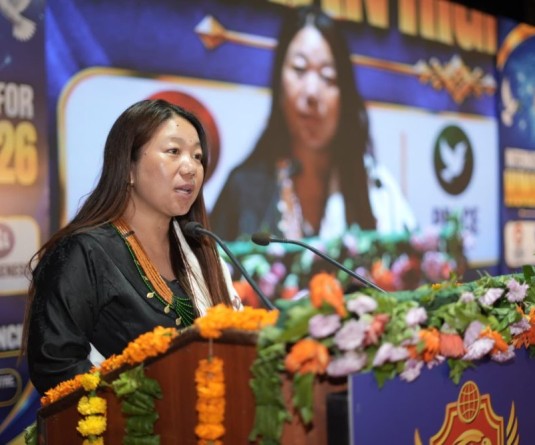
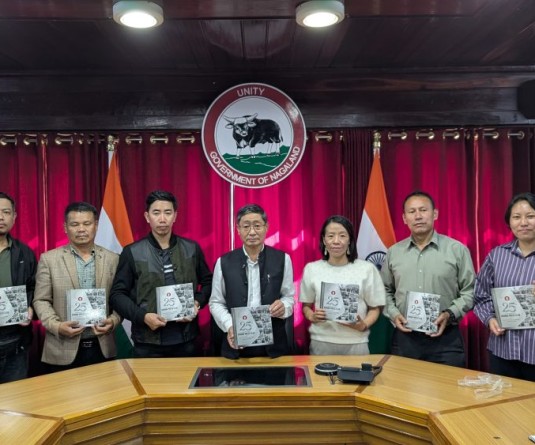
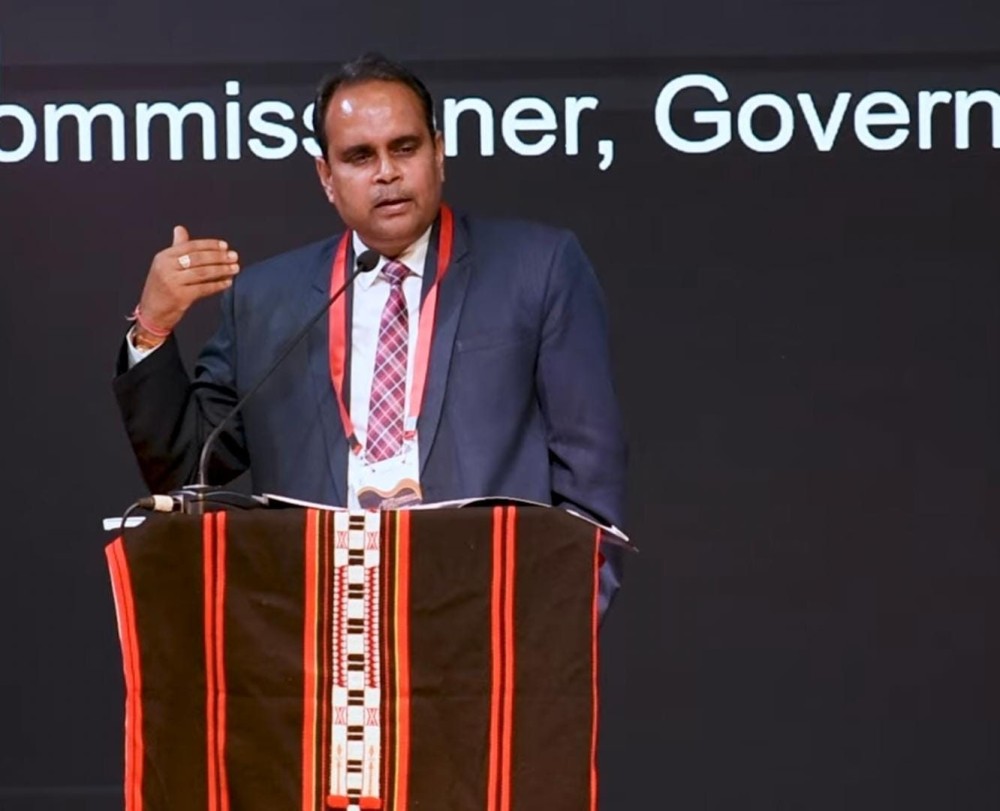
Nagaland Home Commissioner Abhijit Sinha at the inaugural session of the two-day ‘national seminar’ on the BEFR, 1873, which began at the Town Hall, Dimapur, on August 28.
ILP takes centre stage at ILRC-NSF seminar on BEFR
Morung Express News
Dimapur | August 28
The Inner Line Permit/Pass regime was a buffer line and continues so, practically serving as a travel document (like a visa) for Indian citizens, who are not indigenous to states where the Bengal Eastern Frontier Regulation (BEFR) is in effect.
The issue has transformed into a thorny puzzle amidst growing protectionist sentiments and a perceived lack of enforcement by government authorities. On one hand, it has had the government staring at the prospect of economic isolation while handling questions over the regulation’s constitutional validity; on the other, nativist movements lobbying for stricter border controls.
With this as the backdrop, the Inner Line Regulation Commission-Naga Students' Federation (ILRC-NSF), organised a two-day ‘national seminar’ on the BEFR, 1873, which began at the Town Hall, Dimapur, on August 28. Home Commissioner Abhijit Sinha was the special invitee, while North East Students' Organisation (NESO) and All Assam Students’ Union (AASU) Chief Advisor Samujjal Bhattacharyya also addressed the session.
As per the ILRC-NSF, the seminar is “intended to bring together different bodies of knowledge and experience to examine both the legal foundations and the ground realities of the existing system (Inner Line regime).”
In his address, Home Commissioner Abhijit Sinha explained the transition to a digitised ILP system, which has reduced application turnaround times. While the state has migrated registration online, he sought the cooperation of citizens, particularly hoteliers and homeowners to assist by reporting non-indigenous arrivals to the authorities.
In terms of logistics, he admitted to enforcement in Dimapur a particular challenge. He said that given the district’s geographic location as a border hub with Assam — featuring a railway head, an airport, and transit traffic to Manipur — makes enforcement more complex than in other states.
On December 9, 2019, the ILP regime was extended to cover the then undivided Dimapur district. In September 2024, the state government introduced exemptions in Dimapur district classifying non-indigenous residents into three categories— those settled before December 1, 1963, and those who settled during December 1, 1963 to November 21, 1979. These categories were exempted from ILP. Those who came after November 21, 1979 were required to obtain ILP.
Sinha cited a June 16, 2024, Gauhati High Court judgment upholding the state’s powers to extend the ILP. However, he cautioned against making it too restrictive, stating, “It’s only a regulatory mechanism, we are not creating any barriers.” According to him, if one is too restrictive, “or one makes things very difficult for somebody to come,” it would impact the economic growth of the state.
ILRC-NSF Chairperson Senchumo NSN Lotha termed Nagaland's prevailing enforcement system as “facilitative” citing a government report, and thereby, ineffective. He called for a shift from the alleged facilitative to a “regimental” model on the lines of Mizoram.
Originally meant to protect British imperial interests, he said that it evolved into a protective instrument for Nagas, and incorporated in the 16-point memorandum.
Lotha presented data obtained through the Right to Information (RTI) Act to demonstrate a gap between policy and practice. In Kohima district, out of 2,26,563 ILPs issued between 2003 and 2020, there were no records of prosecution and only 36 official deportations. He added that Mokokchung district issued 25,000 permits and collected Rs 47,37,403 in revenue but had no records of penalisation or deportation. Lotha also pointed out a lack of coordination between the state Commissioner's office and Deputy Commissioners at the district level.
NESO and AASU Chief Advisor Samujjal Bhattacharyya called for the implementation of both the ILP and a National Register of Citizens (NRC) across the entire Northeastern states. Bhattacharyya described the influx of undocumented migrants as “a threat to our identity.”
Bhattacharyya stated that the CAA 2019 exemption for Sixth Schedule and ILP-covered states serves as a safeguard. However, he termed the total abolition of ILP provisions for Assam as an injustice by the Union government, noting that Manipur received the permit system while Assam was excluded. Bhattacharyya clarified the purpose of the regulation, stating, “ILP is not a prohibition, it's a regulation.”
.jpg)