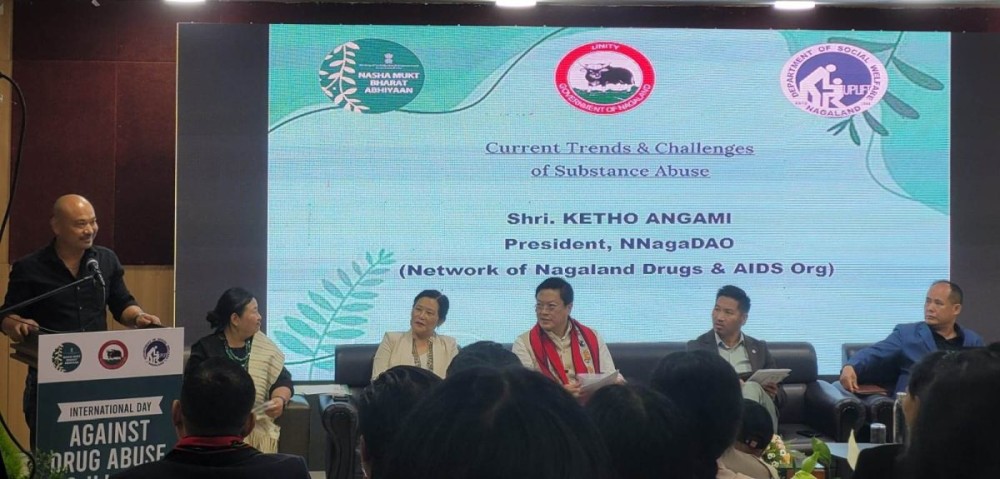
Ketho Angami, President of NagaDAO, during the event organised by the Social Welfare Department at the Capital Conventional Hall on June 26. (Morung Photo)
Our Correspondent
Kohima | June 26
A recent Rapid Need Assessment conducted in Kohima, the state Capital of Nagaland has revealed that nearly half of the substance users are unemployed, with the majority having initiated drug use during their teenage years.
The findings were shared by Ketho Angami, President of NagaDAO, during the event organised by the Social Welfare Department at the Capital Conventional Hall on June 26 to mark the International Day against Drug Abuse & Illicit Trafficking. This year’s global theme is ‘World Drug problems; Persisting issues, New challenges, Innovative responses’.
Key findings of the assessment
The assessment, carried out by the ARK Foundation, collected 51 samples from respondents.
The highest group of users fell within the 21-25 years age bracket, constituting 42% of the sample. This was closely followed by the 17-20 years group at 31%.
A staggering 49% of the respondents were unemployed. Students made up 25%, while only 14% were employed in the private sector.
A critical finding pointed to early initiation, with 55% having their “first drug use experience” between the ages of 16-20 years. Another 29% began between 11-15 years, 14% between the age group of 21-25 years, and 2% between the age group of 26-30 years of age.
High-risk behaviour and poly-drug use
Angami highlighted the current trends and challenges of substance abuse. All participants had a history of injecting drugs, with 48% currently injecting daily. Among daily injectors, 63% reported injecting between 2-5 times a day.
The assessment also noted widespread poly-drug use, with a mix of substances being consumed: Sunflower (25%); Alcohol (22%); Marijuana (17%); Dextropropoxyphene (13%); Yaba (11%); Heroin (10%); Codeine Phosphate (2%)
Overdose and misconceptions
Underlining the life-threatening risks and lack of awareness among users, the report revealed that 25% reported that they have experienced overdose, with 46% of them experiencing it once, 16% 2 times, 15% 3 times another 15% 5 times and 8% 6 times.
Adding to the concern, a significant 55% of all participants admitted they did not know how to manage an overdose while 39% have the misconception of managing overdose by administering salt and lemon.