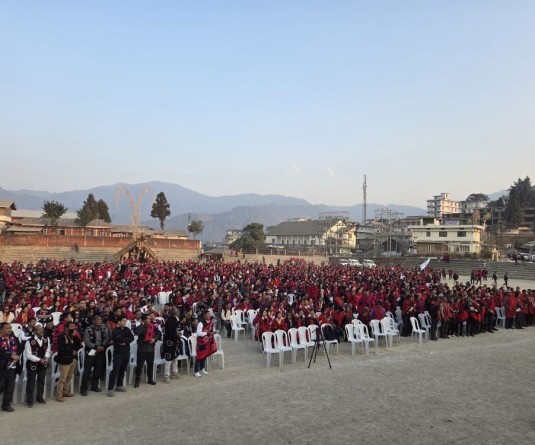
Officials during a district-level sensitisation meeting on vector-borne diseases (VBDs) held at the Conference Hall of the DC's Office in Mon on September 10.

Mon, September 11 (MExN): A district-level sensitisation meeting on vector-borne diseases (VBDs) was held at the Conference Hall of the Deputy Commissioner's Office here on September 10, bringing together community leaders, civil society organisations, church leaders and health officials to strengthen prevention and control efforts.
Ahead of the meeting, the state National Vector Borne Disease Control Programme (NVBDCP) team conducted field visits across Mon district from September 7 to 10, interacting with communities and health personnel and assessing the ground situation.
The team visited Tizit PHC, Shangsha HWC, Longting village, Tuimei HWC, Longlam village, Tammong village, Laokun, Phomching PHC, Longshen SC, Longwa SC, T/Chingha HWC, Aboi CHC, Chenwetnyu SC, District Hospital and UPHC.
The meeting was attended by representatives of the Konyak Union, KNSK Women Organisation, Konyak Students Union, ward presidents, KBCM church, youth and women leaders, besides district and state health officials.
The state team was led by Dr Imnapokim, SPO and Joint Director, NVBDCP, Dr Imkongtemsu Longchar, SPO and Joint Director, UIP, and Dr Kavito Zhimomi, Deputy Director, NVBDCP, along with consultants, an insect collector and a data entry operator.
District VBD Consultant N Nokman presented the district's current VBD scenario, highlighting reported cases and disease trends and stressing the need for sustained surveillance, early detection and timely response, particularly in areas reporting malaria and other vector-borne diseases.
Deputy Commissioner Wennyei Konyak said tackling VBDs could not be left to the health department alone. He called for active involvement of community and ward leaders in awareness campaigns, identification and prevention of mosquito breeding sites and encouraging people to seek timely medical care.
He also urged ward leaders to take VBD awareness activities to schools so that children could participate in prevention efforts.
Dr Imnapokim sensitised participants on mosquito breeding, different types of vectors and practical preventive measures. He said the state team had visited villages where positive cases were detected and interacted with village leaders and the local administration.
He also announced plans to establish a larvivorous fish hatchery at Tizit PHC as an additional measure for mosquito-larvae control and urged the public to promptly report positive cases through the designated helpline.
The meeting also focused on Japanese Encephalitis (JE) prevention and immunisation. Dr Imkongtemsu Longchar said that in view of JE cases emerging in the district, the department was proposing the availability of JE vaccine in Mon. He also stressed the importance of HPV vaccination and improving routine immunisation coverage.
Community leaders raised concerns regarding fogging, chlorine, DDT powder and drainage, which were discussed and clarified by health officials.
The meeting concluded with an emphasis on community participation, preventive action and coordination between the district administration, health department and local stakeholders to reduce the burden of VBDs.
The programme was chaired by Chief Medical Officer Dr Supongmenla Walking, with a welcome address by Dr Cheyale Kath, DPO-CD I, and vote of thanks by Shingong MTS.
Following the programme, the state team held a review meeting with the CMO and NVBDCP staff to discuss observations and findings from the field visits and identify gaps and strategies to strengthen surveillance, case management and vector control in the district.