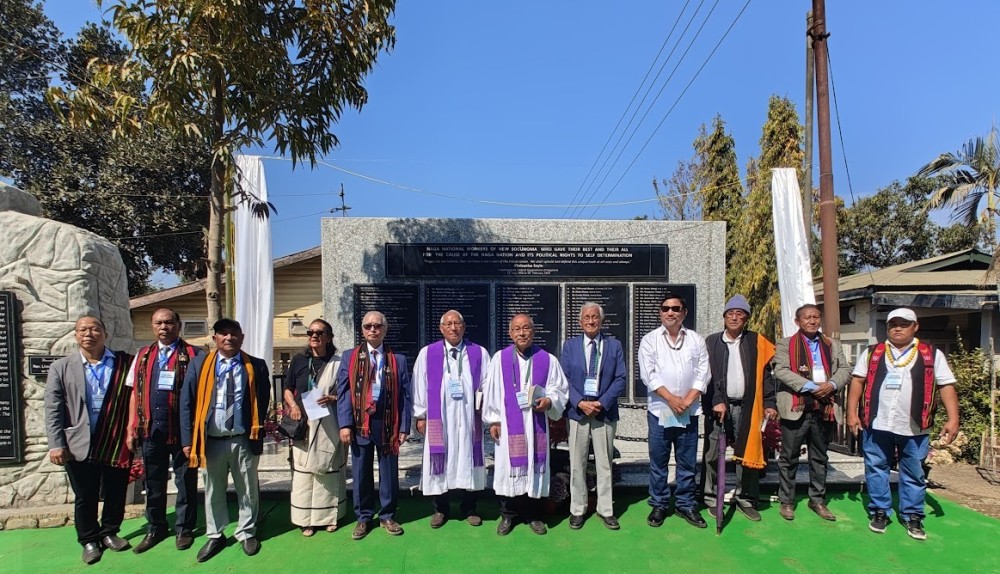
Niketu Iralu and others after unveiling Naga National workers memorial monoliths at New Socünoma village on February 19. (Morung Photo)
Memorial dedicated to Naga National Workers unveiled in New Socünoma
Our Correspondent
Kohima | February 19
The Naga National Workers Memorial monoliths have been unveiled at New Socünoma Village Ground near Medziphema on February 19.
These monoliths have been dedicated to honour the legacy of sacrifice, commitment, dedication with time tested unfailing courage and great human values and virtues, and invaluable contribution to the Naga Nation's service with conviction for the best interest of the Nagas and for posterity.
The main monolith was unveiled by eminent social activist Niketu Iralu while two other monoliths in the persons of Juno Meyase and Neisorieno Krose have been unveiled by Rev Lhouzoviu Shüya and Rev Megovotuo Kuotsu respectively.
The monoliths featured 154 Naga national workers of New Socünoma who gave their best and their all for the cause of the Naga nation and its political rights to self-determination.
“Nagas are not Indians; their territory is not a part of the Indian Union. We shall uphold and defend this unique truth at all costs and always,” scripted in the monolith, quoting Khrisanisa Seyie, first president, Federal Government of Nagaland (1956- 1959).
Gracing the event as the chief guest, Niketu Iralu said that the position of the Nagas is that “Nagas are not Indians.” He said, “We are not less than what we are that we should be justly proud and capture this truth,” adding, “Our story and our movement is unique and cannot be erased from history.”
Stating that there should be a clean transparency and truthfulness, Iralu said, “We have to bring truthfully in the examination of our crisis.”
“We have to rise up and should do what is right. We should not shift responsibility,” he said and stressed on the need to take up the matter with a complete sense of responsibility.
Honouring sacrifice, reaffirming truth
Speaking on behalf of the Organising Committee of the Naga National Workers’ Monolith installation, Kuolachalie Seyie said, “We are gathered here today to honour the legacy, sacrifice, commitment, dedication, conviction, courage, values, virtues and invaluable contributions of our elders, brothers and sisters towards the Naga National movement and in the best interest of the Nagas.”
He said that they (Naga National workers) offered and made such great sacrifices “because Nagas are not Indians.” That is the historical truth, and their acts of service were meant to protect the political sovereignty and ancestral rights of the Nagas, he said.
“The bogus and deceptive claim that Nagas are Indians and that Naga territories are part of the Indian Union is incorrect and an apparently wrongful political claim that has been engrained in the present-day situation through colonial inheritance and cruel military power. The Naga community constitutes a distinct people, with their own land, identity, unique history and political system since the days of yore, much before the creation of an Independent India,” Seyie said.
He said that the “baseless and unjustified claim to include the Naga territory into the Indian Union is neither democratic nor tenable. Such an idea is simply a result of postcolonial expansion by means of barbaric military aggression and cruel suppression of the interest and will of the Naga people, and their ancestral rights. The Naga issue is not a question of secession from India; rather, it is a question of brutal military force attempting to assimilate the Nagas into a political entity with India to which the Nagas have never belonged.”
The Nagas are a distinct people. They are not Indians. They are neither a subgroup of any Indian civilization nor were they subjected to the Indian caste system at any point of time. Nagas are a nation comprised of people belonging to many tribes, each with its own language, identity, tradition, customs, laws, and system of governance. Long before the British or Indian rule, Naga villages functioned as sovereign political units, governed by customary laws and collective decision-making bodies, which were universally known as the “Purest form of Democracy”, Seyie said.
He said that Naga ancestral land extends far beyond the artificial boundaries of present-day Nagaland. They include large areas of Manipur, Assam, Arunachal Pradesh, and parts of Myanmar. These boundaries were drawn by Colonial administrators and later frozen by post-colonial States without Naga consent, he said adding that Naga ancestral ownership, customary law, identity, and collective historical memory outweigh these imposed borders.
No external authority in the world has the moral right to divide a people’s land and then claim sovereignty over the fragments, he said.
Retd Pastor Savizo Hozoyie and Rev. Pastor Tsolie Chase, both of them (One of the former first top secretaries of the Federal Government of Nagaland) delivered short speech. The programme was compered by Nilevono Vüprü and Megowheno Rürhie with Rokosituo Hozoyie as pianist. Blowing of trumpet was done by Aviso Vüprü while Pastor Neise, BCNS invoked God’s blessings. A minute silence in solemn remembrance of the Naga martyrs was observed during the programme.
New Socünoma Women Organisation, Rokorieno Seyie and Kevikhono Mor presented special songs.
Traditional attire show also marked the occasion. Vote of thanks was proposed by Medievi Zhünyü, chairman, New Socünoma Village Council. The programme concluded with mass thanksgiving prayer.