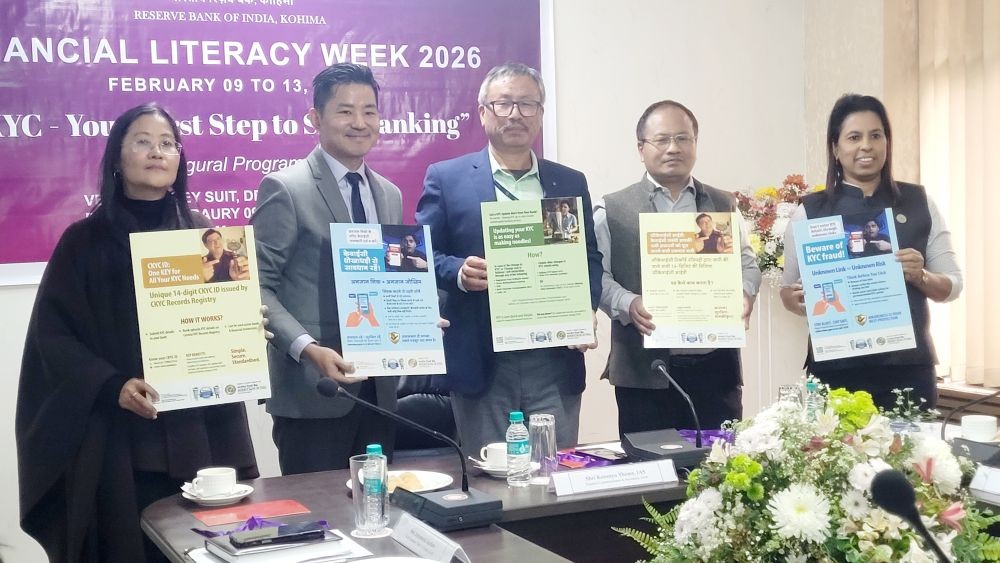
Finance Commissioner & Secretary, Kesonyü Yhome and others launched the FLW posters.
Morung Express News
Kohima | February 9
Finance Commissioner and Secretary, Kesonyü Yhome, on Monday said the concept of financial literacy must be understood in two distinct ways — one for the common people and the other for banks and financial institutions themselves.
Speaking at the inaugural programme of Financial Literacy Week 2026 organised by the Reserve Bank of India (RBI) at de Oriental Grand, Kohima on February 9, Yhome observed that one of the key reasons people dread visiting banks is the perception that the moment they step inside, they will be asked to submit “a hundred forms.”
Though it is an exaggeration, he said, the sentiment reflects the general attitude of common people towards banks and financial institutions, and while the latter may not agree, he said, “that is a matter of fact” which also extends to government offices - the middlemen.
While the intent of such financial literacy programmes and outreach to common people is important, Yhome asserted that it is equally crucial for banks and financial institutions to educate themselves on financial literacy and service delivery.
“When there are four or five stakeholders, it is not fair to blame each other. But since we are part of the same institution, I feel that we should understand that point very well,” stated Yhome matter-of-factly emphasising that there must be a shared understanding of the issues.
Diving into the loan sector which can be debated another day using facts and figures, he however, referring to the MSME sector review held under the aegis of the RBI in Kohima in 2022 said, the data clearly shows that the “Nagaland case” is not as bad as it is often portrayed/debated.
“Nagaland is always made the villain when it comes to loan returns. That is not exactly the case. In fact, it is one of the best-performing in the whole country in terms of loan return,” he said, while clarifying that a debate would be more appropriate once verified data is placed on the table to know whether “the government’s position is incorrect or the banking institution’s claim is incorrect.”
While acknowledging the concerns and apprehensions of banks and financial institutions, he said, the government, over the past few years, has made ‘very’ conscious and concerted efforts to ensure that the banks’ apprehensions are also adequate, including giving a strong push to credit guarantee schemes at both the state and central levels.
“The banking institutions should not have any apprehension whatsoever,” Yhome said, adding that the government is making every effort to ensure banks do not accumulate non-performing assets (NPAs), particularly within the state.
Meanwhile, he strongly urged the banks to ‘seriously’ look on small individual loans, wherein he has personally observed reluctance among some banks to sanction loans as small as Rs 50,000, including educational and key loans.
“If you look at our society, there will be very few people asking for big-ticket loans,” he said, stressing that the requirement of the common people is far more important than the size of the loan.
Stating that the State is not looking at large industries but at building beneficiaries from the grassroots, Yhome maintained “we have to start from scratch, from small enterprises” explaining that small entrepreneurs do not have the capacity to absorb large sums at once but asked for what is well within their repayment capacity.
However, he pointed out that banks often impose far more conditions on small-ticket loans than on large ones. “This is one of the key reasons why banking and financial literacy is not taking off, and why banking culture is not growing in the state,” he noted, adding that trust between service providers and clients must improve before addressing other systemic issues.
“Because people do not have much trust in the government and in the banking institutions -trust in the sense that the service provider and client relationship has to improve in the first place before we talk about other issues in the banking sector,” stated Yhome.
Describing the State as a “very disadvantaged society,” he noted that while mainland states have moved beyond fundamental issues, Nagaland is still grappling with basic access to loans for people who genuinely need them. “The whole idea is about giving the common good and the benefit at the quickest possible time,” he stated.
He also strongly stressed that bank institutions must better understand the schemes and play a facilitative role when people visit their branches rather than asking people to visit multiple institutions or bring another ten forms.
To this end, he emphasised on the need for a facilitation, which he noted does not actually happen in common banking.
While the banks may have their own protocol, and the government has ‘absolutely’ no business in that, Yhome however, asserted that these protocols need fine-tuning to suit the realities of the common people.
Along with other officials, Yhome launched the financial literacy week posters. Others who spoke include Sibo Nekhini, GM & OIC, RBI, Kohima; Imtimenla Imchen, Additional Secretary, Department of Finance, GoN; P Bulte, GM & OIC, NABARD RO, Dimapur and Surabhi Bhattarcharyya, Deputy General Manager SBI, Jorhat.
KYC - Your first step to safe banking
It may be mentioned that FLW 2026 under the theme is “KYC - Your first step to safe banking” which is being observed from February 9-13 was inaugurated by Governor, RBI Sanjay Malhotra in Mumbai on February 9, 2026. The purpose is to highlight the importance of Know Your Customer (KYC) as the foundation of safe and secure banking.
Some of the core objective of FLW is to clarify that while KYC is an essential regulatory requirement, it is also simple to comply with, as various safe and convenient modes of doing so are available while the campaign will also seek to familiarise the public with facilities such as Central KYC (CKYC), which aids in the ease of KYC, it also encourages people to stay alert against fake calls, messages and links relating to KYC updation which can lead to financial loss and to sensitise people about the painful consequences of becoming money mules by falling prey to inducements.
.png)