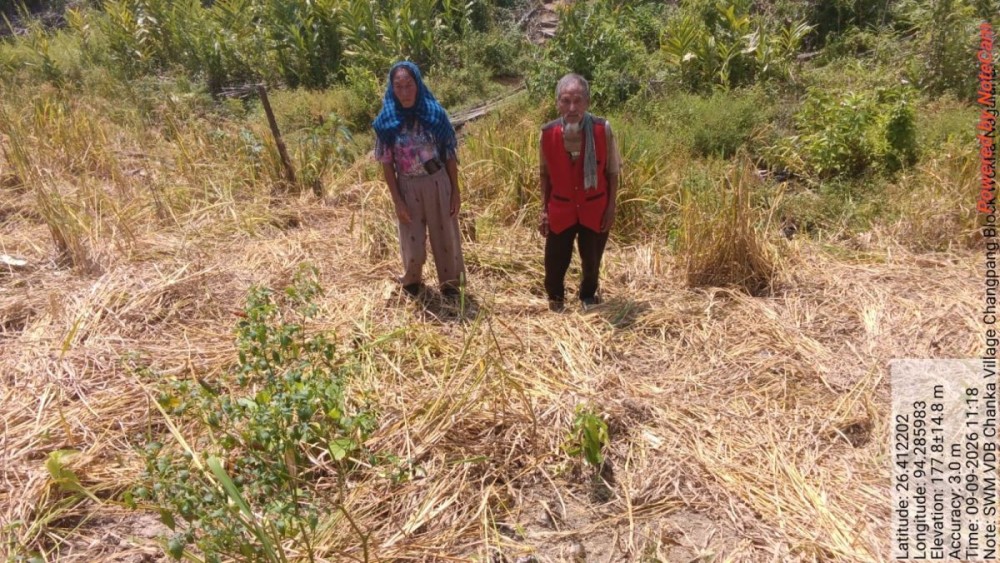
Two farmers stand beside a paddy field reportedly damaged by wild elephants at Chanka village under the 40 Bhandari Assembly Constituency in Wokha, in this geo-tagged photo from September 9. (Photo: Special Arrangement)
Morung Express News
Wokha | September 13
Human-elephant conflict is intensifying in parts of Wokha district as the harvesting season gets underway, with wild elephant herds repeatedly entering agricultural areas and causing extensive crop damage.
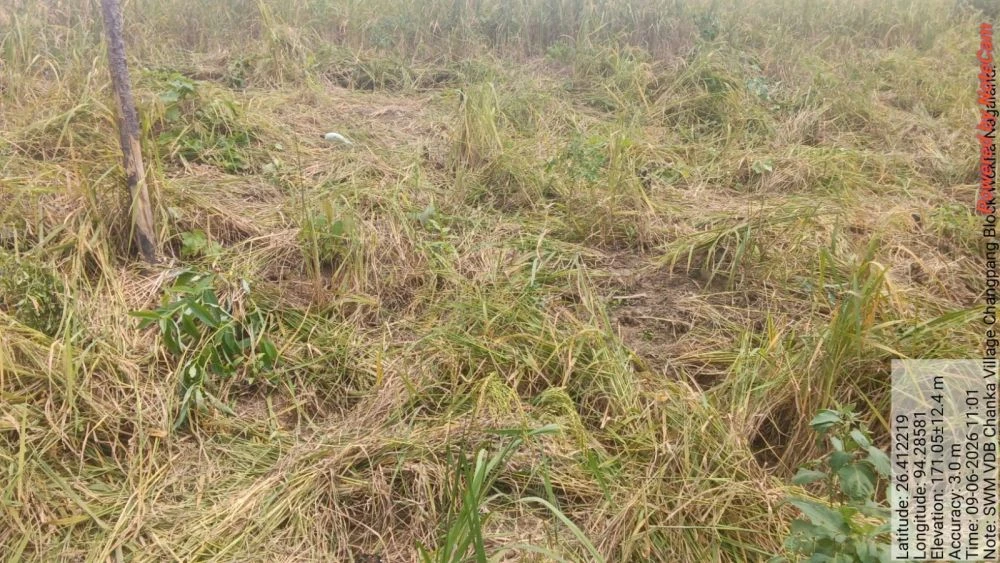
The latest incident was reported from Chanka village under 40 Bhandari Assembly Constituency, where a herd of around 12 to 13 elephants, including young ones, entered a paddy field at around 2 a.m. on September 12, severely damaging the ripening crop.
According to Sentsüdy PB Sen Yanthan, President of the VDB Secretaries’ Association and ADS Changpang Block, farmers staying in a farm hut for night patrol attempted to drive the elephants away. He said the herd is still around the area, creating fear among villagers.
Earlier, elephants were also sighted entering cultivated areas on September 3 and 5, damaging paddy fields, rubber plantations and areca nut groves.
Yanthan, who is also the General Secretary of Naga People’s Front Bhandari AC, claimed that such incidents were now occurring almost every week.
With farmers entering the harvesting season, he expressed concern over the impact of repeated crop destruction on their livelihoods. He said some affected farmers had received relief of around Rs. 9,000 to Rs. 10,000 in previous instances, according to information shared with him by the victims. However, he maintained that the amount remains inadequate in comparison with the actual losses suffered, particularly considering the labour, investment and expected yield lost due to crop damage.
Yanthan also expressed concern over the safety of villagers, particularly as elephants have reportedly begun entering village areas in addition to agricultural fields.
He said villagers are increasingly afraid to travel at night or go to their fields, and raised concern over the possibility of a serious human-elephant encounter.
“What if an untoward incident happens and a person loses their life? Who will take the responsibility?” he questioned, stressing the need for preventive measures before a tragedy occurs.
He said he has approached various concerned departments seeking assistance and has remained in contact with the Forest Department. For the latest incident, he said the matter was reported to the Assistant Conservator of Forests, Wildlife Warden and the Forest Department control room.
Yanthan said he had also requested solar lights for the village, stating that improved lighting could help discourage elephants from approaching inhabited areas. He further said he had applied for a watchtower to enable villagers to monitor elephant movements, but that assistance had not yet been received.
He said the concerned authorities have been conducting awareness and prevention programmes, but suggested that more practical measures should be taken at the village level.
According to Yanthan, many awareness programmes are conducted from the town, while affected villages require preventive measures suited to the situation on the ground.
He said he had repeatedly appealed to the Forest Department and received assurances that assistance would be provided if relevant schemes became available. However, he expressed concern that preventive assistance should not be delayed until after a serious incident occurs.
Yanthan said he had also approached higher authorities and submitted an open letter to the MLA and the Minister for Forest, Environment and Climate Change, seeking intervention in the matter.
He said his efforts so far had not resulted in the level of assistance required by the affected villagers.
Meanwhile, he also said an elderly villager suggested that the government consider measures to control the reproduction of wild elephants as one possible way of addressing the growing elephant population. The suggestion was expressed as a local opinion and not as an established or officially recommended measure.
Yanthan maintained that a balanced approach is needed to address human-elephant conflict, with measures that ensure the safety of villagers while also protecting the elephants.
With the herd reportedly still around Chanka and the harvesting season now underway, villagers are seeking immediate preventive measures, better support for affected farmers and adequate compensation to address the recurring conflict and prevent possible loss of human life.