Officials and participants of farmers extension programme on January 12.
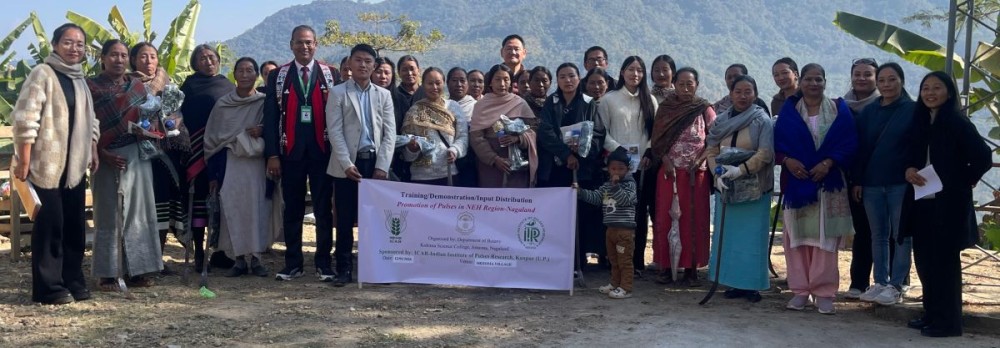
Kohima, January 13 (MExN): Farmers extension programme cum input distribution and field visit was conducted at Mezoma and Peducha villages in Kohima district on January 12.
It was organised by the Department of Botany, Kohima Science College, Jotsoma (KSCJ) in collaboration with All India Coordinated Research Project (AICRP) on Kharif Pulses, School of Agricultural Sciences (SAS), Medziphema, Nagaland University.
The programme was sponsored by ICAR-Indian Council of Pulses Research (IIPR), Kanpur under the Promotion of Pulses in Northeast Region (Nagaland).
Dr Dharmendra Prasad Patel, Principal Scientist and Nodal Officer (Northeast component), ICAR-IIPR, graced the event as the special guest.
Dr Lowrence Kithan (Agronomy), Dr Akumla Longchar (Plant Breeding), Kavi Sumi (Plant Pathology) and Dr Rokozeno (Entomology), Scientists under AICRP on kharif pulses, SAS, and Dr Moaakum and, research scholars from Department of Botany, KSCJ participated in the discussion and interaction with farmers.
In his welcome address, Dr Wenyitso Kapfo, Head Department of Botany, KSCJ expressed gratitude to Dr Patel and his wife for their visit.
He thanked the ICAR-IIPR, Kanpur for the support that enables the institutions to work for the community.
He acknowledged the progressive mindset of the farmers in collaborative effort to bring growth in farming sector in Nagaland and expressed appreciation to scientists from AICRP on kharif pulses, SAS for being an active collaborator. Lhouvikhotuo Vikhrie, Mezoma village, gave an update on the types of farming activities in Mezoma village.
Dr. Rokozeno highlighted that kharif pulses are important source of protein for human diet and pulses are essential for improving soil health.
She encouraged the farmers to give equal importance to kharif pulses along with the existing cereals to achieve self-sufficiency even in pulses production.
She conveyed that Scientists team of AICRP on kharif pulses, SAS, are ready to help farmers with any concerns regarding kharif crop farming, diseases and pests management.
Dr. DP Patel highlighted on the importance of pulses production in India and encouraged the farmers to grow more pulses for nutritional requirement, economic sustenance and soil health.
He emphasized the essentials of collaborative work among farmers, scientists and educational institutions to increase pulses production in Nagaland.
During the interactive discussion session, farmers expressed their concerns regarding pests and yield issues in their fields. In response, the SAS expert team provided views on possible causes of such problems and provided options to address those concerns.
Kithan discussed the benefits of pigeon pea production in Nagaland.
Diezelhounuo Kiso, Research Scholar, KSCJ explained the management of chickpea pod borer.
Dr Samadangla Ao, Department of Botany, KSCJ chaired the session and pronounced the vote of thanks. Earlier, Rokomeno Sirie, member Mezoma Women Self-help Group invoked God’s blessings.
The programme was attended by 25 farmers and input distributions such as biopesticides, gumboots, daos and hand gloves were distributed to the farmers.
Earlier, during the day Dr DP Patel had meeting with Dr Temjenwabang, Principal, KSCJ and Kevilhuninuo Nagi, Vice-principal, KSCJ and discussed on the future collaboration prospects.
In the afternoon, Dr Patel visited experimental and farmers’ fields at Peducha village, where chickpea and lentil trials were undertaking.
This was stated in a release issued by Dr Richard Dzüvichü, president KSCTA.