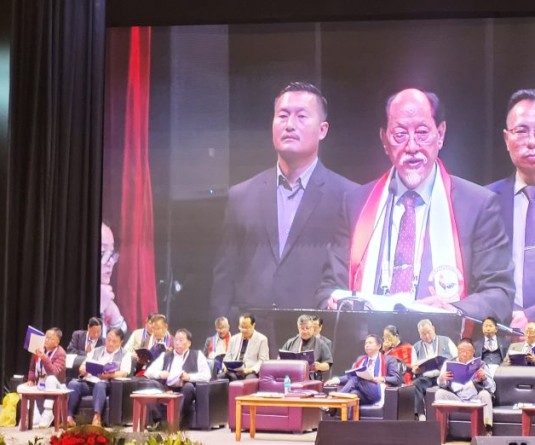
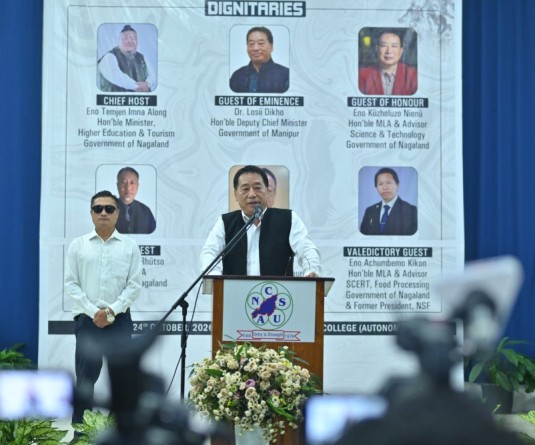
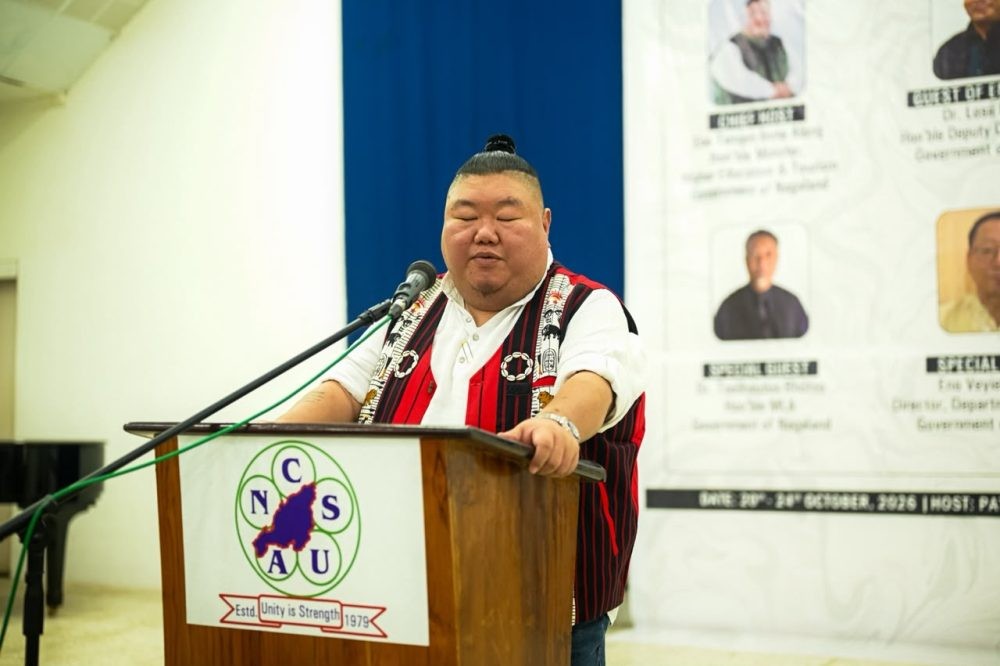
Nagaland Minister for Higher Education and Tourism Temjen Imna Along addresses the inaugural session of the All Nagaland College Students’ Union Collegiate Meet 2026 at Patkai Christian College (Autonomous) on October 21. (Photo: Special Arrangement)
Morung Express News
Patkai | October 21
Nagaland Minister for Higher Education and Tourism Temjen Imna Along has called on Naga students to embrace challenges with courage, resilience and inclusiveness, stressing that overcoming personal challenges is essential to addressing the larger aspirations of the Naga people.
Touching upon the theme Embrace the Challenge at the inaugural session of the All Nagaland College Students’ Union (ANCSU) Collegiate Meet 2026 at Patkai Christian College (Autonomous) on October 21, Along said students must first learn to overcome individual challenges before contributing meaningfully to the collective aspirations of the Naga people.
“The first requirement for overcoming challenges is courage,” he said, adding that courage did not mean confronting opponents, forming unions against other communities or insisting that only one side was right. Rather, it required remaining steadfast, accommodating differences and building pathways that strengthened society.
He cautioned that giving in to nepotism, tribalism and clanism undermined efforts to overcome challenges. Overcoming them, he said, was not merely about winning but also about responding to defeat and taking the longer path towards lasting gains for families, communities and the Naga people.
Personal challenges and collective aspirations
Along said the ability to contribute to the larger Naga agenda depended on first building individuals who were courageous and resilient. Responding to the challenges facing society required preparation, he said, rather than simply moving directly to questions concerning the collective aspirations of the people.
He also located courage in everyday acts of consideration and generosity, asking whether students would help a friend unable to afford an examination fee. Such acts, he said, were part of building a stronger society and required sustained effort rather than good speeches alone.
Turning to divisions within Naga society, Along questioned why differences and disagreements had come to outweigh commitments to collective strength. He asked why people could not sit together, discuss their differences and still maintain unity.
With representatives from 26 colleges attending the meet, he urged students to build friendships across tribal and community boundaries. Referring to Naga students studying in Delhi, he said he wanted to see them sitting together and building relationships irrespective of their tribal affiliations.
Acknowledging that some might find it difficult to compromise or set aside their pride, he said accommodating one another was necessary if the community was to overcome its challenges.
Acknowledges differences in approach
Addressing the relationship between the aspirations of the Naga people and the approaches adopted by different organisations, Along acknowledged that he and the Naga Students’ Federation (NSF) might have differences in their perspectives and approaches.
“Today, I will not dwell on differences in our approaches or thought processes with the NSF. I know that we may have different perspectives, but our hearts are one. We may differ in the paths we take, but our aspirations for our people remain shared,” he said.
He also congratulated the NSF for taking the initiative on the Power 60 programme to the state government, describing such initiatives as important for the Naga people.
Along said Nagas should aspire to have candidates entering the civil services every year and occupying important positions in public life. He called for Naga representation at the forefront of policymaking and meaningful contributions across India.
He also expressed the hope that Naga doctors would practise across the country and the world while remaining compassionate, and that Naga professors and teachers would contribute to universities beyond Nagaland, where ideas were developed and intellectual traditions nurtured.
Recalling the contributions and sacrifices of Nagas in India, he said the community had aspirations and had never shied away from working alongside the rest of the country. However, he cautioned that tribalism was increasingly being prioritised over the collective development of the Naga people.
His remarks placed the differences in approach with the NSF alongside a broader appeal for unity: while perspectives and methods could vary, he said, the shared aspirations of the people should remain central.
Calls for responsible use of social media
Along also urged students to recognise their influence through social media, noting that what young people posted and discussed could influence political leaders, including the Chief Minister.
Rather than using digital platforms merely to criticise others, he encouraged students to highlight good work and draw attention to issues requiring action, irrespective of a person’s tribe, community or family.
“There is a very thin line between amplifying understanding and amplifying ignorance,” he said, urging young people to recognise the difference between constructive engagement and the promotion of hostility.
He said students could also set an example for leaders and elders through their conduct, demonstrating courage, discipline and inclusiveness. The gathering, he added, should help students develop friendships beyond their own churches and communities and sow the seeds of a strong Naga society that would endure beyond the tenure of present leaders and their own lifetimes.
“Only cowards divide. Brave people unite,” Along said, cautioning against allowing pride and hostility to deepen divisions.
He encouraged students to pursue education, develop their skills and maintain an inclusive outlook, urging them to be ambitious and learn to “punch above our weight”.
Appeals for peace amid Manipur conflict
Addressing the ongoing conflict in Manipur, Along expressed concern for Naga communities in the southern part of the Naga homeland and called for practical support, alongside prayer, for those suffering.
He also expressed concern for the Kuki community, stressing that innocent people should not suffer amid the conflict.
Along urged Nagas to become bridges of peace and progress, observing that standing up for the welfare of others could be more difficult than standing with one’s own community.
Referring to the values of Christ, he called for a future in which neighbouring communities could live together in peace. The region, he said, should not be defined by anger, division, killing and arson, and Nagas should set an example as peacemakers.
Concluding his address, Along urged the student delegates to carry the spirit of Embrace the Challenge back to their respective colleges. He asked them to share the experience of students from different institutions and tribes coming together, with the aim of building a strong and prosperous Naga people.