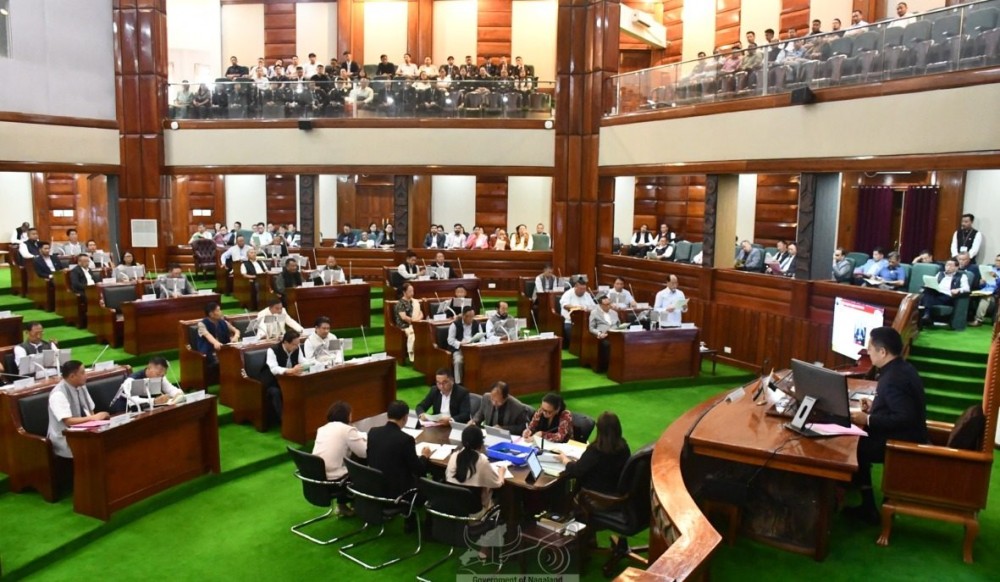
A new Government Bill on the Frontier Nagaland Territorial Authority was introduced in the 9th session of the 14th Nagaland Legislative Assembly on September 1. (DIPR Photo)
Passage set for September 3
Our Correspondent
Kohima | September 1
A new Government Bill on the Frontier Nagaland Territorial Authority (FNTA) was introduced in the 9th session of the 14th Nagaland Legislative Assembly (NLA) here on Tuesday.
Deputy Chief Minister Y Patton moved the Bill, which seeks to constitute the FNTA for the region comprising six eastern districts, Tuensang, Mon, Longleng, Kiphire, Noklak and Shamator.
NLA Speaker Sharingain Longkumer informed the House that the consideration and passage of the Bill would be taken up on September 3. He added that any clarification or amendment could be submitted till 2:00 PM on September 2.
This comes after an earlier version of the FNTA Bill, 2026, introduced on March 26, 2026 was withdrawn by the House, also moved by the Dy CM.
The proposed legislation is based on a Memorandum of Agreement signed on February 5, 2026, between the Government of India, Government of Nagaland and Eastern Nagaland Peoples’ Organization (ENPO). The agreement envisions the FNTA based on the spirit of Article 371 A of the Constitution, aiming to provide for democratic, decentralized self-governance at the regional level through a transparent, efficient and accountable Authority with legislative, executive and financial autonomy within the State of Nagaland.
Objectives of the Bill
In the Statement of Objects and Reasons, Deputy CM Patton outlined the core purpose of the legislation. The objective of the constitution of FNTA is to establish a unique self-governing Territorial Authority to enable the people of Eastern Nagaland, fulfill their socio, economic, educational, cultural and linguistic aspirations, the statement read.
The Bill further aims to provide for “democratic decentralized self governance at the regional level with legislative, executive, administration and financial autonomy within the state of Nagaland.”
Patton added that the FNTA is also envisioned as a vehicle for comprehensive economic development. “Though the FNTA, it also envisaged for comprehensive economic development of the Eastern Nagaland region aligning its process with the rest of the state,” he stated in the objects and reasons.
Financial and Administrative provisions
On the financial front, Patton clarified that the state government would allocate funds to the FNTA. “The quantum of funds for the developmental outlay for the Eastern Nagaland region will be proportional to its population and area shareable development outlay shall be calculated after deducting common expenditures,” he said in the Financial Statement. He added that funds earmarked for the development of the region would be apportioned between the state government and the FNTA.
‘The Bill, if enacted and brought into force, the financial involvement under the state consolidated fund will be as above,’ he stated.
Addressing the delegation of powers, Patton noted that the Bill empowers the state government to frame rules and issue orders to carry out the purposes of the Act. He emphasized that these provisions are “procedural, administrative and technical in nature.” He further explained that the delegation is necessary to ensure flexibility and effective implementation. “The power to issue orders is intended to facilitate effective implementation and to address practical difficulties that may arise. It allows for periodic modification to meet the emerging requirements without the need for frequent legislative amendments,” Patton stated.
The Dy CM said that the delegation of legislative powers is “limited to essential administrative and procedural matters ensuring smooth implementation while maintaining legislative supervision.”
FNTA Constitution outline
As per the Constitution of the Frontier Nagaland Territorial Authority (FNTA), it will function as a body corporate with ‘perpetual succession and a common seal,’ exercising legislative, executive, administrative and financial powers in the region in respect of the subjects transferred to it and on terms, as specified in the First Schedule.
The Authority will comprise 62 members, with 40 directly elected from territorial constituencies on the basis of adult suffrage, and ‘provided that one-third of the seats shall be reserved for women.’
Additionally, the Governor will nominate two members from recognised tribes in Frontier Nagaland Territory (FNT) who may be unrepresented or underrepresented, and these nominees will enjoy full voting rights and privileges equal to elected members.
The FNTA will also include 20 MLAs from the Nagaland Legislative Assembly whose constituencies fall within the FNT, but they will serve as ex-officio members without voting rights. The total of 40 constituencies will cover the entire FNT region, and both elected and nominated members will hold office for a standard term of five years.
The Act mandates that the share of development outlay for the Eastern Nagaland Region will be proportional to its population and area. The sharable development outlay will be determined after deducting common expenditures, and the remaining funds earmarked for the region will be apportioned between the State Government and the FNTA. The Governor, acting on the advice of the State Government, will allocate funds to the Authority, which in turn is tasked with ensuring equitable development across all areas within the FNT.
Projects for FNT under Special Grant
The list of projects under the Special Development Grant covers higher education, healthcare, transport and digital infrastructure among others.
It includes upgradation of Wakching Modern College into a separate campus of Nagaland University, elevation of Mon Medical College to a Regional Institute, and establishment of a National Institute of Information Technology, an Engineering & Management College, a Nursing College, and a Hotel Management institution.
To strengthen teacher training, the plan includes a District Institute for Education & Training (DIET)/B.Ed College, a Polytechnic/ITI, and an Agricultural University/Research Centre. Health infrastructure gets a boost with Herbal Medicine and Ayurvedic Hospital & Research Centre.
Cultural and linguistic preservation finds place through the FNTA History, Language & Culture Research Centre and a Handicraft/Handloom Research Centre. Additionally, FNT guest houses will be built at the FNTA headquarters in New Delhi and Guwahati.
On the connectivity front, it includes construction of inter-District 4-Lane Roads, Eastern Frontier Railway connecting Kiphire and Naginimora/Tizit, Domestic Airport/Air Strip in FNT, Trans Eastern Frontier Highway Connecting Arunachal & Manipur via FNT, International Trade Centres.

FNTA Bill: Key provisons At A Glance |
Constitution of FNTA:
Transitional provisions
Powers and Functions:
Administrative functions
Law and Order
Financial Matters
Rules for functioning: State Government, in consultation with FNTA/Interim Council, shall frame rules covering FNTA’s composition and membership, qualifications, tenure and allowances, conduct of business, staffing and service conditions, and electoral constituencies and procedures. Power to remove difficulties: The Government may issue orders to address difficulties in implementing the Act, provided they are consistent with its provisions and made within two years of its publication in the Official Gazette. Such orders must be laid before the State Legislature. Continuance (Saving)
|
Source: Frontier Nagaland Territorial Authority Bill, 2026
FIRST SCHEDULE Transferred subjects to the Frontier Nagaland Territorial Authority
(i) Agriculture & Allied – a Regional head will be set up for supervising the activities covering FNT areas. (ii) Art & Culture of Tribes in FNT. (iii) Co-operation. (iv) Forest not being Reserve Forest. (v) Irrigation, use of any canal or water course for the purpose of agriculture. (vi) Regulation of practice of jhum or other form of shifting cultivation. (vii) Fisheries & Aquatic Resources. (viii) Health & Family Welfare- Up to Primary Health Centre to be transferred. Decision regarding feasibility of transferring higher Medical Centres/Institutions will be taken up after evaluating the effectiveness of the current arrangement. (ix) School Education up to Higher Secondary. (x) Horticulture. (xi) Labour & Employment including running and setting up of new ITI and skill development institutions. (xii) Land Records and Survey & Revenue. (xiii) Land Resources (as per the programmes and activities of the Department of Land Resources of Nagaland) (xiv) Supervision of VCs and ULBs within FNTA. (xv) Power- New & Renewable Energy, Mini-Hydel Projects and Rural Electrification including implementation of schemes may be transferred. Distribution & revenue and maintenance of power lines may be transferred. The power dues collected shall be deposited into the State exchequer. (xvi) Operation of Public transport. (xvii) Public Works Department up to District roads and bridges/culverts/retaining walls thereof within FNT. (xviii) Medium, Small, Cottage and Rural Industries, Khadi and Village Industries. (xix) Printing & Stationery. (xx) Rural Development – a Regional Head shall be set up for supervising the activities covering FNT areas. (xxi) Sericulture. 14 (xxii) Social Welfare (Women Resource & Child Welfare). (xxiii) Soil & Water Conservation. (xxiv) Vocational Training & Skill Development. (xxv) Shops and Establishments. (xxvi) Trade and Commerce within Frontier Nagaland Territory. (xxvii) Tourism – any project exclusively in ENPO areas shall be managed by FNTA. However, tourism projects such as circuit and destination with state-wide potential and coverage shall remain with the State Government. (xxviii) Village Guards. (xxix) Veterinary & Animal Husbandry. (xxx) Water Resources. (xxxi) Youth Resource& Sports. (xxxii) Handloom and Handicrafts. (xxxiii) Regulation of money lending by individuals or entities other than banks and non-banking financial institutions (xxxiv) Collection of land revenue. (xxxv) Collection of local taxes, tolls and fees. (xxxvi) Urban/Rural housing including implementation of schemes. (xxxvii) Tribal Affairs including implementation of special schemes. (xxxviii) Public Health Engineering including implementation of small projects. (xxxix) Planning, Coordination, Development and Statistics- a Regional Head shall be set up for supervising the activities covering FNT areas. (xl) Village Customary courts. (xli) Geology and Mining – The subject shall exclusively remain under the State Government while a Regional office will be set up under FNTA. (xlii) Food and Civil Supplies. (xliii) Markets and Fairs. (xliv) Department of Under-Developed Area (DUDA). (xlv) Fire and Emergency services up to District level. (xlvi) FNTA may set up their own Bamboo Mission project |
Source: Frontier Nagaland Territorial Authority Bill, 2026
SECOND SCHEDULE OF FNTA Illustrative List of Development Projects/Institutions to be implemented under Special Development Grant |
|
Source: Frontier Nagaland Territorial Authority Bill, 2026
.jpg)