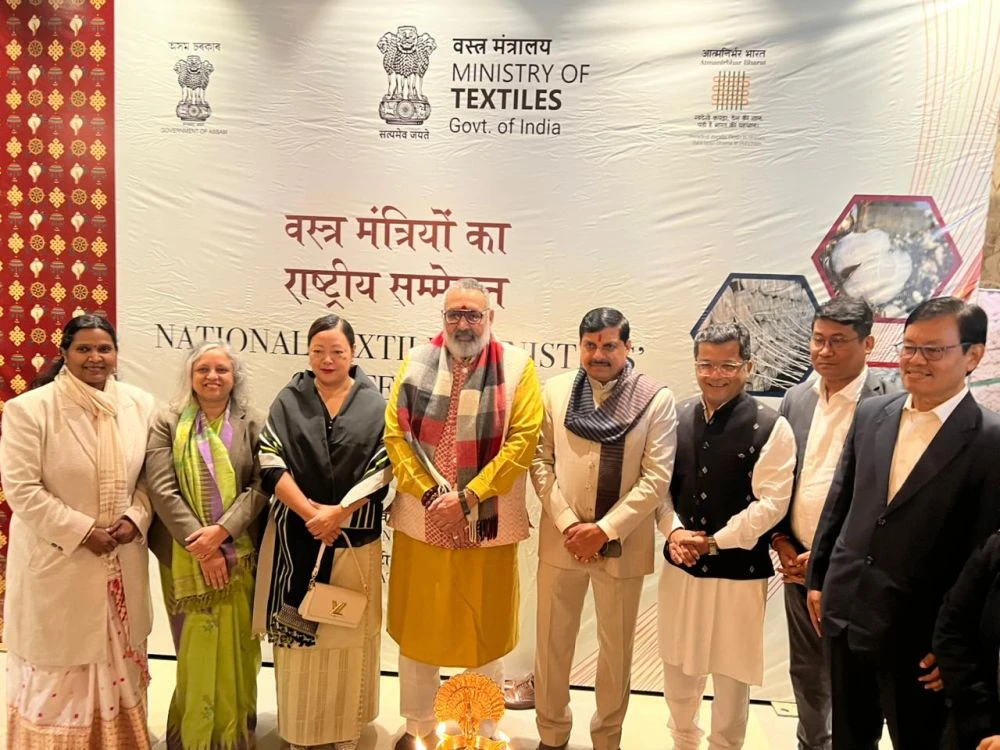
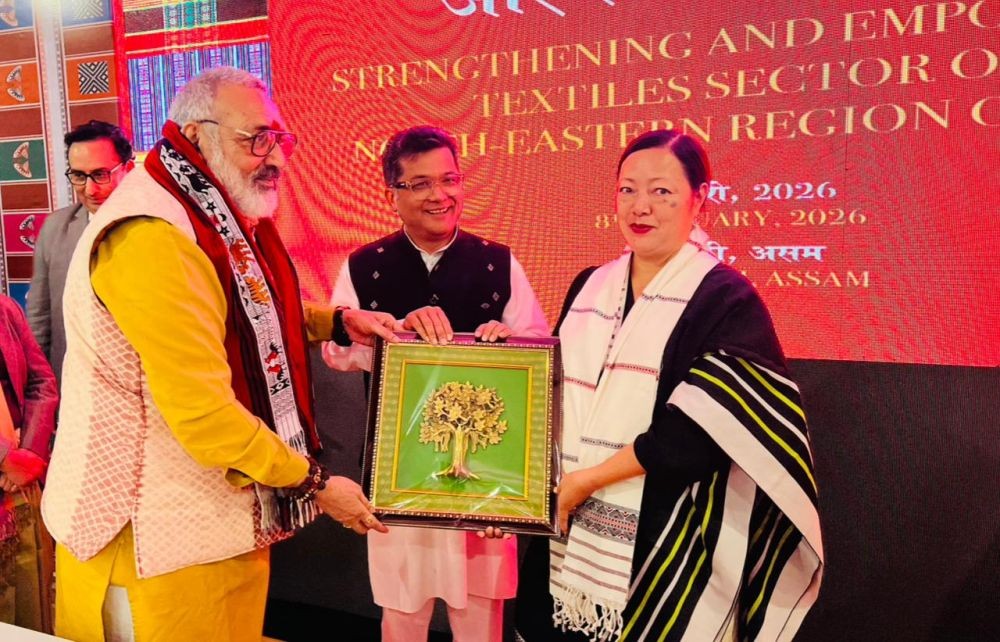
Minister for Horticulture and Women Resource Development, Salhoutuonuo Kruse during the National Textiles Ministers’ Conference held in Guwahati, Assam.
Morung Express News
Kohima | January 8
Minister for Horticulture and Women Resource Development, Salhoutuonuo Kruse, highlighted Nagaland’s untapped textile potential during the National Textiles Ministers’ Conference held in Guwahati, Assam.
The two-day conference under the theme “India’s Textiles: Weaving growth, heritage & innovation” was organised by the Ministry of Textiles in collaboration with the government of Assam bringing together Textile Ministers and senior officials from the state and Union Territories to deliberate on the future direction of India’s textile sector.
Addressing the session on ‘Infrastructure and Investment,’ she highlighted on the need for inclusive growth, sustainable textiles and focused policy interventions for the Northeast.
The Minister underscored that the state’s textile sector is deeply rooted in traditional handlooms and handicrafts, sustained largely by tribal artisans and women weavers. She highlighted that Nagaland produces are unique and eco-friendly textiles using natural fibres such as cotton, bamboo, and nettle that align closely with growing global demand for sustainability.
However, she pointed out that despite the huge potential, the absence of modern infrastructure has significantly limited the sector’s ability to scale up production and access wider markets.
To this end, Kruse urged the Ministry of Textiles to prioritise the establishment of an Integrated Textile Park (ISTP) in Nagaland under the Scheme for Integrated Textile Parks (SITP). She observed that while 59 textile parks have been approved across the country with 22 of them already completed, Nagaland has not yet received a single sanctioned park.
She proposed that an ISTP in Dimapur or Kohima could integrate existing handloom clusters with world-class facilities for weaving, dyeing, and finishing which will not only generate employment for artisans, most of whom are women but also attract high-value investments, particularly under the Act East Policy and the Asian Markets and beyond which borders the state.
“This intervention will drive inclusive growth in the Northeast, aligning with the national goal of enhancing textile exports to $3.10 billion as seen in recent surges,” she stated.
Dwelling further, Kruse noted that despite its rich cultural heritage, Nagaland’s textile sector continues to lag in industrial scaling. “Our handloom output, valued for its artisanal quality, contributes to the Northeast’s emerging hub status as noted in the Rising Northeast 2025 report, but we lack the processing and investment backbone to match national growth projections of 9-10% for textiles in FY26” she pointed out.
To address this, she called for focused investments under the Production Linked Incentive (PLI) Scheme, particularly in the area of technical textiles derived from bamboo and natural dyes which still remain underutilised.
Referring to the Rs. 27,434 cr worth of MoUs signed nationally in 2025, she advocated for ring-fencing a portion of funds for Northeast states, enabling Nagaland to attract up to Rs. 500 cr in private investment for integrated textile units.
The Minister requested the formation of a joint task force comprising the Ministry of Textiles and the Nagaland government to map opportunities, fast-track approvals, and pilot sustainable textile hubs by FY 2026–27. She maintained that this approach would strengthen resilient supply chains, empower women artisans, and position Nagaland as a model state for green and sustainable textiles in India.
Also highlighting the state’s inherent advantages, Kruse pointed to Nagaland’s rich biodiversity that supports natural fibre production, its strong women-led artisanal ecosystem, and growing sericulture initiatives that promote employment and sustainability.
She suggested key policy focus such as including enhanced support for cotton, Eri and Muga seed production and other indigenous natural fibre plants, host plant cultivation which has tremendous potential for the niche market and modern reeling/processing techniques.
Emphasising on Nagaland’s rich indigenous knowledge, she called for the promotion of natural dyes, value addition, marketing, and GI protection for the state’s natural fibres and silk handlooms and stressed the need to encourage sustainable sourcing and blending of natural fibres to improve economic viability while preserving cultural identity.
“These targeted interventions,” the Minister said, “will provide excellent opportunities for Nagaland's unique contributions to India’s natural fibre landscape and seek targeted interventions for growth.”
The Minister was accompanied by the Additional Director, Industries & Commerce, EE Industries Commerce and Assistant Director, Women Resource Development.