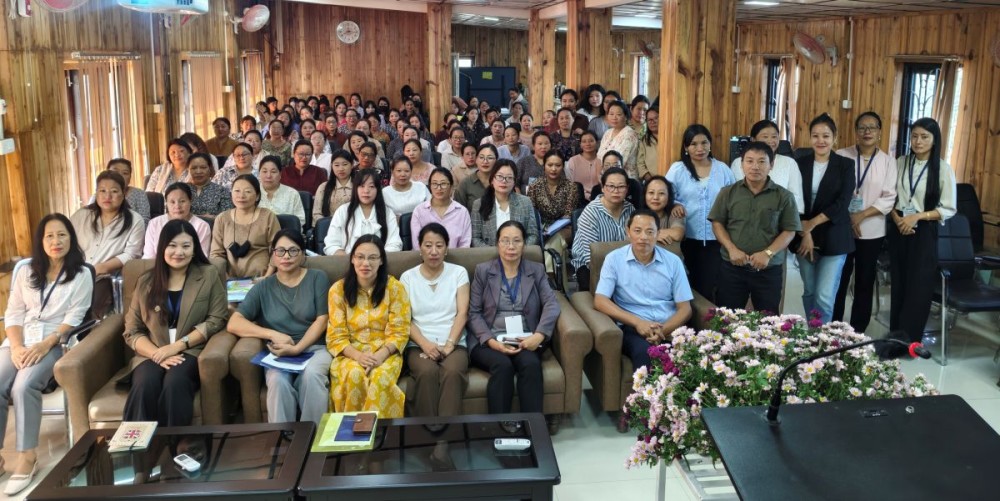
Pinuo Nakhro, Vezhodulu Swiho and others during CNE seminar in Kohima on September 22. (Morung Photo)
Our Correspondent
Kohima | September 22
A two-day state-level Continuing Nursing Education (CNE) seminar, organised by the Naga Hospital Authority Kohima (NHAK), got underway on September 22 at the NHAK Auditorium Hall under the theme, “Quality in Healthcare: Empowering Safe, Effective and Patient-Centred Care.”
The seminar brings together nursing personnel from different parts of Nagaland and focuses on updating their knowledge and skills in quality healthcare practices in accordance with the National Quality Assurance Standards (NQAS).
Delivering the keynote address, NHAK Nursing Superintendent Pinuo Nakhro introduced participants to the NQAS framework, describing it as a national institutional mechanism for improving, monitoring and certifying the quality of care in public healthcare facilities.
She said quality in healthcare should not be viewed merely in terms of infrastructure or advanced equipment.
Rather, she held, it is the result of sustained efforts, proper direction, effective implementation and a commitment to continuous improvement.
Nakhro highlighted the role of quality improvement tools and internal quality assessment in identifying gaps, measuring performance and improving healthcare services.
She stressed that quality improvement is not a one-time exercise but an ongoing process of observation, assessment, correction and improvement.
A significant focus of the seminar is infection prevention and control.
Nakhro spoke about hospital-acquired infections and environmental hygiene, emphasising that maintaining a clean healthcare environment is fundamental to patient safety.
She said infection control cannot be the responsibility of a single individual or department, but requires collective adherence to practices ranging from hand hygiene and appropriate precautions to safe clinical procedures.
‘Quality assessment becomes priority in health centres’
Another focus of the seminar was corrective and preventive action (CAPA), which enables healthcare facilities to identify the causes of problems, take corrective measures and establish preventive measures to avoid their recurrence.
Addressing occupational safety and patient safety, Nakhro pointed out that the safety of patients is closely connected to the safety of healthcare workers.
She said a healthcare facility cannot provide a safe environment for patients if its workforce is exposed to preventable occupational hazards.
To this end, the Nursing Superintendent emphasised the importance of proper documentation in ensuring continuity and quality of care, describing records as a reliable source of patient information. She noted that without proper documentation, critical information can be lost during handovers even when clinical skills and systems are otherwise in place.
Patient rights, communication and patient-centred care are also part of the seminar, alongside medication safety, high-alert medications and the prevention of medication errors.
Organising Secretary Vezhodulu Swiho said the seminar had been organised not merely to provide CNE credit points but to strengthen the capacity of nursing personnel in the context of the increasing emphasis on NQAS across healthcare facilities.
She said quality assessment had become a priority in hospitals as well as sub-centres and healthcare facilities in rural areas.
A pre-test was also conducted to assess participants' existing understanding of quality healthcare before the technical sessions.
The programme was led by Pezalhouwheno, a member of the organising committee. About 100 participants are attending the seminar, which will continue till September 23.