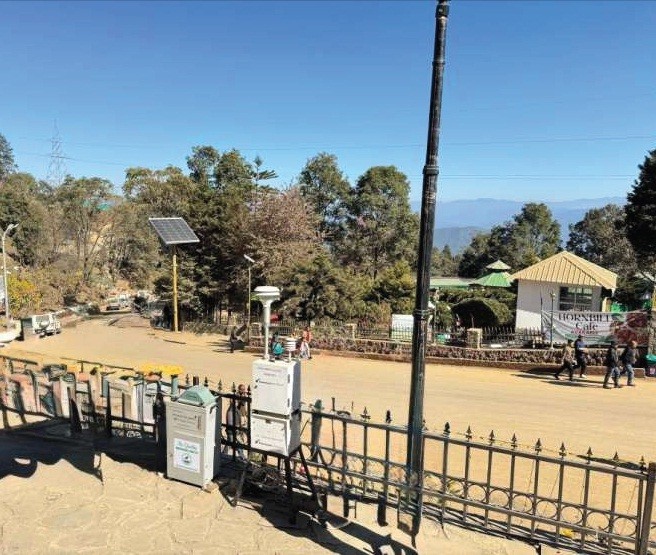
Respirable Dust Sampler 460NL and Fine Particulate Sampler APM 550 MFC at at the Entrance of Bamboo Pavilion at Kisama, which lies within the main festival zone by the NPCB
NPCB monitoring finds repeated PM norm breaches at Kisama, mixed trend compared with 2023
Morung Express News
Kohima/Dimapur | December 21
Traffic congestion, burning of firewood at morungs and food stalls, dust from unpaved surfaces, and construction-related road dust have been identified as three key factors driving repeated breaches of air quality norms during the Hornbill Festival 2025, according to a monitoring report by the Nagaland Pollution Control Board (NPCB).
The report, based on ambient air quality monitoring conducted from December 1 to 10, indicated that these combined sources significantly worsened particulate pollution at the main festival venue in Kisama, particularly during peak activity hours.
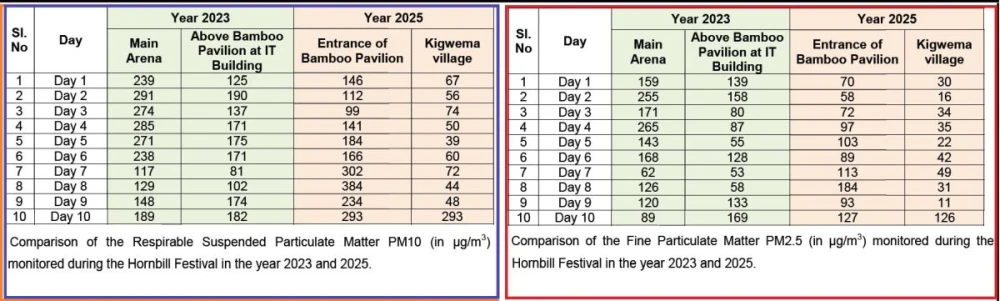
The NPCB monitored Respirable Suspended Particulate Matter (PM10) and Fine Particulate Matter (PM2.5) at the Entrance of Bamboo Pavilion at Kisama, which lies within the main festival zone, and Kigwema village, an adjoining settlement.
In both the locations, Respirable Dust Sampler 460NL and Fine Particulate Sampler APM 550 MFC to aid in the monitoring process.
It was conducted from December 1 to 10 with the objective of assessing the impact of large-scale festival activities on air quality and determining compliance with the National Ambient Air Quality Standards (NAAQS), the Board said.
PM levels breach norms at Kisama
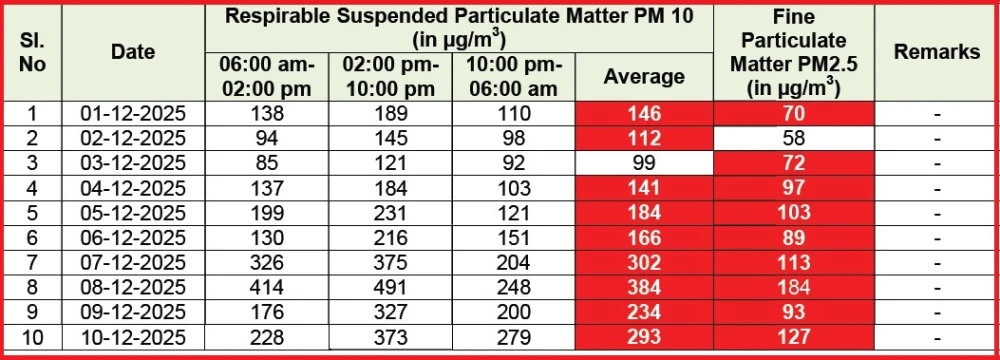
Monitoring data showed that at the Entrance of Bamboo Pavilion, Kisama, both PM10 and PM2.5 concentrations exceeded National Ambient Air Quality Standards on most festival days.
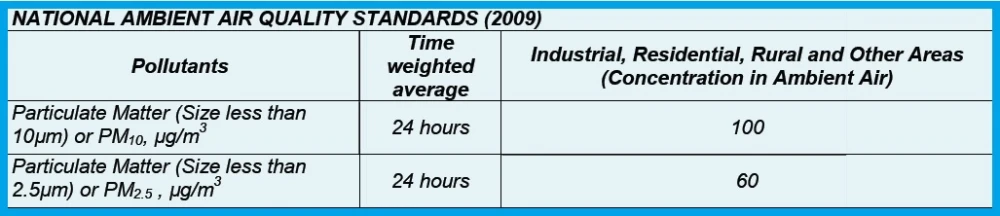
The permissible 24-hour limits are 100 µg/m³ for PM10 and 60 µg/m³ for PM2.5.
PM10 levels rose steeply during the second half of the festival, with daily averages crossing 300 µg/m³ on December 7 and peaking at 384 µg/m³ on December 8.
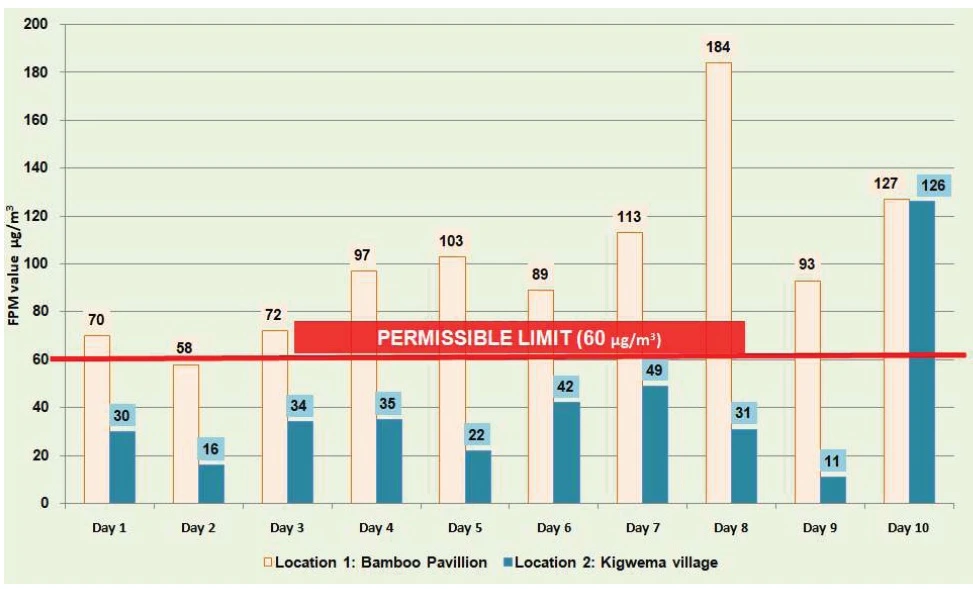
PM2.5 concentrations also reached critical levels, touching 184 µg/m³, more than three times the prescribed standard, on December 7. Only on December 2, it was lesser than the norm at 58 µg/m³.
Major triggers
NPCB noted that PM concentrations were consistently highest between 02:00 pm and 10:00 pm, a period marked by heavy visitor movement, cultural events, vehicular congestion, and commercial activity.
The concentration of vehicles in and around the festival arena led to increased emissions, while frequent stop-and-go traffic further aggravated pollution levels.
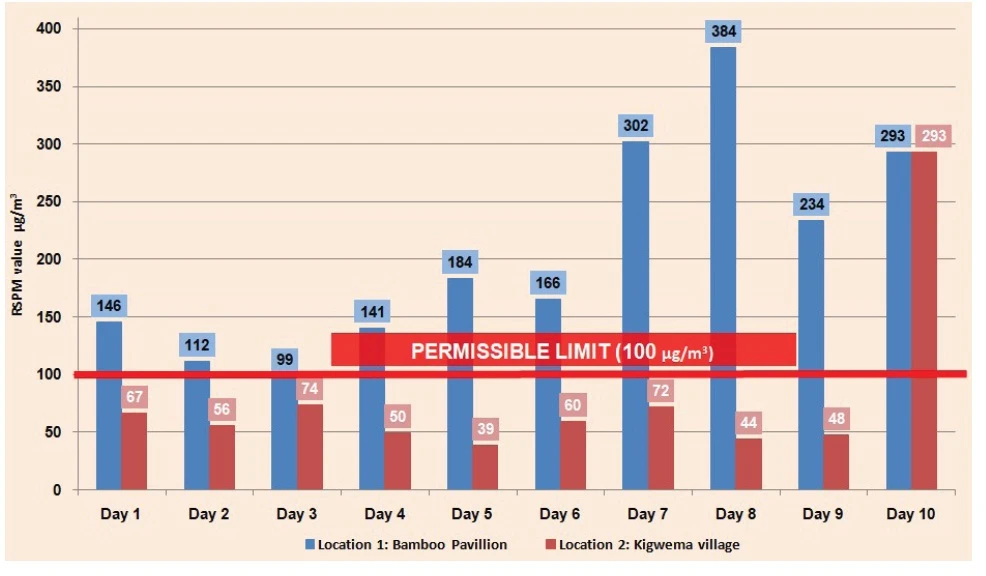
24-hourly average concentration of Respirable Suspended Particulate Matter at Bamboo Pavillon, Kisama and Kigwema Village.
The report also highlighted the burning of firewood at tribal morungs and food stalls as a steady contributor to particulate emissions, especially during evening hours when cooking activity peaks.
Another major aggravating factor identified this year was dust generated from unpaved roads, parking areas, and ongoing construction activities at and around the main arena.
NPCB observed that while water sprinkling was undertaken during the initial days of the festival to suppress dust, the practice was discontinued in the later stages, coinciding with sharp increases in particulate levels.
According to the Board, construction-related road dust emerged as a significant new contributor in 2025, adversely affecting ambient air quality at the festival site.
PM10 included larger particles that can be inhaled into the respiratory system, while PM2.5 consists of finer particles that can penetrate into the lungs, posing potential health risks, the NPCB stated.
Exposure to PM10 and PM2.5 has been linked to adverse health effects, including respiratory and cardiovascular issues, it added.
Adjoining village largely unaffected
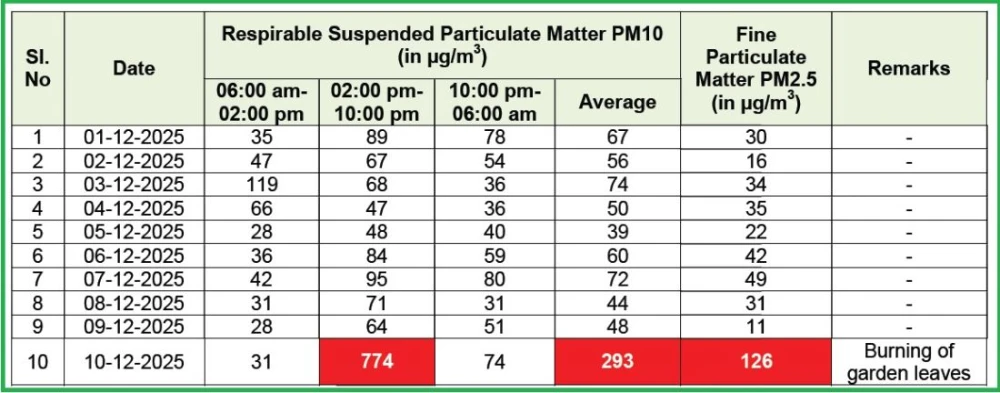
In contrast, air quality monitoring at Kigwema village, an adjoining settlement, showed that particulate concentrations remained within permissible limits for most of the festival period.
An exception was recorded on December 10, when a sharp spike was observed, with PM10 levels reaching 293 µg/m³ and PM2.5 rising to 126 µg/m³.
However, the Board attributed the rise the burning of garden leaves near the monitoring location.
The NPCB clarified that the monitoring data reflects air quality conditions during the festival period and does not represent year-round ambient air quality.
Mixed trend compared with 2023
The report also compared air quality data from the Hornbill Festival 2023.
For PM10, concentrations during the first six days of the 2023 festival were higher than those recorded in 2025.
However, during the last four days, PM10 levels in 2025 exceeded those of 2023, indicating a worsening trend toward the end of the festival this year.
For PM2.5, concentrations were generally higher in 2023 across most festival days.
Nevertheless, 2025 recorded notable spikes on December 8 and 10, pointing to episodic pollution events linked to local activities.
Measures recommended
To mitigate air pollution during future festivals, NPCB recommended regular road cleaning, continuous water sprinkling or mist sprinklers in dust-prone areas, paving of parking zones, and improved traffic management systems
The Board also emphasised the need to promote cleaner cooking fuels and strengthen public awareness on clean-air practices
NPCB also recorded positive changes since 2023, particularly in waste management practices.
The report noted reduced littering, improved waste collection systems, and no incidents of waste burning during the 2025 festival, which helped limit waste-related air pollution.