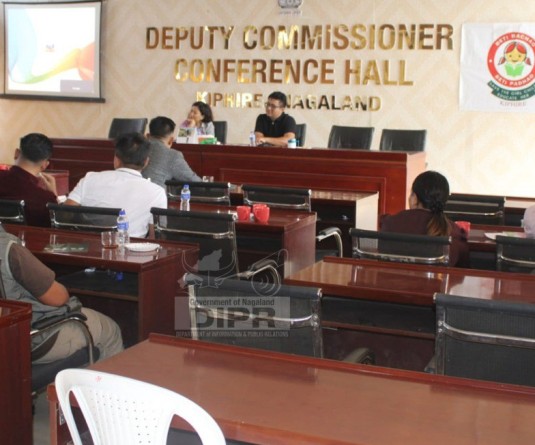
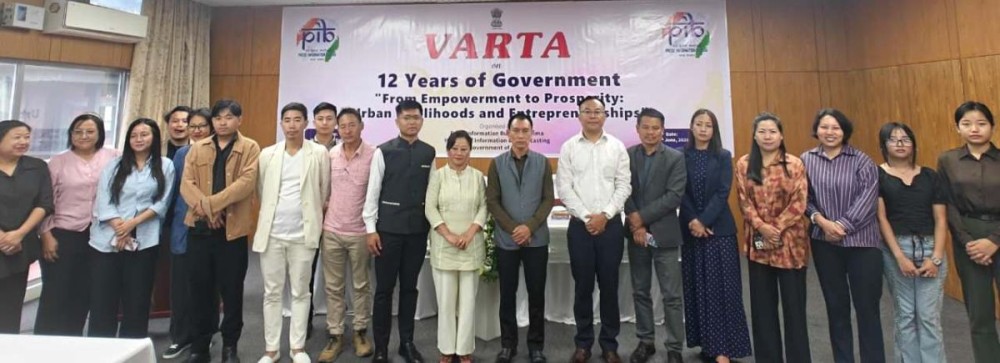
Resources persons and PIB officials with media persons during Varta on 12 years of government in Kohima on June 29.
Our Correspondent
Kohima | June 29
The Press Information Bureau (PIB) Kohima under Ministry of Information & Broadcasting on June 29 organised a Varta on the theme “12 Years of Government – From Empowerment to Prosperity: Urban Livelihoods and Entrepreneurship” at Hotel Japfu, Kohima.
The programme brought together media representatives for an interactive session on the Government’s urban livelihood initiatives and its impact in Nagaland.
Petevilie Khatsu, Additional Director & State Mission Director, DAY-NULM and Abaii Suokhrie, State Mission Manager, DAY-NULM, Directorate of Urban Development as resource persons highlighted the government initiatives on empowering urban livelihood and entrepreneurs.
Petevilie Khatsu highlighted the transformative impact of the PM Street Vendor’s AtmaNirbhar Nidhi (PM SVANidhi) scheme in empowering street vendors through affordable, collateral-free credit and enhanced social security.
The Ministry of Housing & Urban Affairs (MoHUA), Government of India implements this special loan scheme since June 1, 2020 to facilitate micro credit to street vendors and has now been extended until March 31, 2030. This scheme, launched in 2020, to support street vendors affected by the COVID-19 pandemic, has entered a new phase following its restructuring in January 2026.
Khatsu said that this new phase broadens the scope through partnerships between MoHUA, Department of Financial Services (DFS), and Ministry of Rural Development for census towns. The main goal of PM SVANidhi is to give street vendors and affordable loans without any collateral or security.
“Anyone who sells goods or offers services on the streets, footpaths, pavements, or by moving from place to place can get these loans,” he added. This includes people selling vegetables, fruits, street food, tea & coffee, clothes, books, etc. It also includes service providers like barbers, cobblers and laundry workers.
Street vendors can apply for the loan online via the SIDBI-developed PM SVANidhi portal.
The beneficiaries/vendors who pay their loans back on time are rewarded by letting them borrow more money the next time. The loans come in three stages. 1st at Rs: 15,000, 2nd- Rs 25,000 (After paying back the 1st loan) and 3rd Loan- Rs. 50,000 (After paying back the 2nd loan). The government gives an interest subsidy up to 7%.
The vendors do not need to give any security to avail the loan. The government guarantees the loan for them under (CGTMSE) Credit Guarantee Fund Trust for Micro & Small Enterprises, the State Mission Director added.
Vendors get cashbacks when they accept digital payments, Khatsu said adding that vendors who successfully pay back their second loan can get a special UPI-linked RuPay Credit Card (from Rs. 10,000 to Rs 30,000) for emergency needs.
Joining this scheme also opens the door to 8 other government welfare programs, including affordable life insurance, accident insurance, ration card benefits, student support, etc.
The schemes include PM Suraksha Bima Yojana, PM Jeevan Jyoti Bima Yojana, PM Shram Yogi Maandhan Yojana, PM Jan Dhan Yojana, One Nation One Ration Card, Janani Suraksha Yojana, Registration under BoCW and. PM Matru Vandana Yojana.
To avail these benefits, the beneficiaries have to be enrolled through a special socio economic profiling drive called Svanidhi Se Samridhi (SSS). This will be facilitated by the stakeholder departments and ULBs.
DAY-NULM strengthen livelihoods at community level
Abaii Suokhrie highlighted the achievements of Deendayal Antyodaya Yojana–National Urban Livelihoods Mission (DAY-NULM) scheme in empowering the urban poor through sustainable livelihoods, skill development and financial inclusion.
She informed that since its implementation in Nagaland during 2014-15, DAY-NULM has focused on organising the urban poor into Self-Help Groups (SHGs), promoting skill training and placement, supporting self-employment and micro-enterprises, assisting street vendors and providing shelter for the urban homeless. These interventions, she noted, have strengthened livelihood opportunities and social protection across urban areas.
Emphasising women’s empowerment as a core component of the mission, Soukhrie stated that SHGs have enabled women to enhance savings, improve access to credit, foster entrepreneurship and strengthen leadership within communities.
She informed that 984 SHGs are currently functional across 11 districts of Nagaland, creating sustainable income opportunities and reinforcing community-based institutions.
DAY-NULM has enabled beneficiaries to become self-reliant by facilitating access to skill development, credit support and enterprise opportunities, thereby improving the livelihoods of women and economically weaker sections, she added.
Speaking on the future of urban livelihood programmes, she informed that following the conclusion of DAY-NULM on September 30, 2024, the Deendayal Jan Aajeevika Yojana–Shehari (DJAY-S) has been introduced by the Ministry of Housing and Urban Affairs as its successor. The new mission is currently under implementation in a pilot phase following a “Test-Learn-Scale” approach.
She announced that Kohima has been selected as one of 25 pilot cities across the country for DJAY-S.
The programme adopts a targeted approach focusing on vulnerable occupational groups, including gig workers, transport workers, construction workers, waste workers, care workers and domestic workers, while integrating skills, livelihoods and social protection.
Soukhrie stated that the transition from DAY-NULM to DJAY-S represents continuity with improvement, building upon the achievements of DAY-NULM while responding to the evolving needs of the urban workforce.
Earlier, programme was moderated by Andrew Lalchhandama, Media & Communication Officer, PIB, Kohima while vote of thanks was proposed by P Sophie, Head of Office, PIB, Kohima.