• 3 districts face large deficits; Longleng records virtually no rain
• IMD forecasts improved rainfall in July for North-East
Morung Express News
Dimapur | July 2
Monsoon rainfall has remained below normal in 10 of Nagaland's 11 districts so far this season, with three districts recording large deficits and one receiving virtually no rain, according to the latest India Meteorological Department (IMD) data.
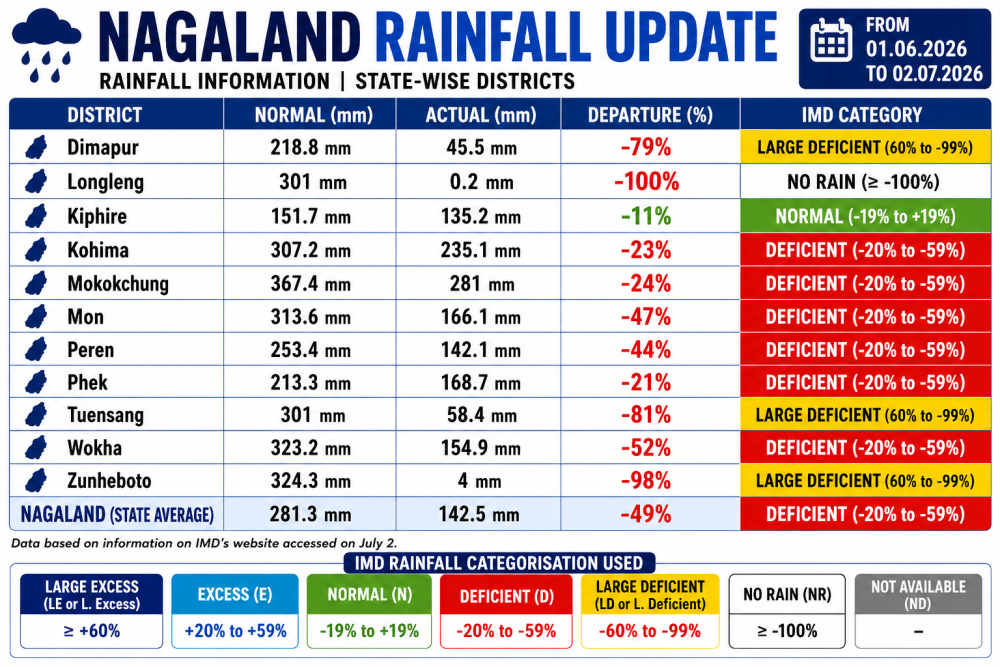
From June 1 to July 2, Longleng received just 0.2 millimetres of rainfall against its normal of 301 millimetres, placing the district in the IMD's 'No Rain' category (-100%).
Besides, Zunheboto received only 4 mm against 324.3 mm (-98%). Tuensang (-81%) and Dimapur (-79%) also remained in the large-deficit (-60% to -99%) category.
Among the remaining districts, Wokha (-52%), Mon (-47%) and Peren (-44%) recorded deeper deficits, while Mokokchung (-24%), Kohima (-23%) and Phek (-21%) remained in the IMD's deficient category, narrowly missing the normal range.
With no other district recording normal or above-normal rainfall, Kiphire, with an 11% deficit, was the only district to remain within the IMD's normal rainfall range.
Overall, from June 1 to July 2, Nagaland received 142.5 mm of rainfall against a normal of 281.3 millimetres, leaving the State with a 49% rainfall deficit.
Since the IMD continues to use the erstwhile undivided districts of Dimapur, Kohima, Phek and Tuensang for assessment, the deficit would be more pronounced when viewed district-wise.
The latest figures suggest that the southwest monsoon has continued its uneven advance across Nagaland, following an exceptionally dry start to the year.
As reported earlier, IMD data showed that Nagaland experienced a 94% rainfall deficit during January-February, with five districts—Kiphire, Kohima, Mon, Phek and Zunheboto, recording no rainfall during the two-month period. All other districts also registered significant rainfall deficits.
Overall, the State received just 1.9 mm of rainfall against a normal of 32.5 mm, marking a 94% departure from normal and placing Nagaland in 'Large Deficient' category. IMD data for the intervening March-April period were not available.
A brighter start to July
Despite the sluggish start to the monsoon, rainfall during the first two days of July has offered signs of improvement. IMD data show Kohima and Phek recorded 'Large Excess' rainfall (60% or more above normal) while Wokha, Mokokchung and Kiphire registered 'Excess' rainfall, receiving between 20% and 59% above normal. Tuensang recorded normal rainfall. Data for the remaining districts were not available.
Among the districts for which data were available, only Dimapur remained in the 'Deficient' category with a 43% rainfall shortfall, while Peren recorded a 96% departure from normal, placing it in the 'Large Deficient' category.
At the State level, the rainfall deficit narrowed to 37% during July 1-2, suggesting an encouraging start to the month even as cumulative monsoon rainfall since June 1 remains well below normal.
Moreover, in its monthly forecast issued on June 30, the IMD said July rainfall over India as a whole is most likely to remain below normal, with the country expected to receive less than 94% of the Long Period Average (LPA).
However, North-East India has been identified as one of the few regions where normal to above-normal rainfall is likely during the month, in contrast to the below-normal outlook for most parts of the country.
The near-term forecast also points to improving conditions, with the IMD predicting fairly widespread to widespread rainfall over Nagaland during July 2-8, including the possibility of isolated heavy rainfall from July 2 to 4.
While it remains uncertain whether the expected increase in rainfall will substantially erase the deficits accumulated over the past month, the July outlook raises the prospect that the Northeast could buck the broader national trend of below-normal rainfall.
Meanwhile, the rainfall situation and floods were among the issues reviewed by the Union Cabinet at its meeting on Wednesday, chaired by Prime Minister Narendra Modi.
According to media reports, Prime Minister Narendra Modi asked ministries to prepare contingency plans in the wake of India's driest June in 12 years, as rainfall remained significantly below normal and forecasts suggested July could also witness below-average precipitation.
Rainfall Information | State-wise Districts
From 01.06.2026-02.07.2026
IMD’s Rainfall Information for Nagaland (From 01.06.2026-02.07.2026)
| ||||
From 01.06.2026 | 02.07.2026 | From 01.06.2026 | 02.07.2026 | From 01.06.2026 |
Dimapur | 218.8 mm | 45.5 mm | -79% | Large Deficient (60% to -99%) |
Longleng | 301 mm | 0.2mm | -100% | No Rain : ≥ -100 |
Kiphire | 151.7 mm | 135.2 mm | -11% | Normal (19% to +19%) |
Kohima | 307.2 mm | 235.1 mm | -23% | Deficient (20% to -59%) |
Mokokchung | 367.4 mm | 281 mm | -24% | Deficient (20% to -59%) |
Mon | 313.6 mm | 166.1 mm | -47% | Deficient (20% to -59%) |
Peren | 253.4 mm | 142.1 mm | -44% | Deficient (20% to -59%) |
Phek | 213.3 mm | 168.7 mm | -21% | Deficient (20% to -59%) |
Tuensang | 301 mm | 58.4 mm | -81% | Large Deficient (60% to -99%) |
Wokha | 323.2 mm | 154.9 mm | -52% | Deficient (20% to -59%) |
Zunheboto | 324.3 mm | 4 mm | -98% | Large Deficient (20% to -59%) |
Nagaland | 281.3 mm | 142.5 mm | -49% | Deficient (20% to -59%) |
Data based on information accessed on IMD’s website on July 2.