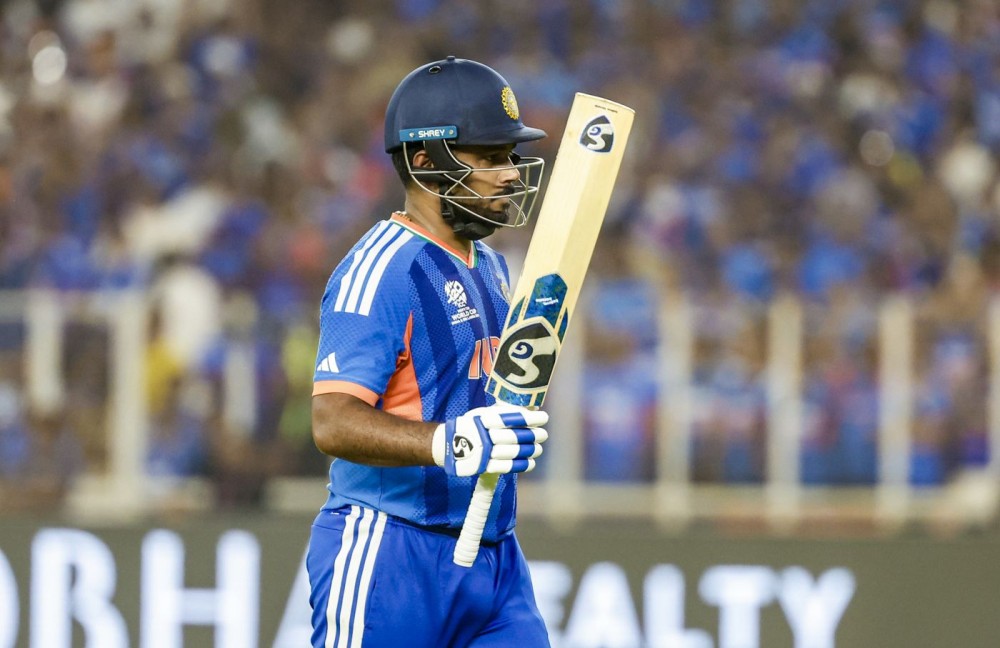
Ahmedabad: India's Sanju Samson walks off the field after his dismissal during the ICC Men's T20 World Cup 2026 final match between India and New Zealand at the Narendra Modi Stadium in Ahmedabad on Sunday, March 08, 2026. (Photo: IANS)
New Delhi, March 10 (IANS) India head coach Gautam Gambhir credited Sanju Samson’s crucial 97 against the West Indies as the turning point in India’s triumphant campaign at the ICC Men's T20 World Cup, which concluded with the hosts lifting their third record title after defeating New Zealand in Ahmedabad.
Gambhir reflected on the emotional significance of winning a World Cup as India’s head coach, describing it as a privilege to contribute to the country once again in national colours.
“I could have never thought about winning a World Cup as a coach. I never thought I would get the opportunity or privilege to be the head coach of the Indian team because it’s an absolute privilege to again wear the India jersey or do something special for the country,” Gambhir said on JioStar.
The former India opener emphasised the emotional connection to representing the nation, adding that recognition from family and the pride of millions of fans made the achievement even more special. “When your mom wishes you and tells you ‘well done’, that’s what you play for and what you live for as well. What bigger feeling is there than making 140 crore Indians proud,” he said.
Gambhir also reiterated a message he consistently delivered to the squad throughout the tournament — that representing India is a privilege rather than an entitlement.
“I’ve always believed that, and I’ve always told the boys as well, that being in that dressing room is a privilege, not an entitlement. Thousands of people would want to be in my position as the head coach of the Indian team, and many would want to be in the position the players are in,” he added.
According to Gambhir, India’s success was built not just on results but on the fearless approach the players adopted during the tournament. He also explained that the team’s focus was on creating impact rather than chasing individual milestones.
“I think more than the win, it was the way the boys adapted to the ideology and philosophy of being high-risk, high-reward. From day one, I had a very strong belief that the T20 format is about impact. It’s not about milestones or individual performances. It’s about going out there and creating an impact, whether it’s on the field, with the ball or with the bat,” Gambhir noted.
He also stressed the importance of staying in the present moment during the shortest game format. “The simple ideology throughout this World Cup was that if we could stay in the present and try to control each delivery. Whatever has gone will never come back, and you cannot control what’s going to come in the future. Even if you get hit for five sixes, the next delivery could be the game-changing moment,” he stated.
While several performances shaped India’s campaign, Gambhir singled out Samson’s innings against the West Indies as the defining moment and pointed out that the match effectively served as a knockout fixture for India.
“It’s very difficult to say, but I still believe that Sanju’s 97 against West Indies was the turning point of this campaign. It was a virtual quarter-final. Chasing 195 in a World Cup game is never easy, irrespective of the ground,” Gambhir explained.
Samson’s calm approach, he said, changed the mood in the dressing room and praised Ishan Kishan for his contribution during the chase.
“With the ease and calmness with which he batted, it gave us a lot of confidence in the group that now we were probably on the right track. When Sanju got going and the way Ishan Kishan batted at number three, a lot of things actually started taking shape,” Gambhir added.
Another factor behind India’s success, Gambhir said, was the players’ willingness to adapt to different roles and batting positions throughout the tournament.
“One thing which will stay with me for the rest of my life is how comfortably the boys accepted different batting positions,” he said.
The coach highlighted that the flexibility began with captain Hardik Pandya, who was willing to adjust his role to meet the team’s needs.
“Against England in the semi-final, Shivam got promoted, and Surya was absolutely fine with it. In the final, Hardik was promoted and the captain was fine with it,” Gambhir said.
He also cited examples of players such as Tilak Varma and Shivam Dube batting across multiple positions depending on the situation.
“Tilak started at number three, then batted at five, six and even seven, and the same with Shivam, who batted from number four to seven. That is what team sport is all about,” he said.
Gambhir also reserved special praise for India’s pace spearhead Jasprit Bumrah, who played multiple roles with the ball throughout the tournament.
“Jasprit started with the new ball, bowled in the middle and delivered the tough overs as well,” Gambhir said. “At different stages in the competition, players were given different roles and they adapted beautifully.”
According to the head coach, it was this combination of fearless cricket, adaptability and key performances that ultimately powered India to a historic T20 World Cup triumph on home soil.