

Livini V Zhimo from Olympic Higher Secondary School Zunheboto Class 12, receiving the prize from Dr L Chuchong Noklang, EAC Zunheboto during the essay competition.
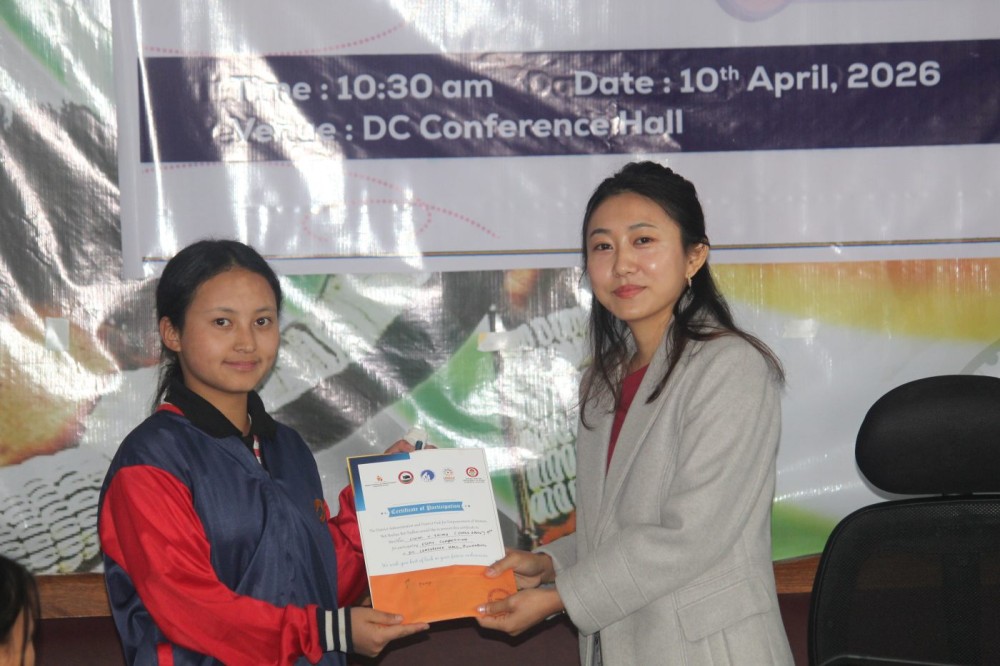
Livini V Zhimo
Class 12, Olympic Higher Secondary School
Imagine a world where every woman is treated equally in the way they play their role. Naga women stand as quiet pillars of strength, wisdom, and resilience, whose contributions have both foundational and cultural significance. Naga women are the backbone of our society, and with their assistance and guidance, we are able to carry out our roles effectively in our daily lives.
Since time immemorial, Naga women have thrived in producing crafts and ornaments, including baskets, mekhlas, and various handicrafts. Today, women are becoming more active and inclusive in government jobs, private sector employment, and educational institutions, holding major positions in many areas.
Our society is growing rapidly and trying to adapt to modernity, where women also play a significant role. People often have misconceptions about women’s roles, thinking that women should only be confined to household chores. They play major roles in the house, which include raising children, preparing meals for the family every day, doing laundry, and handling daily affairs. Yet, we often fail to realize the role of women and the problems they bear every day in executing their duties in society. These duties are often assumed to be confined only to women and are not treated as gender-neutral responsibilities, leading women to be treated like fragile threads.
Speaking about the rights and privileges of women in Naga society, women are not equally treated despite the roles they play and the responsibilities they carry. In various communities, women are often excluded from holding positions of power such as G.Bs, electoral candidates, and council members. Naga women are not given equivalent privileges; rather, men are given more opportunities and preferences compared to women members.
Therefore, I want to convey this message to the various stakeholders that no woman should be left behind in the framework of Viksit Bharat, which represents a living bridge between heritage and economic empowerment. Article 14 of the Indian Constitution states the Right to Equality, emphasizing that everyone has equal rights in our society and shared responsibilities.
“Let’s rewrite the narrative.” Let’s make women’s rights and roles a priority, not a privilege. Stand up, speak out.
The winner of the essay competition organised by District Hub for Empowerment of Women (DHEW), Zunheboto, under the Beti Bachao Beti Padhao (BBBP) scheme for members of the Young Girls Advocacy Club (Illi Lothe Loji), under the theme “The Role of Naga Women in Developed India (Viksit Bharat)” on April 10.

