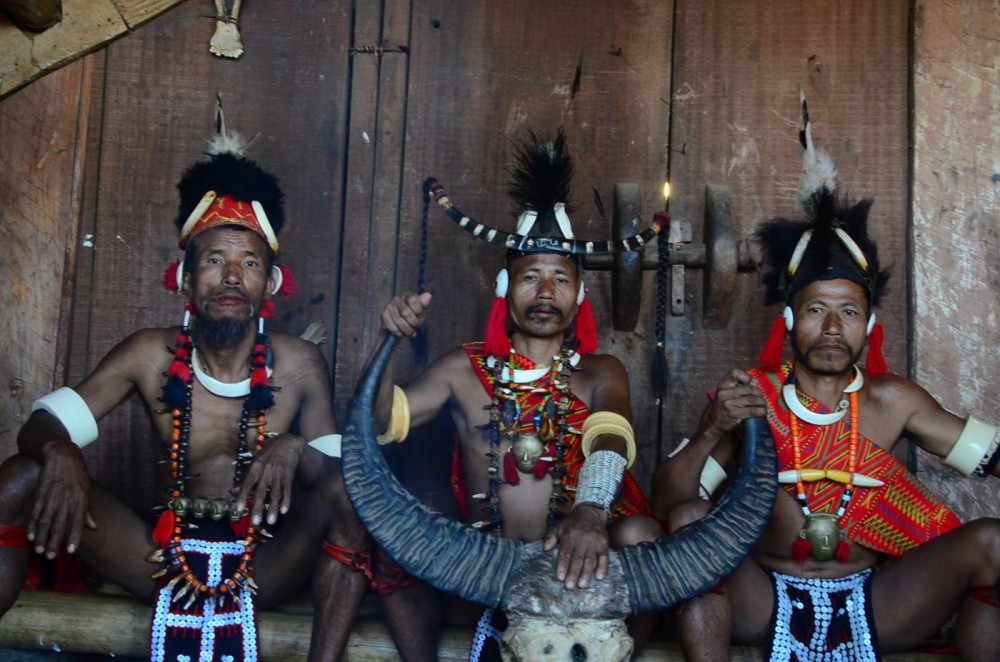
Naga menfolk in their traditional attire during the Hornbill Festival in Kisama Heritage Village. (Photo Courtesy: Manen Aier)
Atoke B Aye (Atoke Naga)
The Naga political issue is not just a matter for the negotiating groups or political leaders. It concerns every Naga, wherever we may be living, because the outcome will shape the future of our people and generations to come.
I strongly believe that every Naga has the right to understand what is being discussed in our name. At the same time, I believe the people of the present State of Nagaland must pay particular attention to how any proposed settlement could affect our land, our rights, our institutions and the opportunities of our younger generation.
I am not against the aspirations of Nagas living outside the present boundary of Nagaland. Their history, identity and concerns deserve equal respect. But protecting the interests of Nagas in other areas should not mean overlooking the rights and future of the people of Nagaland. We must be able to protect both.
Before discussing the concerns, it is important to understand that the 2015 Framework Agreement and the 2017 Agreed Position are two separate agreements involving different negotiating parties. The Framework Agreement was signed on 3 August 2015 between the Government of India and the NSCN (IM). The Agreed Position was signed on 17 November 2017 between the Government of India and the Working Committee of the Naga National Political Groups.
The signed Agreed Position of 2017 is a short document setting out the principles for further negotiations. The detailed proposals that followed it are contained in a separate Status Paper. Similarly, the competency papers circulated in the name of the Government of India in May 2018 and the separate paper dated 2 January 2020 contain detailed proposals. They should not be confused with the signed 2015 Framework Agreement or the short 2017 Agreed Position.
I am making this distinction because people deserve to know which document says what. A proposal in a circulated paper should not automatically be presented as a final and accepted agreement.
The Pan Naga Hoho: A question we cannot afford to ignore
One issue that particularly concerns me is the proposed Pan Naga Hoho.
The full text of the 2015 Framework Agreement has not been made publicly available for everyone to examine. However, the NSCN (IM) has publicly stated that the proposed Pan Naga Hoho is part of the political arrangement it understands to have been agreed upon. The circulated competency papers of 2018 and 2020 also contain details about how this body could be formed and represented.
According to the 2018 paper, the Pan Naga Hoho would be a statutory body comprising all Naga tribes, wherever they are. It proposes that representatives be elected or selected by their respective tribes or regions democratically and according to population.
The 2020 paper goes further. It proposes a Pan Naga Hoho of 130 members. It also proposes that six members nominated by the Pan Naga Hoho would sit in the Upper House of the proposed Tatar Hoho. The same paper says that, until integration, the proposed People’s Government of Nagaland, Regional Territorial Councils and District Councils would consult the Pan Naga Hoho on certain matters concerning Naga identity, culture, customs and related interests.
At first glance, many may see this as a positive step towards bringing Nagas together. I understand that sentiment. But I believe we must also look beyond the name and understand the possible long-term consequences.
My concern is about representation and decision-making power.
The people of the present State of Nagaland already have their own elected government, tribal institutions and customary systems. If a Pan Naga Hoho is formed with representation from Naga tribes across different regions, and if representation is determined partly by population, how will the interests of the people of Nagaland be protected when decisions affect our State?
We must remember that Nagas do not live only in Nagaland. There are Naga communities in Manipur, Assam, Arunachal Pradesh and across the international border in Myanmar. The phrase “all Naga tribes, wherever they are” is broad. However, the specific Regional Territorial Councils listed in the 2020 paper are for Naga areas in Manipur, Assam and Arunachal Pradesh. The paper does not specifically name Myanmar as an area for a Regional Territorial Council.
This raises another important question: if the Pan Naga Hoho is meant to represent Nagas wherever they live, what will be the exact geographical scope, membership and representation formula?
I am not questioning the right of any Naga community to be represented. My concern is whether the people of the present State of Nagaland will have adequate safeguards against being outnumbered or having their interests weakened in decisions that directly affect them.
The number of tribes, the population of different regions and the political weight of their representatives are not necessarily the same. If representation is largely influenced by population, the combined strength of Naga communities outside the present State could have a significant effect on the balance of representation.
This is why I consider the proposed Pan Naga Hoho a matter that needs serious public discussion. It may be presented as a common platform for Naga unity, but we must know whether it will remain mainly an advisory and cultural body or whether its role will extend into important political and legislative decisions.
The 2020 paper itself proposes six Pan Naga Hoho nominees in the Upper House of the Tatar Hoho. That is not a small detail. It creates a direct link between the proposed Pan Naga Hoho and the proposed law-making structure.
If such an arrangement is ever considered, what will prevent the interests of the present State of Nagaland from being overshadowed? What guaranteed representation will the tribes of Nagaland have? Will there be a minimum number of seats that cannot be reduced? Will the people of Nagaland have a decisive voice on matters concerning their land, customary laws and State institutions?
These are not questions against Naga unity. They are questions about protecting the future of our people.
Government jobs and opportunities for our youth
Another matter that deserves serious attention is the proposal for Nagaland Services.
The competency paper dated 8 May 2018 proposes the creation of Nagaland Services, including Civil, Civil Defence, Police and Forest Services, along with a Nagaland Public Service Commission.
The 2020 paper also proposes a new political and administrative structure, including the proposed People’s Government of Nagaland and Regional Territorial Councils. These proposals may sound like administrative reforms, but we must understand what they could mean for young people who are preparing for government jobs.
Today, many educated youths in Nagaland are already struggling to find suitable employment. The Nagaland Economic Survey 2025–26 reports an estimated unemployment rate of 16.07 per cent. It also states that 35 per cent of the respondents without jobs had been unemployed for more than three years.
In such a situation, can we afford to leave questions about future recruitment unanswered?
If a common Nagaland Service is created, who will be eligible to apply? Will recruitment be limited to permanent residents of Nagaland, or will it include eligible candidates from other Naga areas? How will posts be distributed? What protection will be given to local candidates who have grown up, studied and built their lives in the present State?
I am not suggesting that Nagas from other areas should be denied opportunities. But our own youth should not be placed at a disadvantage in their own State.
Before accepting any common service arrangement, the recruitment rules, eligibility conditions, reservation and promotion policies must be made clear to the public. Otherwise, a proposal that appears beneficial on paper could create uncertainty for the very people whose future it is supposed to protect.
Permanent residency: Who will qualify and what rights will it bring?
The question of permanent residency is equally important because it is directly connected to land ownership, voting rights and political representation.
The 2018 competency paper proposes that permanent residents of Nagaland and contiguous Regional Administrative Territorial Council areas be documented. It gives 1 December 1963 as the cut-off date for Nagaland. It further states that only permanent residents would have the right to own land, vote and be elected to public office.
The separate 2020 paper gives 30 November 1963, habitation-wise, as the cut-off year for permanent residency. It also proposes that permanent residents may have the right to own land for residential purposes and to vote.
Even the dates and wording in these two circulated papers are not identical. That alone makes it necessary for the concerned authorities to clarify which proposal, if any, is being considered and what the final rules would be.
Who will determine permanent residency? What documents will be accepted? How will customary village records and existing landholding rights be protected? What happens when people have different claims or records?
These are serious questions because permanent residency is not simply an identity card. It can determine who may own land, who may vote and who may hold public office.
For a State where land and customary rights are deeply connected to the identity and authority of its people, no such arrangement should be introduced without clear public understanding and safeguards.
Land, resources and Article 371A
For the people of Nagaland, land is not merely property. It is connected to our villages, clans, customary practices, identity and inheritance.
Article 371A provides important constitutional protection concerning religious and social practices of the Nagas, Naga customary law and procedure, administration of civil and criminal justice involving customary law, and ownership and transfer of land and its resources.
Any proposed political or administrative arrangement must therefore explain clearly how these protections will continue to operate.
The 2017 Status Paper contains proposals concerning the constitutional and administrative arrangements for Nagaland, including the proposed Tatar Hoho and changes relating to Article 371A. These are proposals in the Status Paper, not provisions of the short signed Agreed Position itself.
The 2020 competency paper also proposes new governing and council structures with separate powers and responsibilities. The public must know exactly how such arrangements would relate to the existing State Government, village councils, tribal institutions and the protections already enjoyed by the people.
Who will have the final authority over land and natural resources? Will decisions concerning our land remain with the people and institutions whose customary rights are protected? How will the rights of individual villages and landholding communities be safeguarded?
We should not wait until a settlement is finalised to ask these questions. By then, the room for public discussion may be much smaller.
What happens to the present State of Nagaland?
Perhaps the biggest question of all is the future of the State as we know it today.
The 2020 competency paper proposes a People’s Government of Nagaland, a bicameral Tatar Hoho and a new constitutional arrangement referred to as the Naga Yehzabo. It also proposes Regional Territorial Councils in Naga areas of Manipur, Assam and Arunachal Pradesh, with separate legislative, executive, judicial and financial powers within their assigned areas.
In simple terms, these councils would not merely be cultural organisations. The proposals envisage bodies that could make laws on specified subjects, administer those subjects, exercise certain judicial powers and manage separate budgets.
The same paper proposes that these arrangements would operate until integration, with their future role to be decided thereafter.
These are major changes. Therefore, people of Nagaland have every right to ask: What will happen to our present Legislative Assembly? What will happen to the existing State Government? How will the proposed Tatar Hoho relate to the present Assembly? What will happen to Article 371A and the powers it protects?
I am not saying that these changes have already been accepted or will automatically become reality. I am saying that the proposals are serious enough for the public to demand clear answers.
We must also recognise the present situation. In September 2026, the Nagaland Legislative Assembly unanimously passed the Frontier Nagaland Territorial Authority Bill. The State Government has also welcomed the appointment of a new interlocutor and the move towards a ministerial-level team for the Naga political talks. These developments show that important political and administrative arrangements are already being discussed and pursued. That makes public awareness even more necessary.
There is also no single public position on every circulated proposal. In September 2026, the NSCN Provisional Government publicly rejected the 2 January 2020 Competencies document. That is its stated position, and it makes it even more important for the concerned negotiating parties and the Government of India to clarify the document’s status.
We must decide what safeguards our future requires
I want to make one thing clear: I am not writing this to oppose a political solution, nor am I questioning the aspirations of Nagas living in other areas. I want an honourable and lasting solution for all Nagas.
But a settlement must not leave the people of the present State of Nagaland uncertain about their own future. Our land, our customary rights, our political institutions and the opportunities of our youth cannot be treated as minor details. They are matters that will affect generations who are not even old enough to participate in today’s discussions.
Our leaders may be negotiating on behalf of the Naga people, but the consequences of the final settlement will be carried by the people. That is why the public must not remain silent or uninformed.
The Government of India and the Naga negotiating groups must place clear information before the people. The status of the circulated competency papers, the proposed Pan Naga Hoho, the question of representation, permanent residency, recruitment, land and the future of the present State must be explained without ambiguity.
There must also be meaningful consultation with tribal hohos, civil society organisations, student bodies, village institutions and the people themselves. Most importantly, the people of Nagaland must have a clear say in any arrangement that directly affects their State, land and constitutional protections.
Unity should not mean that some people’s concerns are overlooked. A political solution should bring dignity and security to all Nagas, not create uncertainty for one section of our people.
This is my personal understanding and concern. I may not have all the answers, but I believe these are questions we can no longer afford to ignore.
We have inherited this land, our identity and our rights from generations before us. It is now our responsibility to understand what is being proposed, ask the right questions and ensure that the future is not decided without the informed voice of the people.
A political solution must secure the future of the Naga people. And in doing so, it must also protect the future of the people of Nagaland.