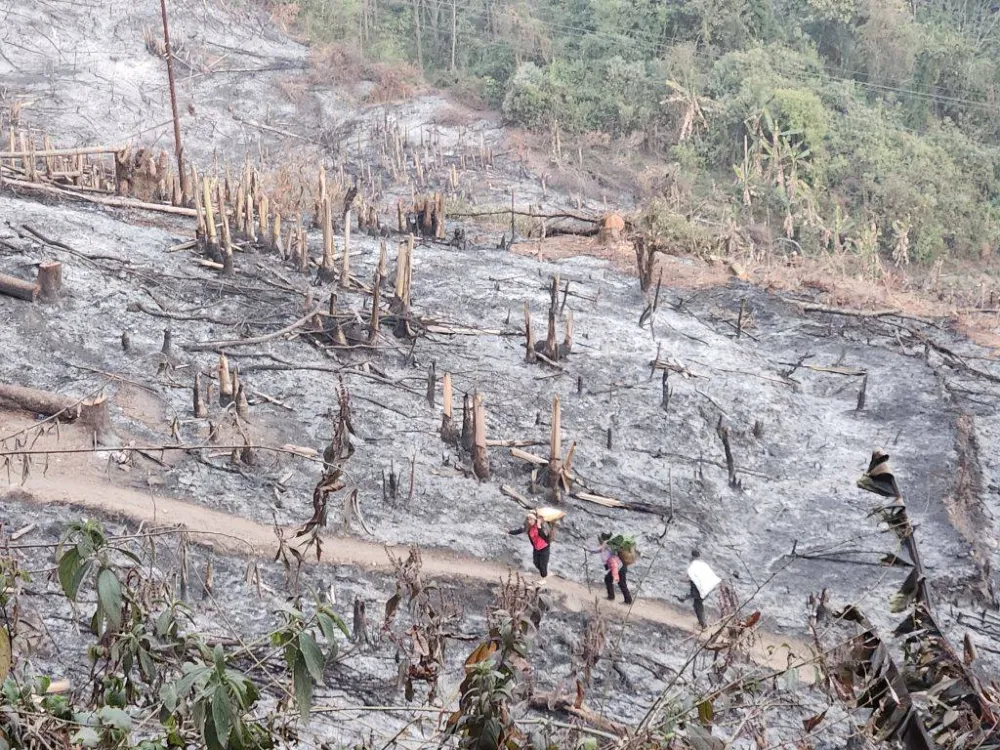
Famers returning from the fields passing through freshly slashed and burned jhum fields in Chendang Saddle, Tuensang District. (File Photo: For Representational Purpose only)
Amba Jamir
Senior Policy Analyst & Development Strategist
In an affidavit filed before the National Green Tribunal (NGT) in Original Application No. 555/2024, made public earlier this week, the Nagaland Government identified two primary culprits behind the state’s declining forest cover: the “age-old customary practices of shifting cultivation” and the “expansion of monoculture cash crop cultivation” on private and community lands.
Grouping rotational jhum alongside commercial monocultures in a legal filing before India’s apex environmental tribunal is neither ecologically accurate nor empirically defensible. Worse, it repeats a colonial-era administrative reflex: blaming indigenous agroecology for forest loss while obscuring the commercial and policy-driven land conversions actually eroding Nagaland’s natural forests.
A look at the state’s own multi-decadal data reveals a glaring contradiction.
Between 1987 and 1999, when Forest Survey of India (FSI) assessments recorded a cumulative jhum footprint averaging nearly 3,900 square kilometres across a decade, Nagaland’s total forest cover remained remarkably stable - declining by just 1.63 percent over twelve years. By contrast, between 2011 and 2023, Nagaland lost over 1,095 square kilometres of forest cover, placing it among India’s top states for net forest decline. Yet over that exact same period, active jhum acreage was shrinking, falling from roughly 1.41 lakh hectares in 2008–09 to under 95,000 hectares by 2017–18, and hovering around 87,000–90,000 hectares in recent state statistical handbooks.
Forest loss in Nagaland did not accelerate because jhum expanded. It accelerated even as jhum contracted.
Equally troubling is that the state is making sweeping causal claims about shifting cultivation without possessing a single sustained, ground-truthed longitudinal dataset on jhum. Because roughly 95 percent of Nagaland’s land is held under customary clan and community ownership protected by Article 371(A), there are no cadastral land records in the hills. State handbooks rely on static block-level estimates that measure only a single year’s cultivated plots, while satellite-based wasteland atlases conflate intentionally rested, regenerating fallows with “abandoned” land. In optical satellite imagery and fire-alert logs, a patch slashed and burned in February or March for a new rubber or oil palm block looks identical to a traditional jhum field. Without ground verification, pre-plantation land clearing is routinely tallied against jhum.
The ecological difference between the two systems is fundamental. Rotational jhum, when practiced with adequate fallow cycles and pollarded native trees like alder, is a temporary agricultural phase within a regenerating secondary forest mosaic. Global Forest Watch data for Nagaland between 2001 and 2025 confirms that 90 percent of tree-cover disturbance in the state was temporary rotational regrowth, while permanent deforestation - driven by commodity agriculture, timber extraction, and infrastructure - accounted for the structural loss.
By contrast, monoculture plantations permanently arrest ecological succession. Across Nagaland today, more than 52,000 hectares - equivalent to nearly 60 percent of the state’s entire annual active jhum acreage - are locked under commercial single-species plantations: nearly 29,800 hectares of natural rubber (up over 55 percent in just five years), roughly 8,460 hectares of oil palm, around 8,000 hectares of coffee, nearly 5,900 hectares of small-grower tea, and over 2.28 million cultivated agarwood trees.
Here lies the policy paradox inside the state’s NGT submission. While the Environment and Forest Department warns the tribunal that monoculture expansion on community lands is driving forest loss, sister departments and state missions actively subsidize targets of 50,000 hectares of coffee, 15,000 hectares of oil palm, expanding rubber belts, and commercial agarwood estates on those very same jhum fallows and foothill commons.
Even the affidavit’s celebratory claim that Nagaland’s growing stock rose by 19.94 percent between 2021 and 2023 - driven largely by a 22.18 percent jump in Trees Outside Forests - masks the real crisis. Under FSI’s definition, any one-hectare patch with over 10 percent canopy density counts as “forest cover,” including mature rubber estates and commercial timber blocks. Replacing biodiverse community forests and multi-species jhum fallows with closed-canopy rubber or fast-growing timber may boost cubic metres of standing wood on paper, while hollowing out watershed hydrology, pollinators, and native biodiversity on the ground.
In reality, jhum is already in steep decline, and with it, Nagaland’s traditional food systems, diverse landraces, and time-tested agroecological practices. Where jhum fallows have shortened in accessible belts, it is largely because cash-crop enclosures and land alienation have squeezed thecommons available for rotation. Stigmatizing customary shifting cultivation before the NGT will not save Nagaland’s forests; it will only accelerate the erosion of both agrobiodiversity and community stewardship under Article 371(A).
If the state is serious about halting forest loss, it must stop scapegoating jhum on the basis of incomplete data. Instead, it needs to reconcile its own contradictory plantation subsidies, regulate permanent land-use conversion on fragile hill slopes, and partner with Village Councils to build sovereign, community-verified data on both regenerating fallows and commercial land-use change.