

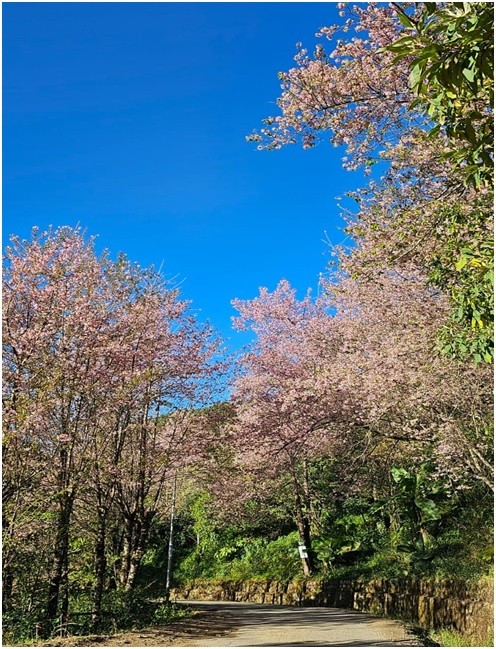
Autumn Cherry Blossom. Prunus cerasoides (dinabandhuana) at Viswema village.
Rusovil John IFS (Retired)
Viswema
There are two types of Cherry blossoms found in Viswema, Nagaland. One is the Autumn Cherry and the other is the Spring Cherry based on its flowering season. In Nagaland, when we come across Cherry trees or cherry blossoms; what comes to mind is the Tepri Tevi or the Himalayan Wild Cherry botanically known as Prunus cerasoides (Prunus dinabandhuana). This species blooms during autumn and is called Autumn Cherry. Besides this popular Autumn Cherry Blossom, there is a rare local species found in the foothills of Japfu mountain range between 900 to 2000 feet above the msl. This species is locally called “Tevi” which flowers in Spring with dark pink flower. This Spring Cherry Blossoms during late February to April. Both the species are found in Mount Japfu foot hills of Nagaland, Manipur and some North-Eastern states of India, We find the two types of Cherry Blossom trees, one which flowers during autumn and other which flowers during spring. Both belong to the family of Rosaccae and genus Prunus.
Autumn Cherry Blossom
Common name: Himalayan Wild Cherry
Botanical name: Prunus Cerasoides (dinabandhuana)
Local name: Tephri Tevi
Morphological Characteristics
Prunus cerasoides is a medium size deciduous tree and known as Himalayan wild cherry. Its bark is brownish-grey, smooth and peels off into thin shining horizontal stripes exposing a shining copper coloured surface. Its leaves are ovate, acuminate, doubly serrate and glabrous. The petiole has 2-4 glands at its base. The stipules are feathery. Flowering takes place in the months of mid November to mid December.
Floral Characteristics
Flowers are bisexual and occur in fascicles of rose-red colour, gradually fading to white. Pollination is mainly through insects. The fruits are produced in abundance having scanty pulp and are scarcely eaten, but are famous for making well-known cherry brandy.
Distribution
The plant is distributed in temperate Himalayan region extending from Kashmir to Bhutan, Khasi hills of Meghalaya in Assam and Manipur at an altitude of 900-2300 meters above the mean sea level. It prefers temperate and moist climate and Soil. The cherry tree prefers light sandy, medium loamy and heavy clay soils and requires well drained condition. The tree grows in temperate regions on the hilly slopes. Propagation is by seed however, it can also be vegetative propagated through air-layering and stem cutting.
The fruit of Autumn Cherry ripens during March- April and are picked up from tree or fallen ones are collected from the ground. The seeds are removed from the fruits, washed free of pulp and sown. The seeds may be sown immediately after collection in April to middle of May. Seeds remain viable for 2-4 months, but germination percentage is more in freshly collected seeds. The seeds should be sown in well prepared nursery beds or polythene bags containing mixture of sand, soil and farmyard manure (1:1:1). The seeds start germinating within 25 days and germination is completed within 15 days.
Naga Spring Cherry Blossom
Local name: Tevi
Botanical name: Prunus species
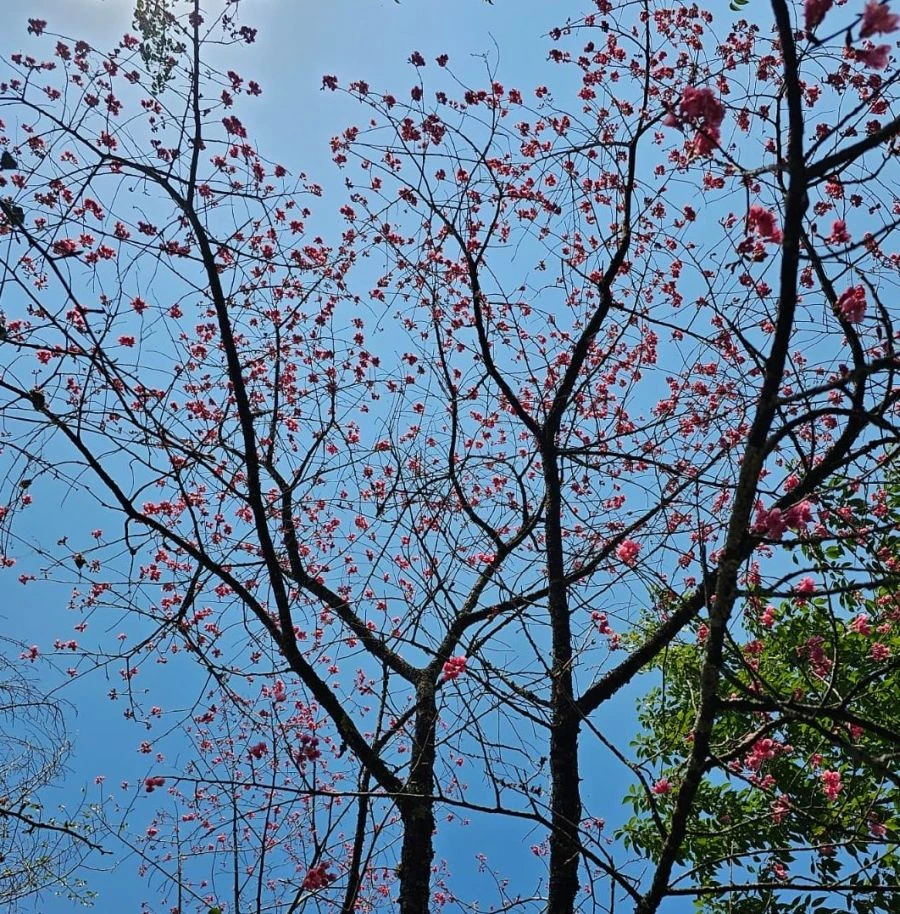
Naga Spring Cherry Blossom is a rare and endangered species of the deciduous cherry tree found in the foot hills of Barail mountain range, in Nagaland and Manipur, India between the altitudes of 900 to 2000 meters above the mean sea level. It is locally called “Tevi” in Chokri Viswema language.
Description
The Naga Spring Cherry Blossom locally known as “Tevi” grows up to about 30 feet in height. When the tree is not in flowering stage, it is characterized by a glossy ringed brownish bark. The leaves are elliptic in shape with serrated margins. The plant prefers medium loamy soils.
Its flowers in winter season from mid February to March. It has an ovoid yellow fruit that turns red when it ripens.
Flowers and fruits
Flowers are hermaphrodite and are crimson pink in color 1.2cms - 2.5cms in diameter, calyx is bell shaped with 5 petals of about 8mm in length, the sepals of the flowers are colored in darker crimson blue.
Flowering normally takes place from mid February to early March at Viswema. Fruits are initially green which turns to yellow and red as it ripens.
Difference between Tephri Tevi and Tevi
Naga Spring Cherry Blossom/Tevi/Prunus species and Autumn Cherry Blossom/Tephri/Prunus cerasoides (dinabandhuana) both found in Viswema are very similar however, there are some differences:
The autumn cherry tree is taller and abundant while the spring cherry is shorter and very rare and difficult to propagate.
The Autumn Cherry Blossoms during autumn in mid November to mid December while Naga Spring Cherry Blossoms during late winter/spring from mid February to April
Fruits of Naga Spring Cherry Blossom (Prunus tevi) are sweeter than Autumn Cherry Blossom/Tephri Tevi.
Germination and survived rate of Tevi is difficult as compared to Tephri Tevi.
Seasons of Nagaland
The seasons of Nagaland can be broadly divided into four seasons:-
1. March –April- May = Spring /Fall
2. June – July –August = Summer/Monsoon
3. September – October – November = Autumn
4. December – January – February = Winter

