

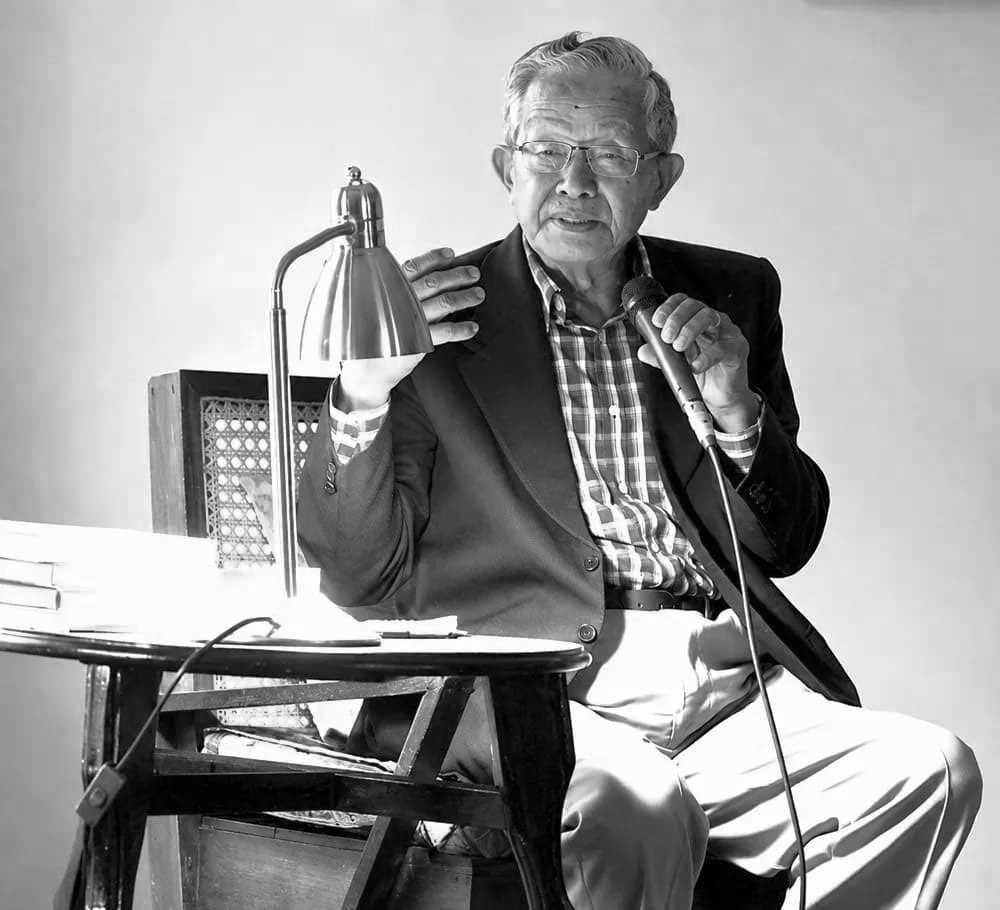
Niketu Iralu. (File Photo)
Meyu Changkiri
Sometimes, an unexpected piece of news in the middle of an ordinary journey takes us back through many memories. My colleagues and I were returning from Assam after our work with the Assam Church Leaders on flood-related relief when friends informed us that Niketu Iralu had breathed his last in New Delhi.
As we continued our journey, my thoughts went back to the occasions when we had read about Niketu, admired his work, appreciated his contribution, and had the opportunity to meet him personally. I felt that I should go to the family, pay my respects and convey the tribute of the North East India Christian Council (NEICC). Some of my associates felt the same, and so we decided to make the journey to Sechü Zubza.
The first time I met Niketu was in Shillong, when I was a young pastor. I knew of him before I knew him personally. I had heard about his work in peace and reconciliation. But meeting him was different. What struck me was not only what he knew, but the way he related to people. He listened. He was approachable. He made you feel that what you had to say mattered.
Since childhood, I have always enjoyed the company of my seniors. Some of my earliest memories go back to the early 1980s, when I was still in school. Some seniors would occasionally send me to a pharmacy in Midland, Kohima, to buy medicine. They would give me ten rupees for the medicine and two rupees for myself. On a small piece of paper, they would simply write: Phensedyl.
At that time, I had no idea what Phensedyl was. I was simply a schoolboy doing what my seniors had asked me to do. Only later did I begin to understand the seriousness of the growing problem of substance abuse in Nagaland. Around that time, names such as the Naga Mothers’ Association, Niketu Iralu, Moral Re-Armament, Kripa Foundation and Mount Gilead Home became familiar to me. They were associated with efforts to respond to a difficult and growing social problem. Looking back, I realise that I had encountered the name Niketu Iralu long before I understood the breadth of his work.
Over the years, through different occasions and conversations, my appreciation for his wisdom, humility and ability to relate to people only grew. Many came to know him affectionately as “Uncle Niketu,” and I can understand why.
By the time we arrived at Shalom Bible Seminary, Sechü Zubza, the hall was already filled with people. Many had come with the same desire - to pay their respects to a man whose life had touched so many.
Before the funeral service began, one of Niketu’s family members invited those who wished to share a word of tribute to do so. I had also been entrusted with condolence messages from leaders of the Baptist World Alliance (BWA) and the Union Christian College Alumni Association (UCCAA), with a request to convey them to the family and read them on their behalf. I was therefore grateful for the opportunity to offer a brief tribute, carrying with me the respect, affection and condolences of the BWA, UCCAA and the North East India Christian Council (NEICC).
It was only a brief moment, as it rightly needed to be. At a funeral, many carry memories, gratitude and words of farewell, and there must be room for others to speak. I was simply grateful for the family’s generosity in making that space available.
Many thoughts, therefore, remained unsaid.
One of them was this.
Niketu Iralu was born into the Iralu family of Khonoma, a son of the Naga Hills. Yet, in the course of his long and remarkable life, he became much more than a person identified by his place of birth. He became a citizen of the world.
He remained deeply rooted in his people, his land and his history. But his roots did not close him in. They gave him a place from which he could reach out to others. He could speak with conviction about the Naga experience while listening carefully to those who saw things differently. He could remain firmly Christian without becoming narrow. He could be deeply Naga without becoming exclusive. He could engage the wider world without losing his sense of where he came from. Perhaps that is one of the beautiful things about Niketu’s life: the deeper his roots became, the wider his embrace.
A Life Shaped by Education and Encounter
Niketu was born on 12 July 1935 into the family of Dr Sevilie Iralu and Vituno, the elder sister of A. Z. Phizo. He was one of their thirteen children. His educational journey brought him to Union Christian College (UCC), Barapani, Shillong, where he completed his Pre-University studies before proceeding to Madras Christian College.
UCC is one of the educational initiatives that grew out of the North East India Christian Council’s vision for Christian education in the region and has continued under the Council’s sponsorship. Over the years, it has welcomed young people from across the region, providing education within a Christian ethos and encouraging a life of service. As UCC begins its Platinum Jubilee year, it is fitting to remember Niketu as one whose life journey was shaped, in part, by this educational endeavour.
At Madras Christian College, where he studied from 1955 to 1957, another important chapter began. In his condolence message to the family, P. Wilson, Principal and Secretary of Madras Christian College (Autonomous), described Niketu as “the first Naga to set foot into the Madras Christian College.” During those years, he came under the influence of Rev. Macphail and Dr. Macnicol and encountered Moral Re-Armament, now known as Initiatives of Change. His subsequent work with IofC, including his service at Asia Plateau in Panchgani, brought him into contact with people from many countries and backgrounds and deepened his engagement with peace, reconciliation and social transformation. His world became larger, but he never became detached from where he came from.
He Lived Ecumenism
For me, one of the most striking things about Niketu was his ecumenical spirit. He did not simply speak about inclusion; he practised it.
He related easily with people from different denominations, tribes, social backgrounds and political persuasions. He could disagree without treating the other person as an adversary. With him, ecumenism was not merely about organisations, meetings or statements. It was personal. It was expressed in the way he welcomed people, made room for differences and built friendships.I believe there was something deeply Christlike in this. Niketu, in his own human way, tried to live a spirit that crossed boundaries and brought people into relationship.
The House of Listening
Perhaps nowhere was this more evident than at Kerünyü Ki - the “House of Listening” - at Sechü Zubza, where Niketu and Christine made their home. People came there from different walks of life. Some came with questions, some with difficulties, some with disagreements, and some simply needed someone to listen.
In a time when most of us are eager to speak, listening is itself a form of service. Niketu understood this well. He did not always have an immediate answer. He listened, reflected and helped people think through their concerns. Many left with a new perspective, encouragement, or simply the assurance that someone cared enough to listen. That, perhaps, was one of his greatest gifts.
A Life of Peacebuilding
During the funeral service, Rev. Dr. Wati Aier described Niketu as “holy vaccinated.” I found the expression profound. Niketu had witnessed violence and lived through difficult periods in the history of our region. Yet he did not allow violence to determine his response to violence. He chose listening, dialogue, reconciliation, forgiveness and peace.
In a message from his close friend Rajmohan Gandhi, read during the funeral by one of his associates, Niketu was described as “a statesman without a public office.” I think that is fitting. His influence did not come from office or position. It came from his life, his relationships and the confidence people placed in his judgement.
Christine perhaps gave us the simplest description of the man behind the public figure: his “incredible humour” and his “love for people.” Those words say much about him.
Niketu understood the Naga struggle deeply, but his concerns extended beyond it. Through the Forum for Naga Reconciliation and many other engagements, he sought to help people listen to one another and find peaceful ways forward.
Why Did We Travel So Far?
The NEICC has a continuing concern for peace and reconciliation in North East India, and we had hoped for more opportunities to sit with Niketu, listen to his experience and learn from his long journey. His passing leaves that possibility unfinished. For me, that is another part of the loss.
As I reflected on the journey to Sechü Zubza, another question came to mind: Why did we feel that we should travel hundreds of kilometres to be present in person?
Our connection with Niketu was not a matter of family or kinship. We came from different places and backgrounds. Yet, when we heard of his passing, we felt that we should make the journey to stand with Christine and the Iralu family and pay our respects. I believe that says something about the kind of life he lived. His influence came through relationships. He gave people his time. He listened to them. He respected them. He made room for them. Over the years, he became a trusted elder to people from many different backgrounds.
For me, the journey was both personal and representative. I went as someone who had known and appreciated Niketu over the years, and also as the General Secretary of the NEICC, carrying with me the respect, affection and condolences of the wider NEICC family. We travelled to honour a life that had touched people far beyond the boundaries of family, village, tribe and denomination. We travelled to say thank you.
His Lasting Message
His son Kevipulie Iralu shared what were among Niketu’s last words: “Nagas must learn to love one another, forgive one another.”
After a lifetime of thinking about conflict, identity, history and reconciliation, his message came down to something very simple: love and forgiveness. These are not easy things. It is easier to speak about justice than forgiveness, to remember our wounds than to let them go, and to talk about reconciliation than to practise it. But Niketu understood that peace must ultimately reach the human heart. Relationships need something more than the resolution of disputes. They need reconciliation, and reconciliation requires the courage to forgive.
What Will Remain?
His son’s recollection of Niketu’s words remains with me: “Nagas must learn to love one another, forgive one another.”The message reaches far beyond the Nagas. In a divided world, we need the grace to forgive and the wisdom to remain in relationship despite our differences. To carry something of that spirit forward would be a fitting way to honour Uncle Niketu.

