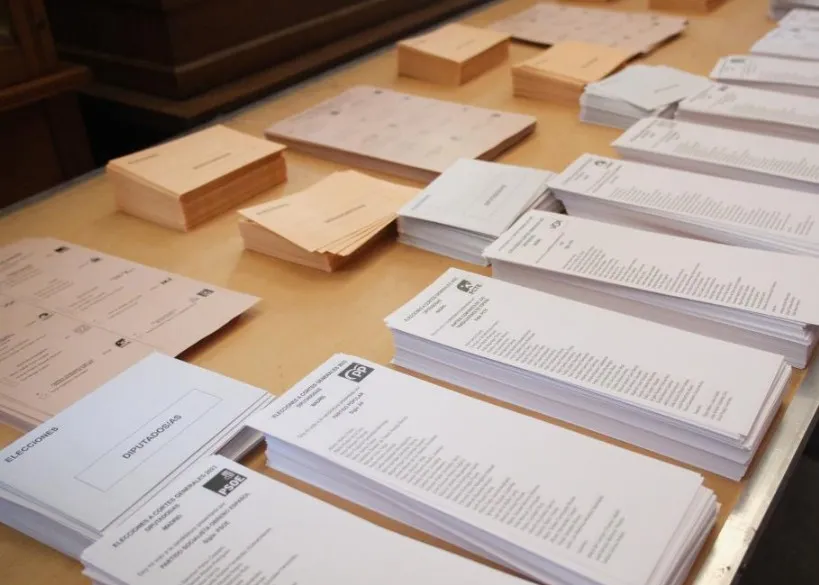
This photo taken on July 23, 2023 shows ballots at a polling station in Madrid, Spain. Voters went to the polls in Spain on Sunday for a snap general election, and 37.4 million Spaniards have the right to vote. The snap election was called by Prime Minister Pedro Sanchez following the Spanish Socialist Workers' Party's (PSOE) disappointing display in the local and regional elections held at the end of May. (Xinhua/Meng Dingbo)
Madrid, November 29 (IANS): Voting began at 9 am local time (0800 GMT) on Sunday in Spain's early general election, with more than 38.6 million people eligible to elect all 350 members of the Congress of Deputies and 209 senators.
Spanish Prime Minister Pedro Sanchez called the election in October after the lower house rejected his government's housing measures. His Spanish Socialist Workers' Party faces a challenge from the conservative People's Party, which joined the far-right Vox and the Catalan party Junts in voting down the measures.
According to the Interior Ministry, Spain has set up over 22,000 polling places nationwide. Polls are due to close at 8 pm local time (1900 GMT). The first provisional results are expected from 9 pm local time (2000 GMT), after voting ends in the Canary Islands, one hour behind the mainland, Xinhua News Agency reported.
The newly elected parliament is due to convene on December 23. After consulting party representatives, King Felipe VI will nominate a candidate for prime minister. The candidate needs at least 176 votes in the lower house to win a first confidence vote. If that bid fails, a second vote is held 48 hours later, when a simple majority is enough to secure parliamentary approval.
On November 10, Spain's People's Party (PP) unveiled its manifesto for the general election, pledging tighter immigration controls, changes to housing policy and increased infrastructure investment.
PP leader Alberto Nunez Feijoo presented the proposals as a plan for "national reconstruction", promising to overhaul state administration and strengthen accountability.
On immigration, Feijoo pledged to ban mass, indiscriminate regularizations of irregular migrants. He promised to establish the identity of anyone crossing the border illegally within seven days and carry out returns "without delay" under the new European mechanism.
The manifesto also proposed repealing the housing law. Feijoo also outlined a 300-billion-euro (335-billion-US dollar) infrastructure plan over 15 years, prioritising maintenance and modernization of existing infrastructure over new construction.
Feijoo pledged to raise pensions annually in line with the consumer price index (CPI) and safeguard the public pension system. He also proposed merging minimum-income support and other benefits into a single scheme aimed at helping recipients enter employment, while allowing them to continue receiving support when they start work.
Feijoo said a PP government would audit public spending within its first 100 days and submit a national budget every year. He also proposed changes that a general election will be held if the budget were rolled over twice consecutively.