

Kopele Tepa
Founder, Bumblebee Society, Kohima
We often assume that fairness means giving everyone the same thing. The same opportunity. The same access. The same rules.
But what if giving everyone the same thing does not give everyone the same chance to participate? Imagine expecting everyone to wear the same shoe size or fit into just one size of clothing. We would recognise immediately that sameness does not mean suitability. Good design considers differences in size, fit and need so that more people can actually use what is provided. Disability inclusion is not so different. Shouldn't we be thinking about our schools, services and society with different needs in mind from the beginning?
Perhaps then, equality alone is not enough.
My work as an educator, along with being an aunt to a child with multiple disabilities, has made me see this not simply as a professional concern, but as a very human one.
Equality is something we hear and speak about often. We talk about equal rights, equal opportunities and equal access and rightly so. These are important foundations for a society where every person can participate with dignity.
I also recognise that disability exists across a wide range of support needs, from mild to profound, and that meaningful inclusion will look different for different people. Equality, and even equity, cannot by themselves remove every barrier or meet every support need. Some people may require significant, ongoing and highly individualised support. But does that mean we should not strive to make our systems as inclusive as possible from the outset? I don't think so. The fact that one approach cannot meet every need should not become a reason to make no effort at all.
But there is a question worth asking: does equal access always result in equal opportunity?
Imagine a school that opens its doors to every child. On paper, this is equality. A child with a disability has the same right to enrol as any other child. But what happens when that child needs additional learning support, assistive technology, a resource teacher, communication support or reasonable accommodation to participate meaningfully in the classroom?
The door may be open. But access to the classroom does not automatically mean access to learning.
The Rights of Persons with Disabilities Act, 2016 recognises the rights to equality and non-discrimination. These rights are fundamental. But the existence of a right does not, by itself, remove every barrier to exercising that right.
Allowing children with and without disabilities to enroll in the same school is an important step towards equality. But if the support needed to learn is not available, equal admission alone may not create an equal opportunity.
And this gap between equality and meaningful participation is not limited to education. We see it across everyday life.
When we talk about accessible transport, for example, it cannot stop at reserved seats or marked parking spaces. These are useful measures, but they are only part of the picture. We also need to ask whether the transport system itself can be used by people with different disabilities.
A public space may not explicitly prevent a person with a disability from entering, yet its design may still make it difficult to move around, use the facilities or participate independently. A job may be open to everyone, but without appropriate training, an accessible workplace or reasonable support, the opportunity may remain largely on paper. A government scheme may be available, but if the person who needs it cannot navigate the process or meet the requirements, availability does not necessarily mean access.
These are the gaps between equality on paper and equality in everyday life.
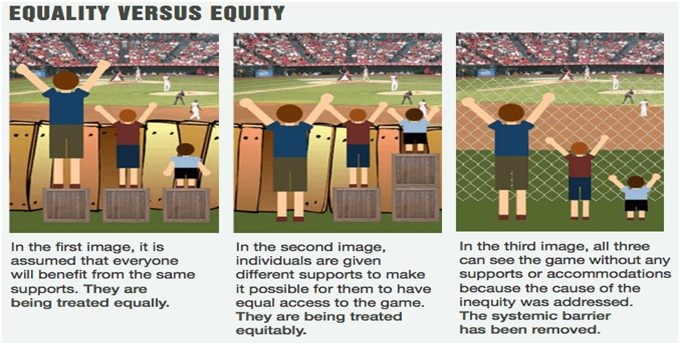
This is where equity becomes important. Persons with disabilities may require more than equal rights and equal access. Equity asks us to recognise that people can face different barriers and may therefore need different forms of support to have a fair opportunity to participate.
Equality and equity are not opposing ideas. Equality establishes the right; equity helps make that right meaningful.
And we also need to think beyond accommodation.
Accommodation is important. Sometimes a person will need a specific adjustment to participate in an existing system, and those adjustments can make an enormous difference. But if we constantly design systems around an assumed “average” person and then make changes only when someone does not fit, we are always responding to exclusion after it has already happened.
What if accessibility and difference were considered from the beginning? If a building is designed to be accessible from the outset, we are not waiting for someone to ask for a ramp. If a classroom considers different ways of learning from the beginning, support is not treated as an exception. If public transport is planned with different users in mind, accessibility becomes part of the system rather than something added later.
The goal should not always be to ask, “How do we accommodate this person?” It should also be to ask, “Who will use this system, and what might they need to participate?”
This is where government has an important role. Policies and legislation can establish rights and set standards, but their real value is seen in how those rights translate into schools, workplaces, public spaces, transport, services and everyday life. Inclusive policy cannot stop at saying that everyone has equal access. It also has to consider what makes that access meaningful.
But government cannot carry this responsibility alone. Institutions, professionals, employers, schools and communities all influence whether inclusion becomes a lived reality. A policy can create a right. The systems and communities around it determine whether a person can actually use it.
There is another question we should ask: who gets to decide what inclusion looks like?
Policies and programmes may be created with the best intentions, but when the people who experience disability are missing from the conversation, we can easily overlook barriers that may not be visible to others. There is knowledge that comes from living the experiencefrom navigating a school, a road, a bus, a workplace or a government office when these systems were not designed with you in mind.
I am reminded of a phrase closely associated with the disability rights movement: “Nothing About Us Without Us.” In India, the principle has also been an important part of disability-rights advocacy; organisations such as the National Centre for Promotion of Employment for Disabled People (NCPEDP) have explicitly used it in their work.
The phrase is simple, but its meaning is profound. Persons with disabilities should not only be recipients of policies and programmes. They should also have a voice in shaping the decisions, spaces and services that affect their lives.
There is a difference between designing for people and designing with them.
Ultimately, meaningful participation is one of the clearest measures of whether inclusion is actually working.
We can say that a child has been admitted to school. But can the child learn? We can say that a job is open to persons with disabilities. But can the person access it, develop the skills needed and remain meaningfully employed? We can say that a government scheme is available to everyone. But can the person who needs it actually access it? We can say that a public space is open to everyone. But can everyone use it independently and with dignity?
These questions take us beyond whether equality exists and towards whether equality is actually being experienced.
As we continue to build a more inclusive society, equal rights must remain the foundation. Equity helps us recognise the different barriers people face. And good design asks us to think about those differences before they become barriers in the first place.
Perhaps, the goal should be bigger than accommodation. It should be to build schools, workplaces, communities, services and public spaces where difference is considered from the beginning—not as an exception, but as part of the people they are meant to serve.
Because sometimes, giving everyone the same opportunity is not enough.
Fairness begins when everyone has a genuine chance to participate.

