

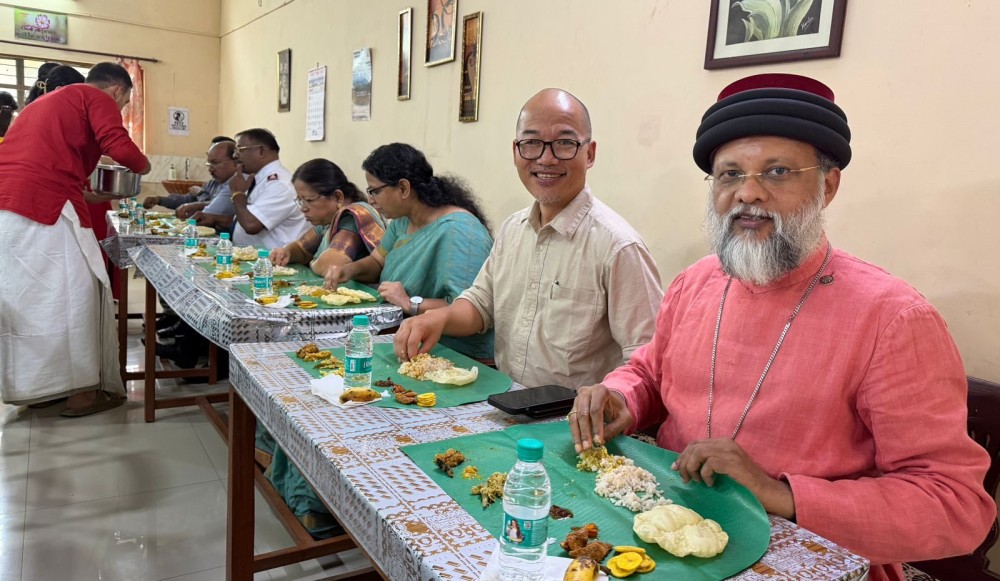
The author with Archbishop Mar Awgin Kuriakose from Kerala
Meyu Changkiri
I landed in Nagpur for the first time to attend a meeting of the National Council of Churches in India (NCCI). Coming from the far Northeast, I expected the usual rhythm of a national gathering - meetings, conversations, consultations and opportunities to meet people from different parts of the country. I did not expect one of my most memorable experiences to come through an Onam meal. It was my first experience of Onam.
In fact, I had never even been to Kerala. My first introduction to Onam goes back to my school days. As a schoolboy, I studied Alternative English from a textbook called New Horizon. Among the lessons on the festivals of India was one on Onam. I learned about Kerala, the harvest, the celebrations, the feast and the story of King Mahabali. At the time, Onam was simply a festival I had read about in a schoolbook. Many years later, in Nagpur, that distant lesson suddenly became real.
There was something almost poetic about the setting. I had come from the Northeast, Onam had travelled from the South, and we met in central India. A Naga was about to celebrate a Kerala festival in Nagpur. India had somehow arranged the meeting.
Many Indias Meet in Nagpur
Nagpur was an appropriate place for such an encounter. Known as the Orange City, it is the winter capital of Maharashtra and an important centre of the Vidarbha region. It is associated with the Zero Mile Marker and its geographical position in the heart of India. The city is also home to Deekshabhoomi, an important landmark of modern Buddhism, and serves as a gateway to some of central India's well-known tiger landscapes.
A city that brings together so many strands of India's geography and history became, for me, the place where I unexpectedly encountered Kerala - not by travelling south, but by sitting down for lunch.
From Tsüngremong to Onam
The timing made the experience especially meaningful. August carries its own cultural significance in the Ao Naga context, when we celebrate Tsüngremong, a festival associated with thanksgiving, community, fellowship and the agricultural cycle.
Tsüngremong and Onam are distinct traditions, with their own histories and cultural expressions. Yet, as I encountered Onam, I recognised something familiar in its spirit: gratitude for the harvest, joy in gathering, the sharing of food and the importance of remembering where we come from. Perhaps festivals everywhere perform a similar human function. They connect the present with memory and bring people together around things that matter to them.
That afternoon, I was being introduced to another people's celebration, and I was happy to become a learner. A festival preserves the memory of a people, but when that festival is shared with someone from another culture, it becomes an invitation to understand one another.
Then Came the Banana Leaf
The organisers of our national meeting thoughtfully arranged a special meal to mark Onam. I was curious, but I was also completely unprepared for what appeared before me. A banana leaf was placed in front of me, followed by an impressive variety of dishes. I knew very little about the ingredients, their names or the traditional way of eating them. I looked at the feast with admiration - and with the quiet anxiety of someone who did not want anyone to discover that he had no idea where to begin.
Fortunately, I was seated beside Archbishop Mar Awgin Kuriakose from Kerala. I am a Baptist from the Northeast; he is a Syrian Orthodox Archbishop from Kerala. But at that moment, our most significant difference was much simpler: he knew how to eat a Sadya, and I did not.
He patiently guided me through the meal, explaining the dishes and showing me how they were traditionally eaten. I followed his lead and soon discovered that the Sadya was far more than a collection of dishes.
Even the banana leaf has its customary arrangement. The accompaniments are placed in particular positions, while the rice occupies its central place. The meal progresses through different combinations of flavours and textures, from parippu and ghee to sambar and other curries, followed by payasam and, eventually, lighter preparations such as rasam or buttermilk.
What first appeared to me as an overwhelming abundance gradually revealed a remarkable order and balance. There was variety, but not confusion; abundance, but also structure. Sweet, sour, salty, bitter, pungent and astringent flavours found their place within the same meal. Vegetables, coconut, lentils, spices, pickles, fried accompaniments, rice and sweets came together as a culinary expression of Kerala's heritage. I was not simply eating lunch; I was being introduced to a culture through its food.
A Non-Vegetarian's Surprise
There was, of course, another dimension to the experience. I am accustomed to non-vegetarian food, yet here I was, sitting before a completely vegetarian feast. There was no meat, no fish and no chicken. The vegetables had taken complete command of the occasion, and they made a remarkably convincing case for themselves.
The more I tasted, the more impressed I became. By the end of the meal, I had to admit that I had not missed the meat - at least that day. It was a useful reminder of how easily we form opinions about things we have never experienced. Sometimes the unfamiliar needs only an opportunity to introduce itself.
Learning to Be a Guest
What I appreciated most was the simple act of being guided by someone who knew what I did not. The Archbishop did not merely tell me what was on the leaf; he helped me enter, however briefly, into a tradition that was part of his own cultural world. I was a guest, and I was willing to learn.
There is something liberating about admitting that we do not know everything. We become better listeners when we are not afraid to be beginners. I did not become less Naga by enjoying Onam, and I did not need to become Malayali to appreciate Kerala. I simply discovered another part of India through someone who was willing to share it with me.
More Than a Meal
The Sadya also reminded me of the simple power of eating together. Traditionally served communally on banana leaves, it brings people into a shared experience of food and celebration. There is a simplicity to that which I found attractive. People come to the meal with different stories and backgrounds, but for a while they share the same food and the same space.
We often speak about harmony in terms of large ideas and institutions, and those things certainly matter. But relationships are also shaped in ordinary places - in conversations, in hospitality and around meals. Sometimes we understand another person better simply because we have spent time together.
Many Indias, One Shared Life
India's diversity is often described through its languages, communities, religions, regions and cuisines. Yet diversity is not merely about recognising that we are different. It is about learning how to live generously with those differences.
My experience in Nagpur was a small example of that possibility. A Naga could celebrate Onam without ceasing to be Naga. A Kerala tradition could be shared with someone from the Northeast without losing its character. Nothing had to be erased for something new to be appreciated.
This lesson extends beyond India. Our world is increasingly interconnected, yet people can live alongside one another without really knowing one another. Cultural encounters matter because they give us opportunities to replace assumptions with experience. We become less uncertain about what is unfamiliar when we have had the opportunity to encounter it personally.
I Had Never Been to Kerala
One thought continued to amuse me after the meal: I had never stepped into Kerala. I had never travelled through its landscapes, seen its backwaters or experienced Onam in a Kerala home. Yet, for a few hours in Nagpur, Kerala came to me through a banana leaf, a traditional feast and the kindness of someone who knew how to manage it.
I had travelled to Kerala without travelling to Kerala. No flight was required, no passport was stamped, and my wallet remained safe. What I brought home was something less tangible but more lasting - a new cultural memory and a deeper appreciation for a part of India I had previously known only through a school textbook.
I Went to Nagpur. Kerala Found Me.
I went to Nagpur for a national meeting and unexpectedly celebrated my first Onam. I arrived as a Naga who had never been to Kerala and as a non-vegetarian who knew very little about a Sadya. I left with a new appreciation for Kerala, a memorable friendship and a slightly greater respect for vegetables.
Perhaps that is the beauty of encountering another culture: we do not lose something of ourselves by discovering something of another. We simply become a little larger in our understanding of the world. I went to Nagpur expecting a national meeting; I returned with a piece of Kerala in my memory. Kerala found me, and I am glad it did.

