

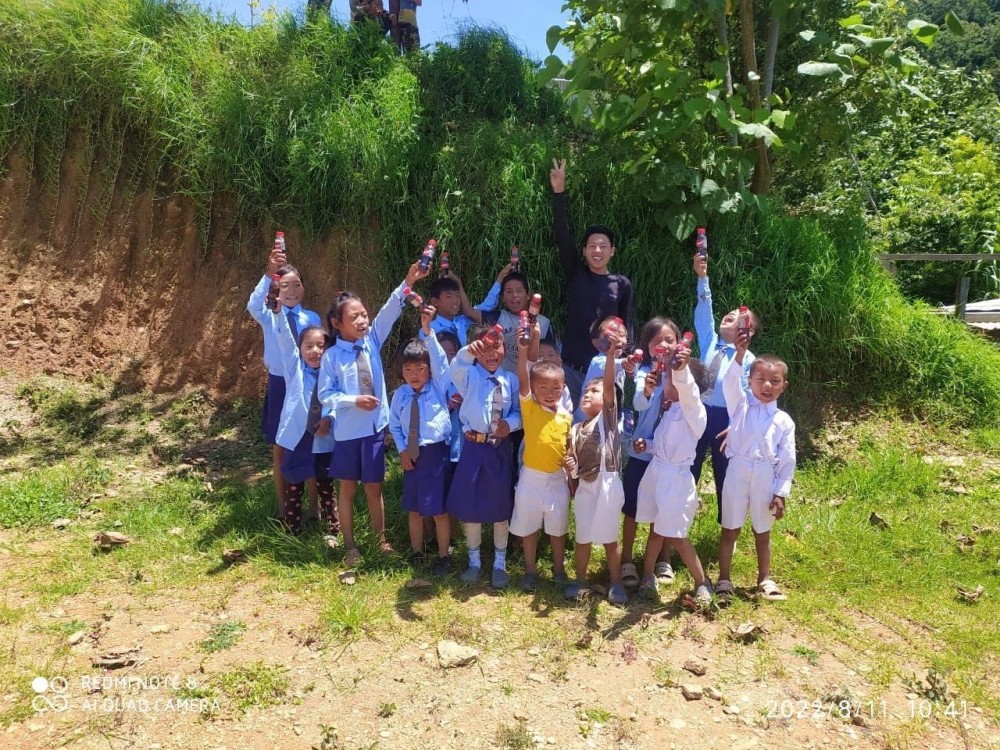
If you walk into Fakim Village on an ordinary December morning, you might hear wind in the trees, a few distant conversations, maybe the occasional rooster announcing something no one asked for. Fakim is not the kind of place where things happen loudly – unless of course the rooster has some strong opinions. Most days move at their own steady pace: fields, forests, familiar routines, and conversations that don’t need to be rushed. The village sits close to the forest, close enough that nature is not something distant or romanticised. It is simply there, woven into everyday life. People grow up knowing the land, recognising bird calls without trying, and understanding seasons not from calendars but from paying attention to the world around. And yet, like many places, something has been quietly shifting. Younger people leave, stories are told less often, and the spaces where generations once met have slowly thinned out. There are fewer opportunities for young and old to meet and to learn from each other, not just ancient customs and practices, but also ways of understanding nature. We wondered how we could bring everyone together to celebrate togetherness and nature.
The idea of the Wühthürang (Tragopan in Chirr language) Sports Festival came from that feeling more than anything else. Not from a grand plan, but from a question- how does one bring people, young and old, to a shared space without making it feel forced? What shared activity can reinforce a sense of camaraderie and excitement? The easiest and most obvious answer to us was a sports event, inclusive of men, women, and children, basically everyone in the village that could talk and walk. And even a few who might just show up to supervise (very seriously) from the sidelines. No long explanations, no complicated expectations. Just a field, a few games, and the promise of a little competition. What we didn’t fully expect was how quickly the village would respond.
.webp)
On paper, the goal was simple: bring people together, create space for elders and youth to connect (not just exist in parallel), and to acknowledge ways of living with the land that have always existed here. So how do we do that effectively? Instead of expecting everyone to come together for something formal (which, let’s be real, nobody gets excited about), we thought, why not a sports festival? Because if there’s one thing that can get an entire village moving, it’s competition- and the very real possibility of beating your neighbour at something. Luckily, the Fakim Students Union and the Fakim Baptist Church took up the mantle of organising this with support from our team of researchers and practitioners Naga Biodiversity Collective and Eco Warriors Nagaland. Christmas time seemed like the perfect time - everyone comes back to Fakim from across the state and country. Thus the Wühthürang Sports festival started. The first surprise? People showed up. Not to watch but to participate.
Ready to play, argue (a little), cheer, and fully commit to the experience. By day two, it didn’t feel organized anymore. It felt like something the village had simply grown into. Of course, people came for the usual crowd pullers of volleyball and tug-of-war. But the real magic happened when the traditional games began - bamboo pole climbing, stilt walking and top spinning. At first, some of the younger participants approached these games like they were trying out something from a museum. Slight hesitation. A bit of laughter. And then the elders stepped in, not in a formal “Let me teach you” but more like “No, no, not like that. Watch this.” Finally, some of the context of these traditional games began to make sense. Then came the stories. Now techniques had meaning. You could see the shift from, ‘oh this is old and boring’, to ‘oh, this is ours!’ happen in real time as the young ones embraced these traditional games. Also, watching someone climb 20 feet of clean and straight bamboo in 13 seconds is a humbling experience. It really puts your own abilities into perspective.
Not everything was loud and fast-paced. There were moments, especially during the storytelling sessions, where things slowed down. The elders narrated age-old, traditional stories and people listened. Many of these stories included birds and other animals, whose antics influenced people and their lives. It was clear that in the traditional worldview animals had the power to influence our worlds. From these stories also emerged knowledge about birds - not the scientific kind necessarily, not in a formal way, but in an everyday manner of how people remember patterns of which bird arrives when, which call means what, what it used to mean when you saw certain birds etc. Then, there was the “Build a Home for Birds: Fakim Challenge”, a very first of its kind here. We were uncertain about how it would go, but we were in for a pleasant surprise when this became a crowd favorite, especially among the children, who really got into it! There were nest boxes made with moss, lichen, and carefully chosen wood. Some looked like they belonged in forests more than on display tables. You could see the thought that went into them, not just creativity, but familiarity with materials. And somewhere in between all that, the idea quietly settled in: If we can build for birds, we can think differently about how we live with them too. The response to these non-sporting activities made one thing very clear: We talk about “conservation” and ‘nature-appreciation’ like it’s a new idea, but here, it has always existed, just under different names, carried in everyday lives instead of reports.
.webp)
Fakim is not secluded from its surroundings. The forests are close. The terrain is unforgiving, but the views are breathtaking. Wildlife is not an abstract concept, it’s part of everyday conversation, sometimes even conflict. People here don’t need to be told that nature matters, they already know. Fakim’s relationship with nature is an everyday one, not one that emerges once a year. But over the years, this relationship is also changing, especially among the youth, who spend more time outside the village. Perhaps, we hope, the sports festival reminded everyone of a slower, deliberate, and mindful way of engaging with each other and with the natural world around them. Yes, there were winners and prizes. But the main goal was seeing elders and youth in the same space, not just present, but engaged with each other, hearing stories that don’t usually get airtime. We hope that there is a seed of curiosity and interest that has been planted in the youth - curiosity to learn about old stories, traditional sports, and about folklores that bring nature into our homes.
The festival did exactly what it set out to do - it brought people together in celebration and in friendly competition. The people of Fakim showed us that people want to be active part of their community, that culture doesn’t need to be ‘revived’, it just needs to be practiced with patience, and that conservation doesn’t always start with awareness campaigns, but often with just a game, a story, or even a wonky bird house!
Are there similar efforts elsewhere in Nagaland or India? Yes, sports festivals, cultural gatherings, and conservation programs are common. But bringing all three elements together, with the village community taking ownership, and led by enthusiastic youth is not common. We believe that such collaborative efforts start a conversation across generations that can grow deeper over time. We hope that these conversations will also highlight the important and unique place that forests and nature have in our everyday lives.
If you ask, what the Wühthürang Sports Festival really was, the honest answer would be: It was five days of people showing up for something they didn’t know they needed. And in between the shouting, laughing, climbing, storytelling, and a few questionable stilt-walking attempts, there was a quiet reminder: that community itself might be the most overlooked conservation tool we have.
Article contributed by Tekameren I Jamir and Dr Priya Tamma with inputs from Liyamong Yimkhiung, Liavirhii Movi & Imkongkumzuk Longchar.

