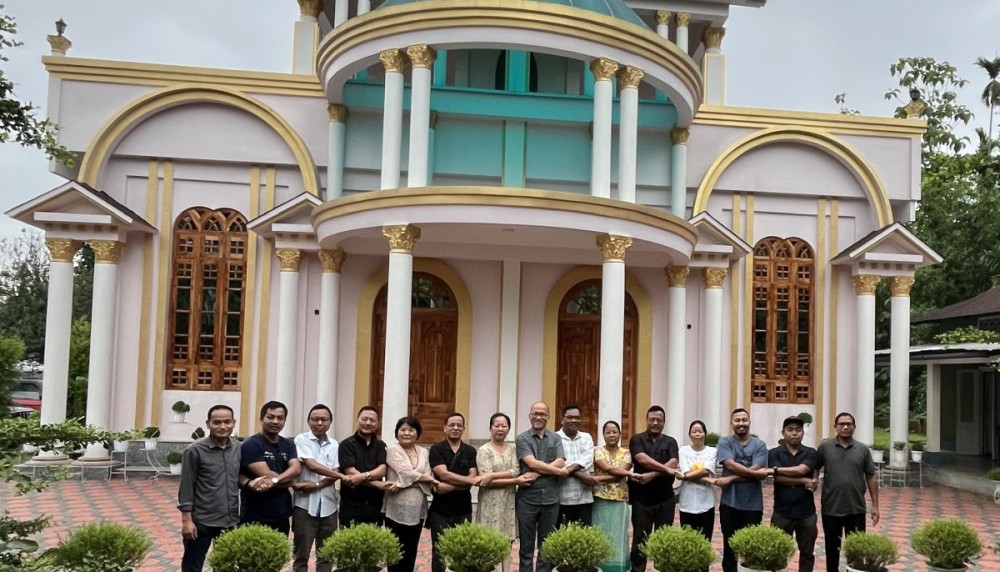
The photo was captured at the church where “Handful of Rice” ministry started, Nisangram Baptist Church.
Meyu Changkiri
Until I came to Shillong for ministry, I had never heard of the term “Handful of Rice” ministry. Over the years, I had encountered many forms of Christian giving and stewardship. Churches collected offerings during worship services, mission funds were raised during conferences, and believers supported various ministries through financial contributions. However, the idea of offering a handful of rice to God was entirely new to me.
When I first heard about this practice, I was told that it had originated from elsewhere. Like many others, I accepted that explanation without much thought. Yet as time passed, I became increasingly curious about its history and significance. Little did I know that this curiosity would lead me to discover a remarkable story of faith, generosity, and Christian stewardship deeply rooted in the life of the church in the Garo Hills.
Learning the Story Behind the Practice
A significant moment in my journey of discovery came when I attended the Fifth Biennial Assembly of the North East India Christian Council at Belpara Baptist Church.
During the assembly, I came across a leaflet containing a condensed account prepared by Mrs. Ameline G. Momin of Bangsi Apal, Meghalaya. As I read through the document, I began to understand the rich history behind what is commonly known as the “Handful of Rice Offering.”
According to the leaflet, among the Garos this practice is known as Merong Jakkep. It is often described as “A Helping Hand from Poor to Poor.” Those words immediately captured my attention because they beautifully express the spirit behind the ministry.
The offering was never about accumulating wealth. It was never designed as a sophisticated fundraising strategy. Instead, it was a simple expression of faith through which ordinary believers could contribute to the work of God and support those in need.
The more I learned, the more I realized that this was not merely a story about rice. It was a story about people. It was a story about faith. It was a story about believers discovering that even the smallest gift can become a blessing when offered to God.
A Meaningful Visit to Nisangram Baptist Church
My interest in this remarkable ministry deepened during a recent visit to the Garo Hills.
My wife and I, along with a few associates, had the privilege of visiting Nisangram Baptist Church. The visit was arranged by my friend, Rev. Sengba Marak, Executive Secretary, who graciously took us there.
Upon our arrival, we were warmly welcomed by the pastor and the church staff. They had been expecting us, and breakfast was already being prepared. The hospitality we received immediately reflected the warmth and generosity for which the Christian communities of the region are well known.
As we sat together and shared fellowship over breakfast, I found myself reflecting on the significance of the place. This was not merely another church building. It was a church connected to a remarkable legacy of faith and stewardship.
Standing on those grounds brought the story to life in a way that reading a leaflet never could. I could almost imagine the early believers who faithfully practiced this ministry, offering their handfuls of rice day after day, trusting that God would use their humble contributions for His glory.
What appeared small in human eyes had become a significant testimony in the history of the church.
The Vision of Rev. Ramke Watre Momin
According to the historical account, the idea of the “Handful of Rice” ministry was first conceived by Rev. Ramke Watre Momin, the first pastor of Nisangram Baptist Church.
His vision was both practical and deeply spiritual.
He understood the realities faced by many families in his community. Most people lived simple lives and had limited financial means. Yet he believed that every believer, regardless of economic status, should have the opportunity to participate in supporting the work of God.
Instead of emphasizing monetary contributions, he encouraged believers to offer a small portion of the rice that they used for their daily meals.
It was a simple idea, but it carried profound implications.
Through this practice, no one would be excluded from the privilege of giving. Rich and poor alike could contribute. Every family could participate. Every household could become involved in supporting the church and its ministries.
The vision reflected a deep understanding of Christian stewardship. Giving was not to be reserved for the wealthy. It was to be a shared responsibility and a shared blessing among all believers.
A Simple Yet Powerful Practice
The practice itself was straightforward.
Before preparing lunch or dinner, rice would be taken from the family container for cooking. Before the meal was prepared, a small portion would be set aside as an offering to God.
For every baptized female member of the family, one handful of rice would be offered. The rice collected through this practice would later be brought to the church as an offering.
What makes this practice particularly beautiful is its simplicity. There were no complicated procedures. There was no pressure. There was no sense of obligation imposed by others.
Instead, it was a voluntary act of devotion carried out in faith.
Day after day, meal after meal, families quietly participated in this ministry. The offerings may have seemed insignificant individually, but together they became a powerful resource for ministry and community support.
More importantly, they became an expression of gratitude toward God.
The Sacred Ministry of Mothers
One aspect of the “Handful of Rice” ministry that deserves special recognition is the role played by mothers.
Traditionally, it was the mother of the household who would set aside the rice before preparing the meal. This task was performed in an atmosphere of reverence and devotion.
The rice was not simply removed from the container and placed elsewhere. It was dedicated to God through prayer.
In that moment, an ordinary kitchen became a place of worship.
The daily preparation of food became a sacred act. The mother became a steward not only of the household but also of a spiritual practice that nurtured faith within the family.
Through this simple routine, children learned valuable lessons about generosity, gratitude, and dependence upon God.
Long before they understood church budgets or mission programs, they learned that giving to God was a natural part of Christian living.
The ministry reminds us that some of the most important spiritual lessons are not learned in church buildings alone. They are learned at home through the faithful example of parents.
Giving Beyond Wealth
One of the most powerful lessons of the “Handful of Rice” ministry is that giving is not determined by wealth.
In many places, people assume that meaningful contributions can only come from those who have substantial resources. As a result, those with limited means may feel that they have little to offer.
The “Handful of Rice” ministry challenges that thinking. It reminds us that everyone has something to give. The value of an offering is not measured merely by its size but by the faith and love with which it is given.
This principle is deeply rooted in Scripture. Jesus Himself highlighted the offering of a poor widow who contributed two small coins. While others gave from their abundance, she gave from her poverty. Yet Christ commended her because He saw the sacrifice and faith behind her gift.
The same principle is reflected in the “Handful of Rice” ministry.
Each handful represented trust in God's provision. Each offering reflected gratitude for His blessings. Each contribution declared that God deserved the first and best portion of what His people received.
“A Helping Hand from Poor to Poor”
Perhaps the most beautiful description of this ministry is the phrase: “A Helping Hand from Poor to Poor.” These words capture the essence of Christian community.
The ministry demonstrated that even those with limited resources could become instruments of blessing to others. The poor were not merely recipients of assistance. They were also contributors to God's work.
This is a profoundly biblical idea.
The church is not built upon the generosity of a few wealthy individuals alone. It is built upon the faithful participation of all believers.
When people with limited means discover that they too can contribute meaningfully, a sense of dignity and ownership emerges. They become active participants rather than passive observers.
The “Handful of Rice” ministry fostered exactly this spirit.
It strengthened community bonds. It encouraged mutual care. It reminded believers that everyone had a role to play in supporting the mission of the church.
Lessons for the Church Today
As I reflected on the history of this ministry during our visit to Nisangram Baptist Church, I found myself thinking about the lessons it offers to churches today.
We live in a world that often values size, efficiency, and measurable results. Churches frequently face financial challenges and are constantly seeking ways to support ministry, missions, and outreach.
While these concerns are important, the “Handful of Rice” ministry reminds us that the heart of stewardship is not found in large budgets but in faithful discipleship.
God is less concerned with the amount we give than with the attitude with which we give.
The ministry teaches us that generosity begins with gratitude. It teaches us that stewardship starts at home. It teaches us that every believer has something valuable to contribute.
Most importantly, it reminds us that ministry flourishes when people participate together in faith and obedience.
The Power of Small Acts of Faith
History repeatedly demonstrates that God often works through small beginnings. A seed grows into a tree. A small group becomes a congregation. A simple prayer changes a life. A handful of rice becomes a ministry. The “Handful of Rice” offering teaches us not to underestimate the significance of small acts of faithfulness. What appears insignificant today may become a lasting blessing tomorrow.
Many of the greatest movements in Christian history began with simple acts of obedience performed by ordinary people.
The strength of the church has never depended solely upon extraordinary leaders or abundant resources. It has often depended upon faithful believers who quietly and consistently served God where they were.
The “Handful of Rice” ministry stands as a testimony to that truth.
A Legacy That Continues to Inspire
Our visit to Nisangram Baptist Church was more than a historical excursion. It was a spiritual reminder.
Standing in a place connected to such a meaningful legacy encouraged me to appreciate the wisdom and faith of those who came before us. Their circumstances may have been challenging, but their faith was strong. They believed that God could use even the smallest offering for His purposes.
Today, the story of the “Handful of Rice” ministry continues to inspire believers across generations. It reminds us that stewardship is not about how much we possess but about how faithfully we use what God has entrusted to us.
What began as a simple practice in a local church became a powerful testimony of faith, generosity, and community care.
The legacy of Rev. Ramke Watre Momin and the believers of Nisangram Baptist Church continues to speak to us today. It calls us to give with gratitude, to serve with humility, and to trust God with what we have.
Above all, it reminds us of a timeless truth: in the hands of God, even the smallest gift can become a blessing to many.
The “Handful of Rice” ministry is more than a tradition from the past. It is a living lesson for the present and an enduring inspiration for the future.