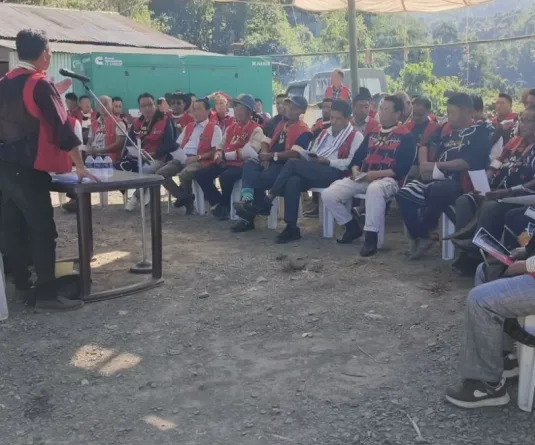
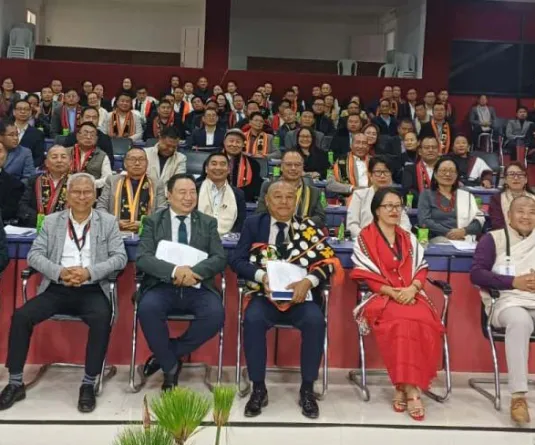
Officials along with the participants during the Civil Society Forum (CSF) Capacity-Building Programme on child safety and protection held in Dimapur on November 26.
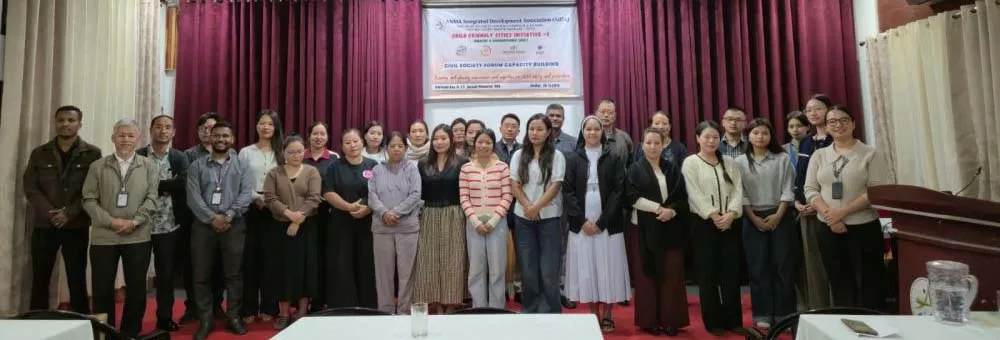
Dimapur, November 28 (MExN): The Child Friendly Cities Initiative Phase 2 (CFCI-2 D&C), implemented by the Asian Institute of Development and Advancement (AIDA), organised its first Civil Society Forum (CSF) Capacity-Building Programme on child safety and protection in Dimapur on November 26.
Held under the theme “Training and Sharing Experiences and Expertise on Child Safety and Protection”, the programme brought together representatives from 13 civil society organisations and institutions to strengthen their understanding, exchange experiences and explore collective approaches to promoting child safety and protection.
The programme was held at the AIDA Rev. Fr. TT Joseph Memorial Hall, Dimapur, at 2 pm.
In his address, Fr. Dr Roy George said that, building on the achievements of Phase 1, CFCI Phase 2 aimed to strengthen child protection systems, promote children's participation in decision-making and create safe, inclusive and child-friendly communities.
The project will directly engage 3,000 children and young people and 1,000 adult stakeholders across Dimapur and Chümoukedima districts.
Its key activities include strengthening Child Rights Clubs, establishing Children's Sabhas, promoting community-based child protection and conducting training on child protection, mental health, gender equality and positive parenting.
An overview of CFCI Phase II was subsequently presented by Toli Z Assumi, Children's Mobilizing Officer.
The first technical session, titled “Community-Based Protection Mechanisms for Children and Juveniles”, was facilitated by Samuel Therieh, Director of Life Ministry Learning Centre and Chairman of Naga United Village, Chümoukedima.
Therieh presented a statistical overview of child protection concerns across Northeast India and highlighted the importance of establishing community safe spaces, culturally grounded protection approaches, whole-family caregiver support and livelihood support circles.
In his concluding remarks, he proposed four immediate measures to strengthen community protection mechanisms: activating Local Child Protection Committees, developing a live inter-agency referral directory, standardising safeguarding and legal literacy training, and institutionalising youth voices in decision-making processes.
The second session, titled “Creating a Safe and Caring Environment for Children: Role of NGOs in Child Development”, was conducted by Rev. Fr. Dr Joe Mariadhas, Director of Shalom Rehabilitation Centre, Chümoukedima.
His session focused on the role of NGOs in child protection, creating safe and supportive environments, identifying children at high risk, recognising signs of abuse and understanding appropriate responses.
Emphasising that every child deserved healthcare, safety, stability and a happy childhood, he encouraged participants to take practical steps towards creating protective and supportive environments.
He also invited stakeholders to make a personal commitment through a “Promise to Protect” pledge. Acknowledging November as Child Safety and Protection Month, he congratulated AIDA and the CFCI-2 team for organising the programme during the month.
The programme also featured a forum sharing and discussion on the way forward for a common action plan, during which representatives from 13 organisations and institutions participated.
They included ACID, Sisterhood Network, Media Team-NLTV, Can Youth, Prodigals Home, Bethesda Youth Welfare Society, NSRLM, Serendip Guardian, Government Children Home with Special Unit, Pro-Rural, Angel Home, Nagaland Centre for Human Development and Information Technology, and Operation Rescue Nagaland.
Two priority areas were identified for collaborative action: community-level awareness and reporting and referral mechanisms.