Source: CAG Report on Social (including Local Governments Audit), Economic, General and Revenue Sectors for the year ended 31 March 2023.
Unrealised dues from police deployment top
Morung Express News
Dimapur | March 29
Despite being a ‘fund-constrained’ and heavily reliant on Union transfers, Nagaland appears to be in no real hurry to collect dues owed to the State.
The latest report of the Comptroller and Auditor General (CAG) of India for the year ended March 31, 2023, while flagging financial irregularities and governance lapses across sectors, also points to a recurring pattern, revenues foregone, dues unrealised, and collections left unattended, raising questions over enforcement in a resource-strapped system.
‘On the House’ police security
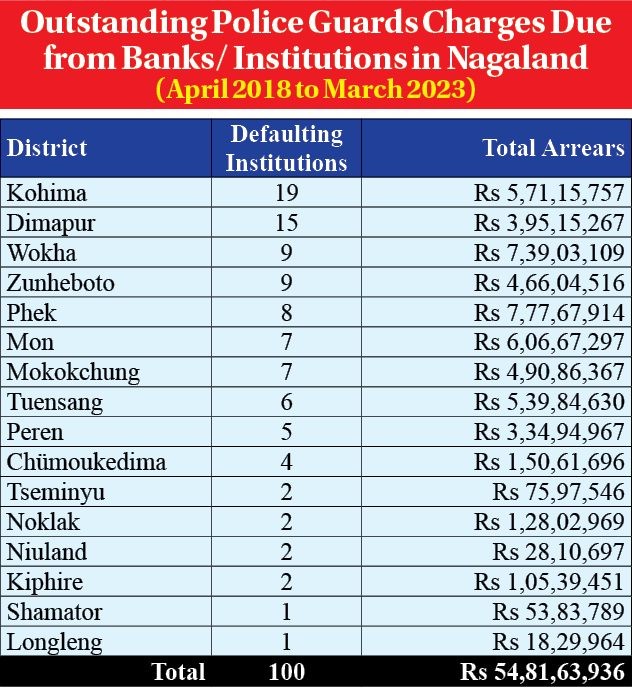
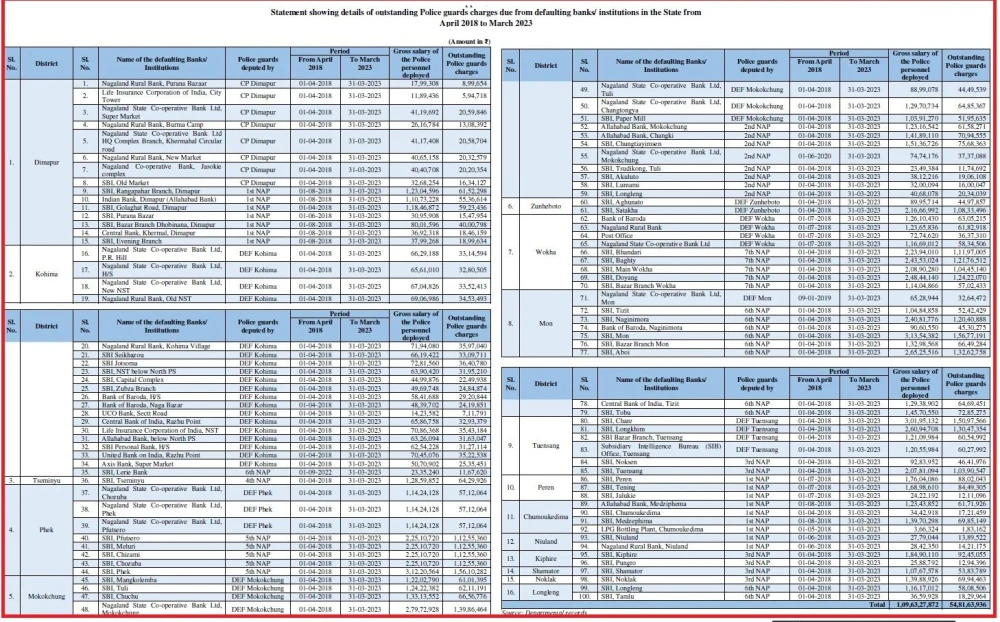
Leading in direct non-realisation, the Home (Police) Department alone accounted for Rs 54.82 crore in unrealised revenue from banks and institutions for deployment of police personnel.
Despite a government decision mandating recovery of 50 per cent of such costs, and repeated recommendations by the Public Accounts Committee (PAC), dues remained unpaid across 100 bank branches and institutions between 2018–19 and 2022–23.
While reminders were issued, enforcement stopped there. Police personnel continued to be deployed at defaulting institutions, with no withdrawal of services.
The absence of formal agreements and lack of coercive measures effectively allowed security services to continue without corresponding payment, the report noted.
“The inability of the Home (Police) Department to enforce provisions of the Government’s decision and the General Financial Rules resulted in the non-realisation of security charges of Rs 54.82 crore,” it added.
The matter was reported to the State Government in August 2023, with reminders issued in October 2023, January and March 2024. As per the CAG, the Government had not furnished any reply as of April 2024.
Kohima and Dimapur districts led the list, with 19 and 15 defaulting institutions respectively (see table). Further, in terms of outstanding amounts, State Bank of India (SBI) accounted for the highest at Rs 38.16 crore, followed by Nagaland State Co-operative Bank at Rs 7.10 crore and Allahabad Bank at Rs 2.81 crore.
In its recommendations, the CAG advised compliance with PAC recommendations and urged immediate, time-bound action to recover dues from defaulting banks and institutions. It also called for a review of police deployment at such institutions to ensure optimal use of resources, and for entering into formal agreements to prevent recurrence of non-payment.
Tourism dept’s 16-year ‘rent holiday’
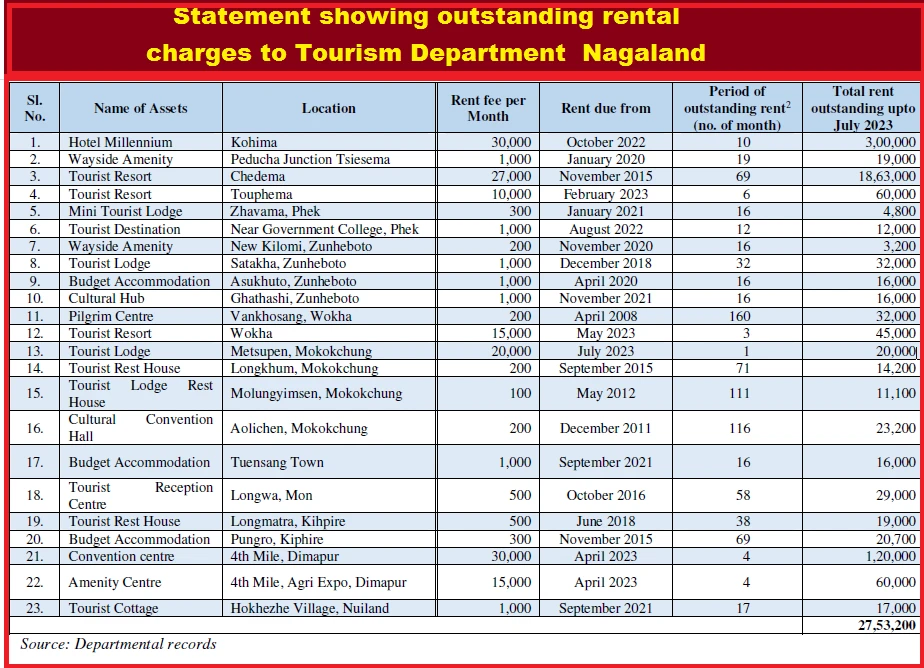
A similar pattern emerged in the Tourism Department, where non-renewal and weak enforcement of lease agreements led to non-realisation of Rs 27.53 lakh in rental income from government assets.
Under Section 5 of the Nagaland Communitisation of Public Institutions and Services Act, 2002, the Department is empowered to lease tourist facilities—such as lodges, rest houses and cafeterias—through MoUs, with provisions for monthly rent, recovery from security deposits in case of default, and termination for non-compliance.
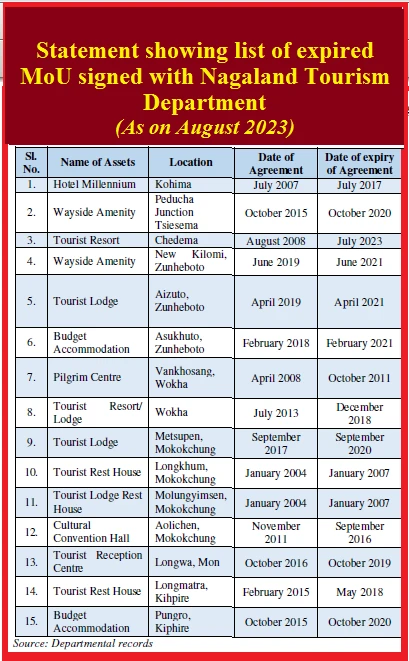
Audit scrutiny found that of 30 MoUs executed, 15 had expired, some for as long as 16 years, yet continuing operations without renewal.
Further, 23 lessees defaulted on rent payments for periods extending up to 160 months.
In terms of the longest period of rent outstanding, dues from Pilgrim Centre, Vankhosang (Wokha) have remained unpaid since April 2008, followed by the Cultural Convention Hall, Aolichen (Mokokchung) since December 2011, and the Tourist Lodge Rest House, Molungyimsen, since May 2012.
In terms of amount, the highest arrears were from Tourist Resort, Chedema (Rs 18.63 lakh), followed by Hotel Millennium (Rs 3 lakh, with 10 months pending) and the Convention Centre, 4th Mile (Rs 1.20 lakh). Notably, these figures exclude the 24-month rent waiver granted from March 2020 to March 2022 in view of the COVID-19 pandemic.
Despite clear provisions for recovery and termination after three consecutive months of non-payment, the Department largely limited its response to issuing reminders. No concrete steps were taken to recover dues or enforce lease conditions, allowing defaulting lessees to continue operations without payment.
While the Department stated it had moved away from periodic MoU renewals and would initiate recovery, the audit noted that neither expired agreements had been regularised nor the Rs 27.53 lakh recovered as of the review period.
Accordingly, the CAG recommended recovery of outstanding rent and strict enforcement of MoU terms, including termination in cases of non-payment.
GST gaps, ULB revenue
Lapses in GST enforcement were also flagged, with notices not issued in 19,815 cases of GSTR-3B non-filers. In addition, turnover mismatches in select cases led to a short levy of Rs 1.86 crore, indicating gaps in compliance monitoring.
Meanwhile, the audit highlighted structural constraints in Urban Local Bodies (ULBs). The 2016 amendment removing property tax powers and the closure of check-gates in May 2022 curtailed key revenue streams, necessitating Rs 9.45 crore in State support.
The audit also pointed to limited devolution of functions, the prolonged absence of elected bodies, and weak financial management systems, underscoring a fragile revenue base. However, these findings pertain to the period prior to the 2024 civic elections.