Performance audit of 2018–2024 reveals unverified deliveries, poor digital tracking, and missing physical assets across Anganwadi Centres.
Moa Jamir
Dimapur | September 8
Nagaland’s implementation of the Integrated Child Development Services (ICDS) Scheme during 2018-19 to 2023-24 was marked by significant gaps in infrastructure, procurement, service delivery, beneficiary identification, digital monitoring and institutional oversight, according to a performance audit by the Comptroller and Auditor General of India (CAG).
The audit examined whether the scheme was implemented according to prescribed policies and guidelines, funds were used economically and effectively, and interventions delivered intended outcomes for children, adolescent girls and mothers. The findings form part of the CAG’s report on Nagaland’s Social (including Local Governments Audit), Economic, General and Revenue Sectors for the year ended March 31, 2024.
No household survey, gaps in services
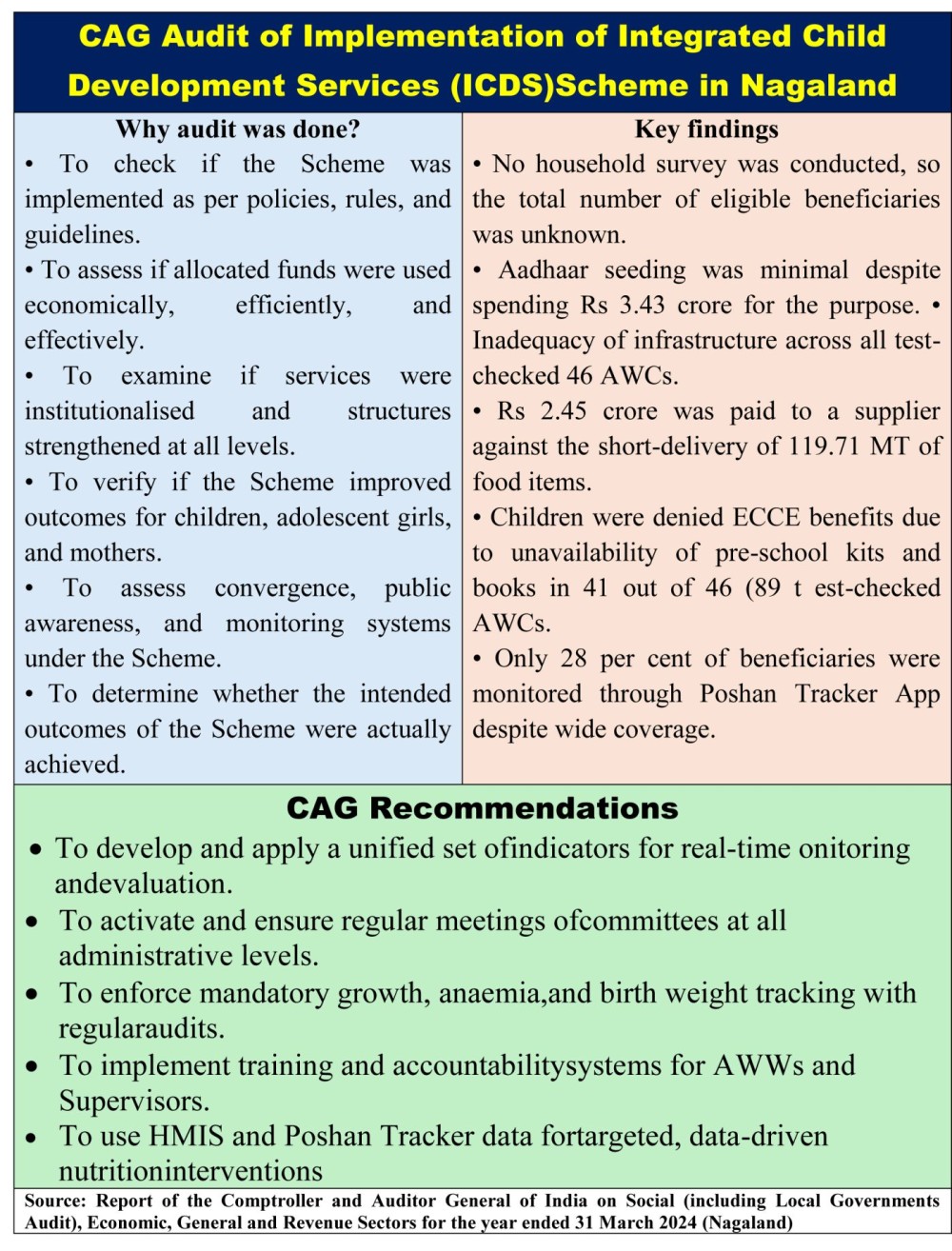
A key finding was that the Social Welfare Department did not know the total number of eligible beneficiaries in the State as no household survey had been conducted.
The Government said in June 2024 that shortcomings identified through a beneficiary survey would be used to improve implementation, but the CAG said the response lacked concrete corrective measures. It pointed to reports of Anganwadi Centres (AWCs) functioning for only two to five days a month, near-total absence of health services, irregular Take-Home Ration distribution and lack of pre-school kits.
Of 3,980 functional AWCs, all 46 test-checked centres lacked one or more prescribed facilities, including the required 600 sq ft space, kitchen, examination room, outdoor activity area, safe storage and sanitary facilities.
The Government acknowledged the infrastructure concerns and cited efforts to identify gaps and convergence with other departments. The CAG, however, said these were general assurances without timelines, responsibilities or an action plan.
Pre-school kits and age-specific books were unavailable in 41 of 46 AWCs (89%). The Government said activity books had been issued periodically but acknowledged that records for 2018-23 could not be traced and procurement for 2023-24 was delayed. The CAG said the claim was unsupported by stock or distribution records.
Supply and inventory lapses
The Department paid Rs 2.45 crore to a supplier despite 119.71 MT of food items being short-delivered to nine test-checked Child Development Project Offices (CDPOs). Although the Government said a review found no discrepancy, the CAG said its finding was based on physical receipt records certified by the nine CDPOs. With no stock registers or acknowledgement receipts establishing full delivery, the short supply remained unaccounted for.
The audit also flagged Rs 2.81 crore spent on medicine kits between 2018 and 2024, citing missing stock registers and untraceable distribution records. The Government said earlier kits had been distributed and exhausted and Rs 1.07 crore sanctioned in 2022-23 was used for fresh kits in 2023-24. The CAG said this could not be substantiated and noted that CDPO certifications of non-receipt during 2020-23 contradicted the Department’s claims. Audit assessed that ineffective utilisation of Rs 2.27 crore contributed to denial of basic healthcare services.
Uniforms and badges worth Rs 1.36 crore were similarly affected by inadequate documentation. None of the nine test-checked CDPOs received supplies during 2021-22 and 2023-24, with no documentary evidence of procurement or dispatch.
Rs 3.43 crore spent, Aadhaar seeding just 14.51%
Despite spending Rs 3.43 crore on Aadhaar seeding, only 14.51% of 5,47,228 ICDS beneficiaries had been seeded. The Government cited COVID-related disruptions, UIDAI training delays and repeated machine/software upgrades. The CAG said the prolonged under-utilisation of infrastructure and absence of contingency measures remained unexplained.
Digital monitoring was also weak, with only 1,13,619 of 4,09,851 beneficiaries (28%) covered through the Poshan Tracker. Poor connectivity, limited digital skills among Anganwadi workers and outdated smartphones were cited by the Government. The CAG said no mitigating or phased strategy had been put in place, weakening real-time monitoring of nutritional status.
Oversight mechanisms ineffective
Although the State Mission Steering Group and State Empowered Programme Committee had been constituted, records of meetings and policy guidance were unavailable.
The State Child Development Society had not been constituted, while there were no documented records of Village Health, Sanitation and Nutrition Committees performing their intended convergence and supervisory roles.
The Government said SCDS formation was under process and VHSNCs were outside the Department’s administrative control. It also said the State Empowered Programme Committee had met only once, in 2013.
The CAG noted that SCDS had been mandated since 2012 and said the single documented meeting, with no evidence of subsequent policy guidance, indicated that key oversight mechanisms were effectively non-functional.
CAG recommendations
The CAG concluded that ICDS implementation suffered from systemic weaknesses in infrastructure, service delivery, convergence, inventory management, financial propriety and accountability, despite substantial Central and State funding.
It recommended unified input, output and outcome indicators; regular committee meetings; mandatory tracking of growth, anaemia and birth weight; stronger training and accountability for Anganwadi workers and supervisors; and greater use of HMIS and Poshan Tracker data to target nutrition interventions.