Moa Jamir
Dimapur | September 27
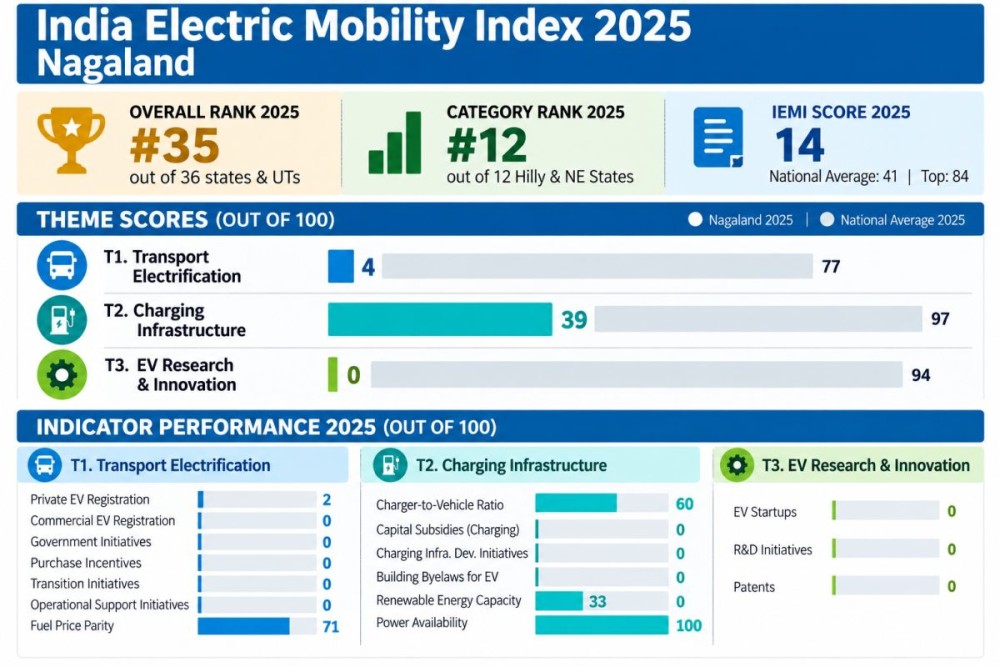
Nagaland has scored 14 out of 100 in the India Electric Mobility Index (IEMI) 2025 (https://www.niti.gov.in/whats-new/india-electric-mobility-index-iemi-2025), ranking 35th among 36 States and Union Territories (UTs) and last among the 12 Hilly and Northeastern States.
The second edition of the IEMI, developed by NITI Aayog in collaboration with World Resources Institute (WRI) India, assesses the progress of States and UTs towards electric mobility during January-December 2025
The Index covers 16 indicators across three broad themes: transport electrification, charging infrastructure and EV research and innovation.
Nagaland's weakest score was EV Research and Innovation Status, scoring Zero while in Transport Electrification Progress, it scored just 4 out of 100, and lingered at bottom among all State and UTs for both.
Incidentally, Nagaland was among four States and UTs that had never had an EV policy by December 2025.
The State scored relatively better in ‘Charging Infrastructure Readiness’ at 39, although this still placed Nagaland in the lower half of the national assessment.
Meanwhile, among the State's overall score of 14 placed it 12th among the 12 Hilly and Northeastern States, behind Sikkim (16), Arunachal Pradesh (21), Mizoram (24), Uttarakhand (26), Himachal Pradesh (28), Jammu & Kashmir (31), Ladakh (32), Meghalaya (32), Assam (35), Tripura (36) and Manipur (46).
The Nagaland profile shows that its Transport Electrification score increased by one point from the previous edition, to 4, while its Charging Infrastructure score fell by 20 points to 39. Its EV Research and Innovation score remained at zero.
At the indicator level, Nagaland scored 2 in private EV registration and zero in commercial EV registration, governance initiatives, purchase incentives, transition initiatives and operational support initiatives. Its relatively stronger indicator was fuel-price parity, at 71.
For charging infrastructure, Nagaland scored 60 for charger-to-vehicle ratio, while capital subsidies, charging-infrastructure development initiatives and building bye-laws for EVs each scored zero.
Its renewable-energy generation capacity indicator scored 33 and power availability 100. In EV research and innovation, EV startups, R&D initiatives and patents all scored zero.
The low score in IEMI is also reflected in the uptake of eclectic cars in VAHAN Dashboard.
As per the VAHAN Dashboard, out of 5,12,434 vehicle registrations in Nagaland, only 128 or just 0.025%are explicitly classified as electric as of September 27, 2026: 77 under ‘Electric (BOV)’ and 51 under ‘Pure EV’.
A further 161 vehicles are classified as ‘Strong Hybrid EV’, while 84 are listed as ‘Diesel/Hybrid’ and 3,372 as ‘Petrol/Hybrid.
Recommendations
The report recommended Nagaland Government to frame and notify an EV policy to enable comprehensive and integrated approach to e-mobility.
It further advocated for considering implementation of appropriate incentives and initiatives to promote electric vehicle adoption, charging infrastructure development and support research and innovation.
On a positive note, the report highlighted the unveiling of a State’s first air-conditioned electric vehicle on World Tourism Day in September in Dimapur.
Nationally, Delhi topped the index with 84, followed by Maharashtra (78) and Karnataka (73). The three were also among the five jurisdictions classified as Top Performers, alongside Chandigarh (71) and Goa (65).
The overall IEMI scores ranged from 84 to 10, with the national median rising from 36 in 2024 to 40 in 2025
What is the India Electric Mobility Index?
The India Electric Mobility Index (IEMI), developed by NITI Aayog and WRI India measures States and UTs on their progress towards electric mobility.
3 themes and16 indicators:
• Transport Electrification Progress (50%): EV adoption, policies and incentives etc
• Charging Infrastructure Readiness (30%): charging network, subsidies, power and renewable capacity etc
• EV Research & Innovation (20%): Startups, R&D and patents
Scorecard:
• Top Performers (65+),
• Frontrunners (50–64),
• Emerging Performers (35–49)
• Aspirants (<35).
Top three: Delhi (84), Maharashtra (78), Karnataka (73)
Bottom three: Andaman & Nicobar Islands (15), Nagaland (14), Dadra & Nagar Haveli and Daman & Diu (10)