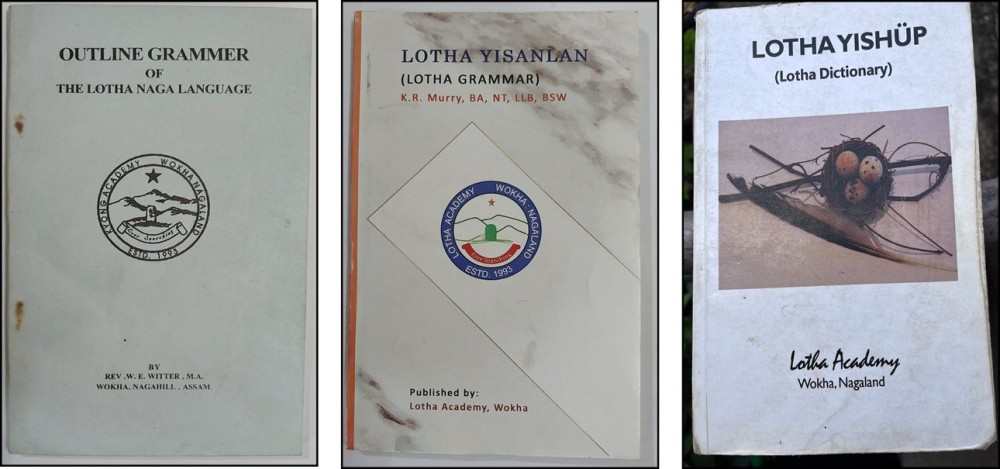
Lotha language textbooks mark a growing academic footprint, yet the gap between institutional learning and living language remains. (Morung Photo)
‘A language cannot survive only through occasional celebrations’
Meribeni T Kikon
Wokha | March 30
The Lotha Naga language continues to remain a powerful emblem of identity for its community. However, as its everyday use declines among younger generations and in urban households, a critical question has emerged, ‘Is the language being practiced as much as it is celebrated?’ Conversations with representatives from the Lotha Academy and educators in Wokha reveal that while awareness about preserving the language is growing, challenges remain in ensuring its consistent use in everyday life, particularly among younger generations.
Gains ground in education system
According to Dr N Janbemo Humtsoe, Vice President of Lotha Academy, the Lotha language remains widely spoken, particularly in Wokha district, where it continues to serve as the dominant mode of communication.
“Like many indigenous languages, Lotha faces pressure from the dominance of major languages such as English, Hindi, and Nagamese,” he observed. “However, we are also witnessing renewed efforts within the community to learn and speak the language with pride.”
Institutionally, the language has gained academic ground over the years. Lotha is currently taught as a subject up to Class 12 in schools. Additionally, from the current academic session, it has been introduced as a Modern Indian Language (MIL) in several colleges, including Mt Tiyi College and Bailey Baptist College in Wokha, as well as Unity College in Dimapur.
Dr Humtsoe expressed optimism about the language’s future, noting that growing awareness of cultural identity and literature could strengthen proficiency in both spoken and written Lotha over time.
The daily disconnect
Despite widespread public support for preserving the language, its daily use, especially within families living outside Wokha, has gradually declined. Many households, particularly those in urban areas or with cross-cultural marriages, rely more on English or Nagamese for daily communication.
Dr Humtsoe acknowledged this gap between cultural advocacy and everyday practice but emphasized that such challenges are not unique to the Lotha community.
“In the past, the use of English, Hindi or Nagamese was often associated with education, employment and sometimes even social status,” he explained. “Today, however, there is a growing realization that language is deeply connected to identity, culture and heritage.”
He cited instances where families living in towns have taken conscious steps to revive language use at home. In one example, a family invited a relative from their native village to stay with them partly to help teach their children the Lotha language.
Another significant factor affecting language transmission is digital exposure. With children increasingly spending time watching online content, most of which is in English or Hindi, the opportunity to hear and practice their mother tongue has reduced.
“Natural language learning happens during early childhood,” Dr Humtsoe said. “Parents must consciously create an environment where children regularly hear and speak Lotha at home before digital content becomes their primary exposure.”
Educators also observe a growing pattern among students: many understand Lotha but lack confidence in speaking it fluently.
Dr Humtsoe attributes this largely to limited exposure. “Proficiency in any language depends on regular use. Without frequent conversation, confidence naturally declines,” he explained, adding that consistent use within families is crucial for strengthening the language.
The real hurdle for learners
Mhonyamo Lotha, a Lotha teacher at Fernbrook School in Wokha, noted that while most students show interest in the subject, they often find it easier to speak the language than to read and write it.
“One of the difficulties is the complexity of Lotha pronunciation,” Yanthan said. “Students are also influenced by English, Hindi and other languages used in their daily conversations.”
Code-mixing with English is common both in speaking and writing. To address this, teachers often translate unfamiliar words and encourage students to understand and use their Lotha equivalents.
Yanthan also pointed out that students sometimes perceive the language as just another school subject rather than as an integral part of their identity. The perception that Lotha offers limited career opportunities can further reduce motivation among learners.
“This perception leads to a lack of interest in the learning process,” the teacher said.
Developing academic resources
Despite these challenges, efforts are ongoing to strengthen the academic foundation of the language.
The Lotha Academy has invested considerable effort in developing textbooks and reading materials. One of its major milestones was the publication of the Lotha Yishüp (dictionary) in 2018 under the initiative of its President, Fr Abraham Lotha. Work is currently underway to prepare a second edition.
At the same time, the Lotha Literature Committee is working toward revising and standardizing textbooks, while also conducting a Lotha Proficiency Test for teachers who wish to teach the subject at secondary and higher secondary levels. With the introduction of Lotha at the undergraduate level, similar proficiency examinations will be extended to higher academic levels.
However, some linguistic challenges remain. While there is only one Lotha language spoken across the region, variations in tone, accent, pronunciation and spelling between villages sometimes complicate standardization efforts.
Beyond cultural performances
Cultural programmes, literary competitions and festivals remain an important part of language promotion. These events help create awareness and encourage pride in cultural heritage.
Yet both scholars and educators emphasize that such programmes alone cannot ensure the survival of a language.
“In today’s digital age, many of these events are recorded and shared online, helping Lothas across the world reconnect with their heritage,” Dr Humtsoe noted. “But a language cannot survive only through occasional celebrations.”
Ultimately, he stressed, the responsibility rests with the community itself. “The role of organizations such as the Lotha Hoho, Lotha Eloe Hoho and the Lotha Academy is to create awareness. But speaking, learning and preserving the language is the responsibility of the people.”
Despite the challenges from digital influence to limited academic pathways, there remains cautious optimism about the future of the Lotha language.
“It is not disappearing overnight,” Dr Humtsoe said. “The language is still widely spoken, and awareness about its importance continues to grow.” For teachers like Yanthan, hope lies in gradual progress. “It is slowly leading to the development of the Lotha language,” the teacher said.
Whether that development translates into stronger everyday usage will depend largely on what happens beyond classrooms and cultural stages inside homes, conversations and the daily lives of the next generation.