68 paise of every rupee comes from the Centre; over 80 paise spent on salaries, pensions and debt
Moa Jamir
Dimapur | March 27
With about 68 paise of every rupee estimated to be coming from central transfers and over 80 paise of spending tied to salaries, pensions and debt, Nagaland State Budget 2026–27 presented in the 8th Session of the 14th Nagaland Legislative Assembly on March 26, raises pressing questions on sustainability amid post–Finance Commission shifts.
A closer reading of the budget numbers reveals a structural imbalance, even as Nagaland Chief Minister Dr Neiphiu Rio, who is Minister-in-Charge of Finance, indicated after presenting the 2026–27 State Budget, that its full impact hinges on fulfillment of assurances from the Union.
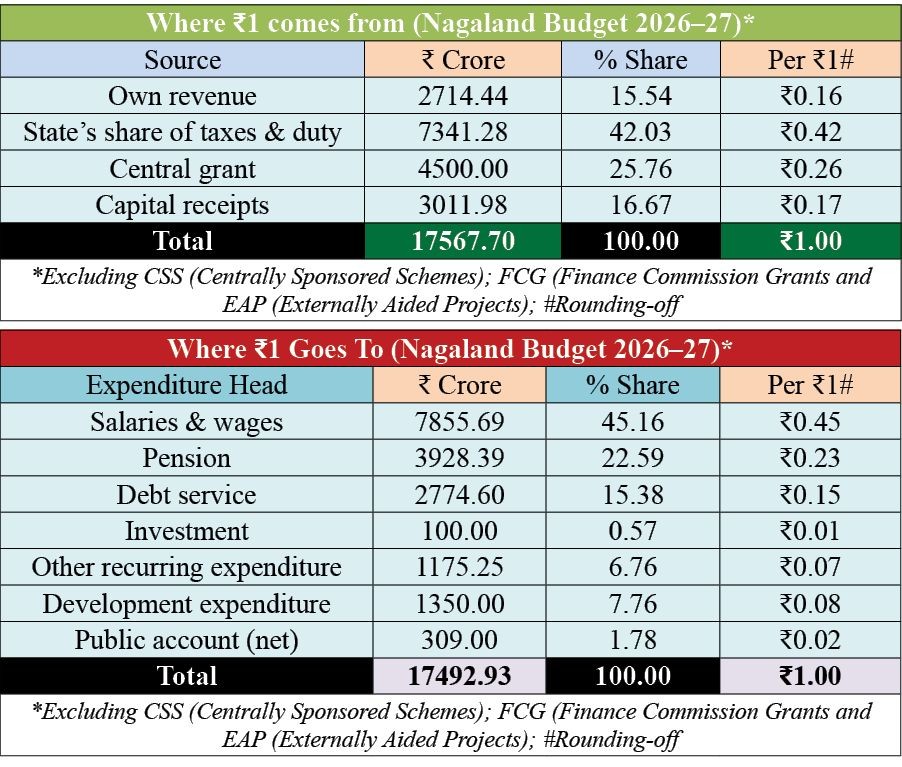
Where a rupee comes and goes
Data presented at the Kohima presser following the budget laid bare the scale of the challenge, perhaps, deliberately framed to situate the State’s position within a broader national context, including the Centre.
On the receipts side 0.42 paise of every rupee comes from the State’s share of Central taxes, and 0.26p from Central grants.
The State’s own revenue contributes only Rs 0.16 while borrowings and other capital receipts account for the remaining Rs 0.17. The outlook is excluding Centrally Sponsored Fund (CSS), Finance Commission grants and externally aided projects (EAP).
Taken together, this means nearly 68p of every rupee originates outside the State, underlining a continued dependence on central inflows even before accounting for CSS and EAPs.
Meanwhile, on the expenditure side, the pattern is even more rigid. 0.45p of every rupee is spent in Nagaland goes to salaries and wages while pensions, debt servicing take up 0.23p on 0.15p respectively.
Together, these committed expenditures consume more than four-fifths of total spending.
This leaves mere 0.08p of every rupee for development expenditure, and 0.01p for investment.
In absolute terms, the State has earmarked Rs 1,350 crore for development expenditure (State programme) for 2026–27, marking an increase from the previous year.
However, as a share of total spending, development outlay remains modest, reflecting the limited fiscal space available after meeting committed obligations.
The budget, presented by CM Rio, comes against what he described as “two fiscal shocks” following the 16th Finance Commission: the discontinuation of Revenue Deficit Grants (RDG) for 2026–31 and a reduction in share of Central taxes.
To manage the transition, the State has proceeded with a full budget in anticipation of at least Rs 4,500 crore in grants in lieu of RDG, following what CM Rio termed a “clear and reassuring concurrence” from the Union Finance Minister.
Fiscal shocks raise hard questions
However, if the anticipated Rs 4,500 crore does not materialise amid reduction of Nagaland’s share of Central taxes, where will the State bridge the gap?
The question of meeting committed expenditure: salaries, pensions and the like, let alone addressing developmental needs, looms large.
With its own revenue at just Rs 2,714.44 crore (about Rs 0.16 of every rupee), the scope appears limited.
The pressure is sharper on the spending side. Over Rs 14,500 crore or more than 80p of every rupee locked into salaries (Rs 7,855.69 crore), pensions (Rs 3,928.39 crore) and debt servicing (Rs 2,774.60 crore), leaving just Rs 1,350 crore for development.
While the budget emphasises improving revenue mobilisation and ensuring that “every rupee of public expenditure produces measurable social and economic impact,” the arithmetic points to constrained space.
In essence, the Nagaland Budget 2026–27 rests on a precarious, high-stakes fiscal gamble, contingent on an estimated Rs 4,500 crore in additional central support to remain viable. Devoid of this, the flight of “Developed Nagaland@2047” risks being clipped before it can even take off.
Regardless, the picture is clear: while a credible alternative was absent within the budget, the State must urgently diversify and strengthen its own revenue base.