.jpg)
Morung Express News
Dimapur | January 10
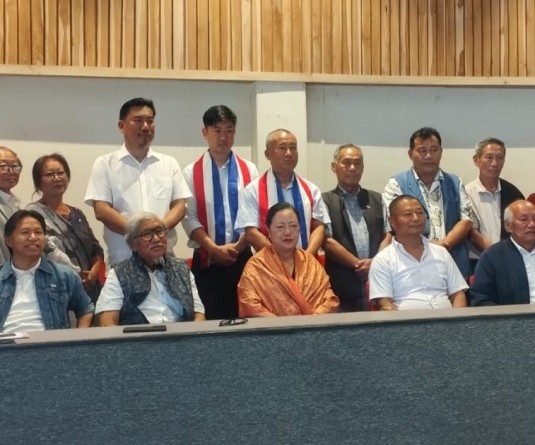
The District Congress Committee (DCC), Dimapur, launched the MGNREGA Bachao Sangram (Save MGNREGA Movement) in the district on January 10. Launched by the opposition Congress party, the nation-wide agitation is against the NDA government’s repealing of the Mahatma Gandhi National Rural Employment Guarantee Act (MGNREGA), and replacing it with the Viksit Bharat—Guarantee for Rozgar and Ajeevika Mission Gramin.
The MGNREGA was enacted by the Dr Manmohan Singh-led UPA government in 2005 guaranteeing rural employment across the country.
Addressing a press conference, DCC President, Kutoho Chishi held that the NDA government’s new employment guarantee scheme will come at the cost of reduced funding, limited job guarantee, and by extension, exclude vulnerable sections of society. Demanding that the MGNREGA be restored, Chishi described MGNREGA as a lifeline for millions of rural households across India, citing its role in providing wage guarantees and poverty alleviation.
While stating that the new legislation would dismantle the core principle of employment guarantee, he demanded that the NDA government reconsider the legislation and engage in dialogue with stakeholders.
According to him, the DCC has chalked out a series of peaceful protests in the district over the course of the 45-day agitation, which will include outreach activities at the ward levels, culminating in a district-level “dharna” scheduled from January 31 to February 6, 2026.
DCC General Secretary, Kumjimong said that the new scheme fundamentally alters the scheme's democratic characteristics by centralising implementation. Under the new framework, he said that decision-making regarding project location and type would rest exclusively with Delhi, bypassing the village councils.
As opposed to the MGNREGA, the new scheme proposes sharing of costs between the Centre and states in the ratio of 60:40 for the bigger and more prosperous states, and 90:10 for the North-eastern and the Himalayan states. Kumjimong expressed doubt regarding the state government’s ability to meet its side of the bargain, citing past difficulties in adhering to funding patterns for other schemes.
He further questioned the perceived political intent behind the branding of the new scheme, and the disregarding of Mahatma Gandhi. “I wonder why BJP hate Mahatma Gandhi so much,” he said, while making a reference to the new scheme’s conspicuous acronym: VB—G RAM G. He held that the stylised acronym is a deliberate attempt by the BJP-led NDA to appease voters from one particular religion.
DCC General Secretary (Media), Andrew Humtsoe noted that Gram Panchayats, village councils in Nagaland’s case, would lose the ability to select local projects. He added that the provisions in the new scheme would restrict work availability during harvest seasons and allow arbitrary setting of wages. He also criticised the shift in financial responsibility, stating that requiring hilly states to cover 10 percent of wages could lead to a reduction in work provided to save costs.