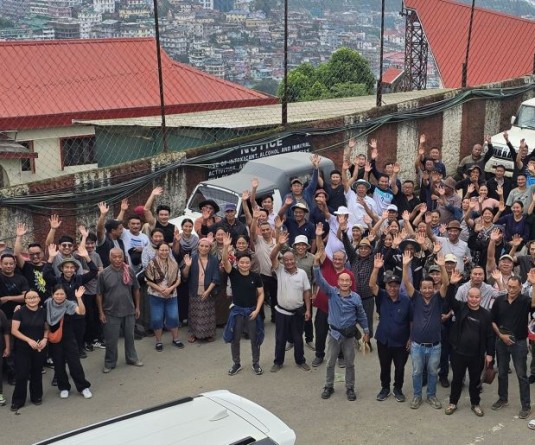
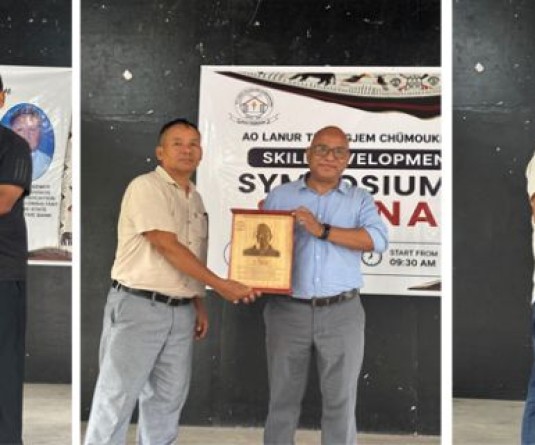
Panelists during the Nagaland Climate Action Forum 2026 on the theme ‘From Heat to Action: Rethinking Urban Resilience in Dimapur,’ held at Hotel Saramati, Dimapur on January 21. (Morung Photo)

‘Nagaland Climate Action Forum 2026’ rethinks urban resilience
Morung Express News
Dimapur | January 21
A Working White Paper titled ‘From Heat to Action: Rethinking Urban Resilience in Dimapur’ was released on January 21 at the Nagaland Climate Action Forum (NCAF) 2026, held at Hotel Saramati, Dimapur, in the presence of district officials, municipal authorities, civil society groups and concerned citizens.
The forum was organised by the Dimapur Municipal Council (DMC) in collaboration with the district administration, Earth Alliance Nagaland, the National Clean Air Programme and the National Youth Climate Consortium (NYCC), with support from community partners including Team Better Dimapur, SEWA, Pro Rural and Can Youth.
Presenting the paper, Boka K Rochill, Policy Analyst and NYCC Fellow, said Dimapur is at a critical inflection point, with rapid urbanisation, unplanned growth and shrinking green cover intersecting with rising temperatures to create a systemic urban heat risk.
“Urban heat stress is no longer a peripheral environmental issue,” Rochill said. “It directly affects public health, informal livelihoods, urban liveability and infrastructure resilience.” The white paper draws on the Greening Dimapur Project, using satellite-based land surface temperature and land-use data.
Between 2000 and 2020, the city’s population nearly tripled, sprawl accelerated after 2007, built-up areas expanded to nearly 40%, and over five square kilometres of vegetation were lost. Cropland disappeared, and open areas were steadily converted to settlements, turning summer surface temperatures up by more than 4.5°C and creating new urban heat hotspots in dense commercial zones, transport corridors and peri-urban areas.
The study also notes a sharp ‘urban heat island effect’ where nearly half of the city faced little heat stress in 2000, but by 2020 over one-third of Dimapur had shifted into strong to very strong heat zones. Hotspots are spreading beyond the city core as built-up land replaces green cover, particularly in fast-growing fringe areas.

According to the report, urban heat acts as a risk multiplier, worsening air pollution exposure, increasing flood vulnerability due to reduced surface permeability, and driving peak electricity demand, straining already limited infrastructure.
Despite mounting evidence, urban heat remains poorly recognised in disaster management and planning frameworks. He highlighted that current systems focus on sudden hazards, leaving long-term heat and climate risks largely unaddressed.
To address this, the paper lays out priority policy measures. A key recommendation was the formal recognition of urban heat stress as a district/state-specific disaster under the Nagaland State Disaster Management Authority (NSDMA), enabling use of the State Disaster Mitigation Fund to support Heat Action Plan measures within a broader Climate Action Plan for Dimapur.
The report also calls for heat-responsive Development Control Regulations in the Dimapur Master Plan, particularly for rapidly urbanising peri-urban areas where future exposure is increasing.
The Greening Dimapur Project is proposed as a practical, district-level climate resilience framework, enabling coordinated action across disaster management, urban development, public health and community actors.
Rochill stressed that investments in cooling, green infrastructure and worker protection are preventive public measures. “Investing today can reduce future health costs, productivity losses and infrastructure strain,” he said.
The white paper, he added, marks an important step in reframing urban heat as a core governance and development challenge, putting Dimapur on a more climate-resilient urban pathway.
The paper was released in the presence of Tarachu Fithu, Director, Urban Development, GoN; Thungchanbemo Tungoe, CEO, DMC; LH Thangi Mannen, Director, Earth Alliance Nagaland; Imlijungla Lemtur, EAC Dimapur; Dr Pangjung Pongen, UNICEF India, Inaka Awomi, NSDMA; Temjenlemla, State Project Coordinator, SEWA Nagaland and author of the paper, Boka K Rochill.
Following the release, a multi-stakeholder dialogue was held on the theme ‘From Heat to Action: Rethinking Urban Resilience in Dimapur.’
Panelists discussed the multiple challenges facing Dimapur’s urban planning and governance, highlighting issues such as unregulated construction, the filling of natural ponds, encroachments, and garbage dumping in drains, which together exacerbate flooding and stagnation.
They noted that while other cities face similar pressures, Dimapur is likely to be most affected in the years ahead. The need for policy support, community participation, and the urgency to formulate and implement by-laws were addressed. Panelists called for a long-term, inclusive approach to urban management, while welcoming youth engagement as a vital first step toward sustainable solutions.