Source: Annual Administrative Report 2025–26, Excise & Prohibition Department, Nagaland.
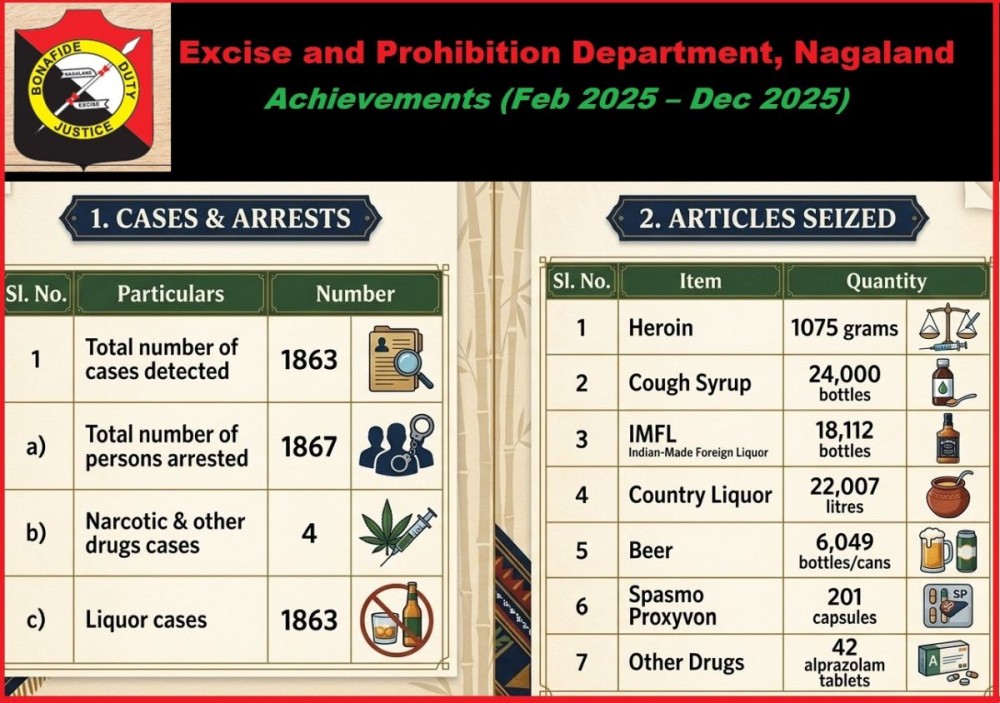
Excise Dept intercepts 18,112 IMFL bottles, 22,007 litres country liquor, 6,049 beer units
Morung Express News
Dimapur | March 18
Despite over three decades of prohibition, Nagaland continues to see large-scale liquor flow, with over 46,000 alcohol units seized in 2025 as well as accounting for nearly all enforcement activity.
The Department’s revenue also depicted a ‘rebound’ in recent years with collection reaching nearly pre-prohibition level in 2024-25.
As per the Annual Administrative Report 2025–26 of the Excise & Prohibition Department, a total of 18,112 bottles of IMFL (Indian Made Foreign Liquor), 22,007 litres of country liquor, and 6,049 bottles/cans of beer were seized across Nagaland between February and December 2025.
Further, the department reported seizure of 24,000 bottles of cough syrup, 1,075 grams of heroin, 201 Spasmo Proxyvon capsules, and 42 alprazolam tablets during the same period.
Meanwhile, liquor-related offences accounted for nearly all enforcement activity, with 1,863 cases and 1,867 arrests reported. Notably, the same total of 1,863 is also attributed to liquor cases, even as four narcotic-related cases are recorded, indicating a possible tabulation inconsistency or overlap.
The department also carried out destruction of seized items at two locations in 2025.
At Zonal Kohima, 8111 IMFL and 9,400 beer units along with 9,000 bottles of codeine-based cough syrup, and 3.8 kg of heroin were destroyed on April 29.
Earlier, on April 17, 1,340 IMFL and 90 bottles of beer as well as 3,966 litres of country liquor were destroyed in Mokokchung,
Revenue trend: From collapse to resurgence
Meanwhile, the report noted that since the introduction of the Nagaland Liquor Total Prohibition (NLTP) Act, 1989, the department’s revenue earnings declined sharply. However, data from 1987–88 to 2024–25 indicates a recent resurgence.
Prior to the NLTP Act, excise earnings were at their peak, reaching Rs 584.37 lakh in 1987–88 and Rs 550.90 lakh in 1988–89. Following the enforcement of prohibition in April 1990, revenue fell sharply to Rs 110.09 lakh in 1989–90, representing an approximate 80% decline from the previous year, and further to Rs 82.32 lakh in 1990–91, the lowest point in the dataset.
Through the 1990s, revenue remained subdued, with a gradual recovery evident from the early 2000s, albeit with fluctuations. Earnings rose from Rs 176.33 lakh in 2000–01 to around Rs 333.08 lakh in 2008–09, before declining to Rs 255.51 lakh in 2011–12.
Revenue then surged to Rs 400 lakh in 2012–13 and averaged around Rs 427 lakh annually until 2016–17, before declining to Rs 247.01 lakh in 2020–21 during the COVID-19 pandemic.
Since then, revenue has shown a consistent upward trend, reaching Rs 517.65 lakh in 2024–25—a sharp 109% increase over four years, bringing it close to pre-prohibition levels.
For the current financial year 2025–26, revenue receipts from April to December 2025 stood at Rs 372.79 lakh, against a target of Rs 530 lakh, the report stated.
This includes collections from compounding of cases under Section 76 of the NLTP Act, 1989.
Department’s mandate and profile
Established on December 1, 1963, the Excise & Prohibition Department is among the oldest departments in Nagaland. It enforces the Nagaland Excise Act, 1967, the Narcotic Drugs and Psychotropic Substances (NDPS) Act, 1985, and the Nagaland Liquor Total Prohibition (NLTP) Act, 1989 along with its 1990 Rules.
With the introduction of prohibition, the department’s role has shifted significantly from a regulatory and revenue-oriented function to enforcement, the report noted.
Its primary responsibilities now include preventing and controlling the possession, sale, manufacture, transport, and smuggling of liquor and narcotic substances in the state, it added.
The department also regulates the supply of liquor to defence and paramilitary personnel through the Canteen Stores Depot and bonded warehouses in Dimapur, while overseeing controlled substances such as opium (for registered users), denatured spirit, and molasses.
It coordinates with central agencies, including the Narcotics Control Bureau (NCB) and the Central Bureau of Narcotics.
Currently, the department’s revenue is derived mainly from restricted liquor supply channels and fines imposed on offenders.
Meanwhile, despite its long institutional presence, the department continues to face logistical and workforce constraints, an issue it had been frequently highlighted in recent years.
As per the report, the Excise department has a total strength of 383 personnel, including 127 under the Directorate, with only 34 in the mobile squad and 28 in the Narcotic Cell, alongside 256 personnel in district establishments.
The department is headed by the Chief Minister, supported by the Advisor for Excise, the Secretary to the Government, and the Commissioner of Excise.