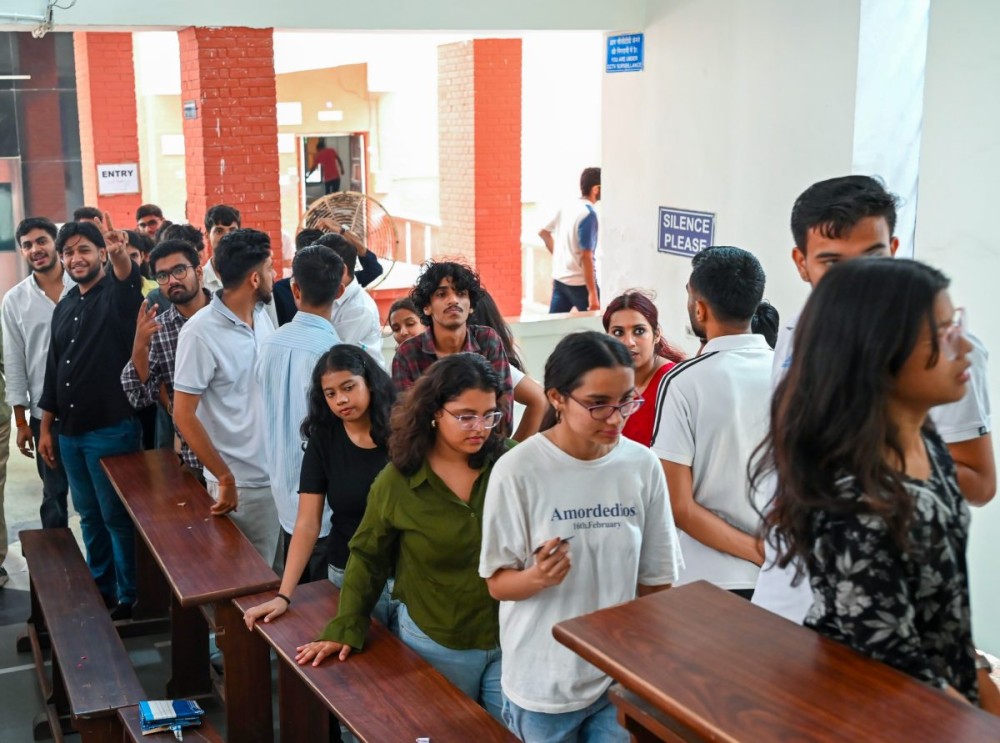
New Delhi: Students stand in a queue to cast their votes during the Delhi University Students’ Union (DUSU) election at Miranda House and Kirori Mal College in Delhi University's North Campus on Friday, September 18, 2026. Vote counting is scheduled for September 19. (Photo: IANS/Wasim Sarvar)
New Delhi, September 21 (IANS) The recent ABVP’s sweep in DUSU elections has shown that students of the premier university have no trust in Congress leader Rahul Gandhi, as his party’s student outfit NSUI failed to win even a single seat out of the four in the central panel and recorded a sharp drop in vote share as compared to last year, said a study released on Monday.
The study titled “Delhi University Student Union Election Comparative Study 2023 to 2026” said that the sharp decline in National Students’ Union of India’s (NSUI) vote share indicates “that the Congress ecosystem has struggled to maintain lasting influence among Delhi's student population”.
“Within two years, NSUI’s vote share declined sharply from 35.79 per cent to 23.39 per cent... After winning two seats and the presidency in 2024, it suffered a complete washout in 2026, failing to secure even a single central-panel seat,” it said.
The study conducted by Dr Syama Prasad Mookerjee Research Foundation compared the central panel performance, voter trends, alliances and external impacts on DUSU election outcomes from 2023 to 2026.
The study also offered a word of caution for the victorious RSS and BJP-backed Akhil Bharatiya Vidyarthi Parishad, which beat NSUI on three out of four DUSU posts.
It said that the ABVP needs to introspect over the drop in its vote share by about 6.88 per cent - from 39.66 per cent in 2025 to 32.78 per cent in 2026.
“Even though the Left-Congress ecosystem clearly lacks trust, the ABVP's vote share fell… in 2026. Despite continuing to win the majority of seats, this decline should not be dismissed,” it said.
“It indicates that while most DU students remain loyal to the nationalist, India-first ideology, the erosion is real and points to a growing space for independents and other groups. The ABVP should actively address this trend rather than ignoring it,” said the study.
While comparing the election results and voting patterns, the study also pointed to a total rejection of Aam Aadmi Party National Convenor Arvind Kejriwal and his party’s student outfit Association of Students for Alternative Politics (ASAP).
“After rebranding as ASAP and entering the electoral arena in 2026, AAP's student wing, Chhatra Yuva Sangharsh Samiti (CYSS), returned to campus politics after staying away from elections through 2024. Its delayed and rebranded debut suggests an attempt to reinvent its campus identity in order to regain relevance and secure a place on the ballot,” said the study.