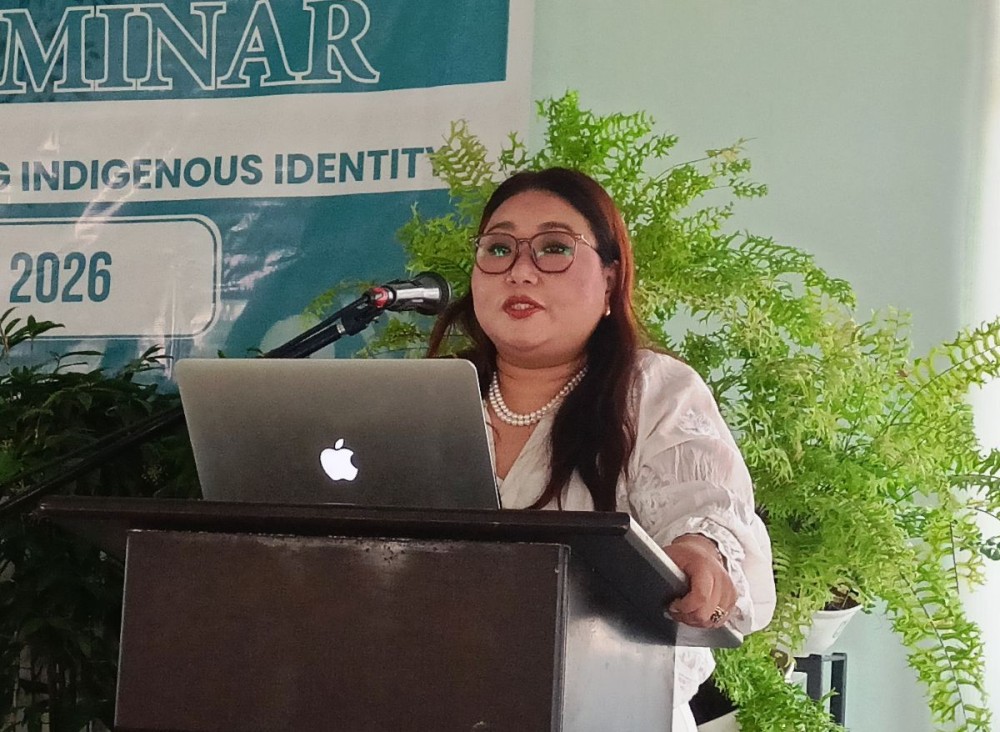
Prof Dr Kaholi Zhimomi presenting a paper titled ‘Eating Empire: Food, Christian Missions, and the Decolonial Turn in the Material Historiography of the Naga Indigenous People in Northeast India’ during the National Seminar at Trinity Theological College, Thahekhü, on February 6. (Morung Photo)
Morung Express News
Dimapur | February 6
Food is not merely about taste or sustenance but a critical site of colonial domination, missionary regulation and indigenous resistance, Prof Dr Kaholi Zhimomi asserted during her paper presentation at the National Seminar on ‘Decolonising Knowledge: Reclaiming Indigenous Identity’ held at Trinity Theological College, Thahekhü, on February 6.
Presenting her paper titled ‘Eating Empire: Food, Christian Missions, and the Decolonial Turn in the Material Historiography of the Naga Indigenous People in Northeast India,’ Prof Zhimomi examined how colonial Christianity reshaped Naga material worlds, particularly food practices, bodily discipline, ritual life, and everyday social relations.
Speaking as an Indigenous student of history, she described her engagement with the missionary past of Northeast India as shaped by both pride and critical reflection. While Nagas are often celebrated for having one of the world’s largest Baptist populations, she said this reality demands deeper interrogation of the historical and ideological contexts through which Christianity was introduced.
Prof Zhimomi, Dean of the Division of Graduate Studies at United Theological College, Bangalore, noted that Christianity functioned not only as a religion but as a ‘material regime’ that reordered everyday life.
Food as material site of ‘othering’
Drawing on Edward Said’s theory of ‘othering,’ Prof. Zhimomi argued that colonial regimes constructed cultural hierarchies through material practices. Indigenous foods, bodies, and domestic spaces were framed through binaries such as civilised/uncivilised, clean/unclean, and regulated/excessive.
Missionaries, she noted, did not operate only at the level of theology but through the regulation of everyday life—reshaping dress, hygiene, education, sexuality, and diet. Indigenous food habits were frequently labelled morally suspect or spiritually deficient.
Within missionary discourse, Naga food practices, including fermented foods and rice beer were often marked as primitive. Strongly pungent and fermented items such as axone (fermented soybean), anishi (fermented yam leaves), bamboo shoots, and sukamass, alongside meat-based diets that included smoked pork, fermented pork, beef, dog meat, snakes, ants, and spiders, were framed as culturally and morally inferior.
Such representations, she argued, embedded Eurocentrism into “the intimate textures of everyday life,” legitimising colonial authority while positioning Western norms as universal standards of civility.
Prof Zhimomi highlighted how missionary interventions extended deep into domestic and communal spheres. Foodways, burial rites, ritual feasts, and exchange systems were regulated or discouraged, often recast as superstition or moral excess.
Rice beer, for instance, held deep social significance in pre-Christian Naga societies signifying hospitality, ritual participation, and community bonding. Yet missionary interpretations reframed its consumption as immoral, promoting abstinence and replacing indigenous moral frameworks with Christian codes of bodily discipline.
Missionary writings describing Nagas as ‘animistic’ or ‘superstitious’ illustrated how indigenous lifeworlds were constructed as primitive and in need of reform. Participation in traditional feasts sometimes led to church sanctions, demonstrating how conversion frequently required distancing from indigenous ritual economies and communal practices.
While critical of colonial impositions, Prof Zhimomi emphasised indigenous agency and negotiation. Drawing on her ethnographic work on Christian culture among the Aos, Lothas, and Sumis, she noted that Christianity today occupies a distinctive and deeply embedded position within Naga social life.
Missionary activity, she observed, was instrumental in laying the foundations of formal education in Nagaland, particularly among the Aos, Angamis, Lothas, and Sumis through Christian educational models that extended beyond literacy to moral instruction, sacramental theology, and structured congregational life.
At the same time, the introduction of Christianity generated complex religious and social tensions. Many indigenous rituals and ceremonial practices were reduced to ‘unorthodoxy,’ even as some were absorbed into Christian life with new meanings.
Material practices especially the preparation, consumption, and regulation of food functioned as key instruments for disciplining taste, appetite, purity, and moral conduct within colonial Christian contexts. Among these communities, such transformations contributed to the fragmentation of certain indigenous cultural practices, effects that continue to shape contemporary life.
Yet, she stressed, indigenous Christians cannot simply reject Christianity nor wholly submit to its institutional structures. Christianity has become deeply entangled with Naga cultural worlds, requiring ongoing reworking from within indigenous traditions.
In a theological turn, Prof Zhimomi drew on Ched Myers’ reading of the Gospel of Mark to argue that food and table fellowship have long functioned as sites of social power.
Jesus’ act of eating with the ‘unclean,’ she explained, disrupted purity codes and exclusionary hierarchies. Table fellowship in many indigenous societies likewise signifies hospitality, solidarity, and communal ethics making food a material arena where social boundaries are negotiated or challenged.
Toward ‘decolonial material historiography’
Prof Zhimomi concluded by calling for a ‘decolonial material historiography’ that centres everyday practices such as food preparation, feasting, land relations, festivals, exchange systems and agricultural cycles as sources of knowledge.
Decoloniality, she stressed, demands more than the inclusion of Indigenous voices; it requires recognising Indigenous material practices as epistemologies in their own right. Such an approach, she said, helps recover histories embedded in lived experience and trace how Christianity was remembered, contested, and transformed within Naga societies.