

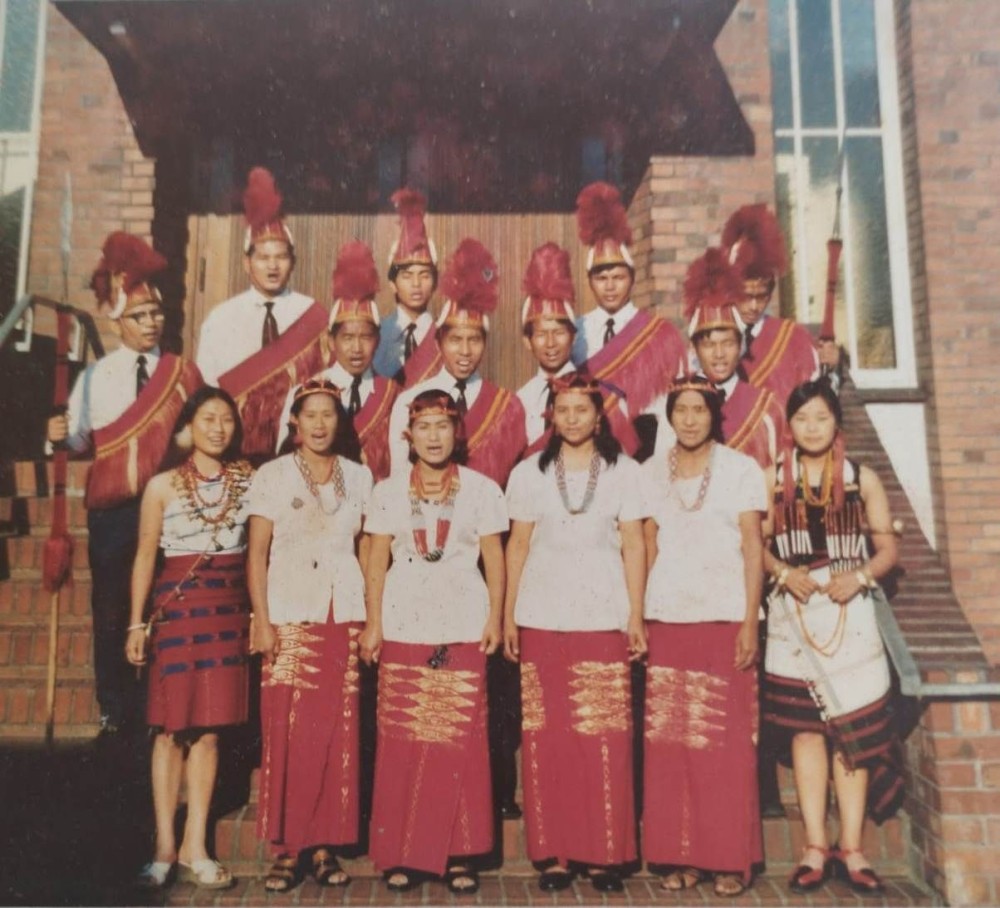
(In memory of Dr Kiremwati Ao, who passed away on 12th February 2026, and also in remembrance of the other choir members who have gone to be with the Lord before him. After 50 years, 7 are alive out of 16)
N Khoto Zetsuvi
Today, choirs from Nagaland go abroad frequently. Even won World Choir competitions. However, the introduction of western music among the Nagas is quite recent. The choir that sang ‘Hallelujah Chorus’ at “All Naga Covention” in 19281 could be the first choir to sing such choir piece. That choir has very distinguished members: A.Z. Phizo, A. Kevichüsa, Keviyabi, Zopianga, Benjamin, Zakietsolie, Pfeno, Dzüvino, Dzobvüno, Rüsokhrieno, Disolhouü, Kezevino, Genuo, Kethonuo, Martha. The first Naga to play the piano was, believed to be, Pfeno Sakhrie. She could play the piano and sing along with it. It was in the 1930’s. Missionary Rev GW Supplee introduced the first Naga Band, Kohima Mission Band in 19342. The first Naga Choir to tour India was in 19543 (That was after the missionaries left). Dr I Ben Wati, General Secretary, Evangelical Fellowship of India invited the Naga choir to tour India. A Naga Choir consisting of 21 members attended EFI convention at Nagpur and went on visiting 10 cities in one month. The team leader was Rev Megosieso Savino and the choir conductor was Kenneth Kerhüo.
It was in 1975, our principal Kiremwati Ao extended the invitation to me to join a choir that was scheduled to visit Scandinavian countries. It was a pleasant surprise. I was included in a 16-member choir. The choir was invited and sponsored by Kronoberg Missions, Sweden. This was the first Naga choir that went abroad. Just before the day we were to leave, I was told to carry traditional dresses. I went back to my village and picked up an old headgear and some other items. The journey started on 7/6/75 and our plane landed at Frankfurt, Germany that day.
As soon as we arrived at Germany, we were taken to Celle and there our songs were recorded and some photos taken. The disc records were on sale as we moved from city to city. From Celle to Hamburg where we were taken out for a sightseeing trip, and also visited the Concentration Camp of Beisen. Our bus was carried from Germany to Denmark through the strait between the two countries by ferry. We stayed overnight at Copenhagen at a Youth Centre and moved on to Malmo, Sweden the next day. From there the journey was mainly in Sweden. We were taken to various cities by bus. We went up to the northern most part of Sweden where we saw the sun set and come up again before darkness could set in. We sang at churches, conventions, open-air meetings, camping sites, jail, old age homes, and street corners as well. Some of the main events were: Singing at a Pentecostal Convention, at TV programmes which covered Sweden and Norway, at the 13th Baptist World Congress where we participated in a grand Music Concert and also sang at City of Stockholm Informal Party for 2000 Congress members. In an open-air programme, we were at the side of the stage, wearing our traditional dresses. Billy Graham was seated on the stage and he winked at us, acknowledging that he noticed us. We also met him at the lounge of his hotel and gave him a present. Three years earlier he was in Kohima at Billy Graham Kohima Crusade.
Our theme song was a song challenging ourselves, “Oh Nagaland, Oh Nagaland. How beautiful. Go and proclaim today…” The traditional song we often sang was a Lotha song, “Pemphia vana”. Traditional dances were presented by some members of the group. The other songs were hymns and choir pieces. Rev Bengt Jonsson reported that we sang 90 times in 40 days and traveled 8585 kms by bus.
At different cities, members were divided to stay at different family homes. They ate potatoes in lieu of rice. We missed rice, and whenever we would meet again, members would try to make other fellows jealous, for fun, saying that their host served them rice. Having reindeer meat while going on the ferry was something to remember. In one of the northern most part of the country we visited, a dinner was thrown in our honour by the city municipal, they served us watermelon imported from India. Once I was hosted by an elderly couple, the wife was a nurse and the husband grew flowers for sale. People growing flowers as an occupation was something new to us then, but it is not a new thing anymore today. Another time I was hosted by a young couple with a small child. I was told the husband worked elsewhere and his wife built their house by herself. It was a nice cottage made of pine wood. In fact, the cottage was in the process of completion. There was a TV in the corner, but they said they don’t watch it. The question of watching TV and the debate whether Christians can go to movie theatres was going on, we were told. In all the places that I went to as a guest, houses were very modest. Not like mansions we see here today.
Rev Ellis Murry, leader of the team and the linkman, Rev Dupor Vasa and Kiremwati Ao took turns to share the gospel Kiremwati took the interviews as well. He was the natural leader. Some of them, including younger members gave their testimonies. Most of us were just crossing our teens. There were our elders like Seno Vihienuo, Queeno Moa and M Odyo whose good rapport and humor kept the team in good spirit. The age gap between the oldest and the youngest was about 25 years, yet we moved together like good friends. Bengt Jonsson, a missionary to India was our constant companion. He led us in prayer, gave briefings and guided us. Rune Gustavsson, an industrialist often accompanied us in our journey. We learned that he was a rich man and supports mission with his wealth in big ways. We visited his factory too. Rune could hardly speak English but communicated with us very well, even cracked jokes. Our main driver was Svensson.
Rev Bengt Jonsson often translated to us what the newspaper said about us. Once he told us, the news reported that a very significant choir from Nagaland, India is touring the country. Bengt also commented that the writer was not an ordinary writer. How can people living in the jungle, hunting each other’s head a century ago could become significant to the world? Because God Jehovah chose them and He gave them music. Thanks be to God.
[1, 2, 3 source- Kerhei Dzükru, ABCC]

