

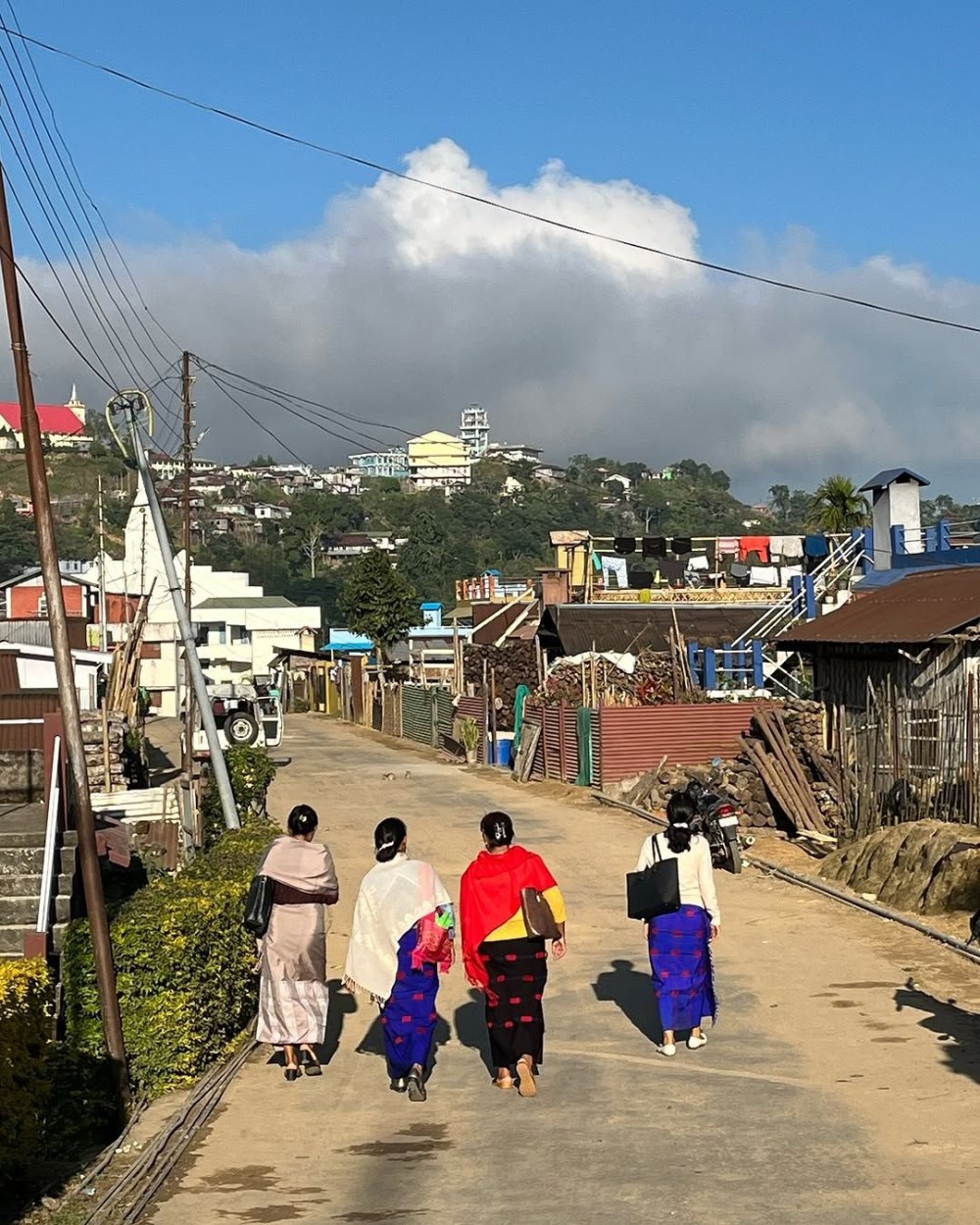
Women of Changki village in Mokokchung District, heading to Sunday church service wrapped in their traditional wrap-around. (Photo Courtesy: changkivillage/Instagram)
Meyu Changkiri
Have you ever heard a familiar voice or dialect and felt instantly at home? Long before we learn grammar, language settles into our hearts as memory and belonging. It is the sound of elders calling our names, the rhythm of laughter in the courtyard, and the tone of prayer spoken in faith. As life carries us beyond our place of birth, we begin to live among many languages and cultures. My journey - from a village childhood to serving diverse communities - has taught me that honouring our mother tongue while embracing other languages is not a contradiction. It is a calling. When language becomes a bridge instead of a barrier, people feel respected, communities grow stronger, and belonging becomes real.
I was born in Changki village at a time when language was not something we discussed. It was simply the air we breathed. The Changki form of the Ao dialect filled our home, our fields, and our daily life. It carried the rhythm of village routines, the warmth of relationships, and the quiet authority of elders. As a child, I did not know that language could differ from place to place. I only knew this was how we spoke, how we belonged, and how we understood one another.
Those early years shaped me deeply. Language was more than a way to communicate; it carried identity, memory, and relationship. Even today, hearing that dialect awakens a deep sense of rootedness.
Visitors often came from other Ao villages, speaking Mongsen and Chungli. I listened with curiosity to the differences in tone and expression. Slowly, I realised that our speech had variations that connected wider communities beyond our village. Even within one people, language carried diversity.
A Home Connected to a Wider World
Our home welcomed influences from beyond the village. My eldest brother studied in Mokokchung, later in Kohima, and eventually in Kolkata. Through his journey and through visitors connected to his studies, new accents, unfamiliar words, and different ways of speaking entered our front yard.
My sisters who studied in Mokokchung and Impur returned home with new expressions and stories. Their speech reflected a broader Ao world beyond Changki village. I began to understand that our language and culture were part of something larger.
My brother often spoke about teachers from different parts of the world, including American missionaries and educators. Through these stories, I learned that education and faith could bring people from different cultures together.
Some visitors were non-Ao, and occasionally even non-Naga guests stayed with us. Conversations moved between Ao dialects, Nagamese, Hindi, and English. I did not understand everything, but I sensed that our home was connected to a world far beyond our hills.
Language as a Bridge in Everyday Life
My father’s life strengthened this understanding. He trained at the Assam Regiment Centre in Shillong and later served in Punjab and Assam. Through his service, he met people from many regions and language backgrounds. Whenever he spoke with people from different communities, he used Hindi and Nagamese so they could understand one another. I did not know all the words, but I understood what was happening: language allowed strangers to sit together, share stories, and build trust.
Adivasi workers laboured in the paddy fields in the Changki valley. When my father spoke with them, he again used Hindi and Nagamese. From these interactions, I saw that language made cooperation possible and relationships respectful. Work became easier, dignity was preserved, and human connection grew stronger when people spoke in ways others could understand.
Language also brought humour into our home. My father sometimes spoke playful English just to make us laugh. Those moments filled our home with joy. They taught me that language is not only about correctness; it is about warmth and connection.
Faith, Strength, and the Language of the Heart
My mother’s life added another layer to my understanding of language and faith. After her mother died early, she helped her father raise five younger siblings and never had the opportunity to attend school. Yet her lack of formal education did not limit her strength, wisdom, or spiritual depth.
She could pray in Chungli and converse in both Chungli and Mongsen with ease. I often listened as she prayed with sincerity and quiet strength. Her words were shaped not by textbooks but by lived faith. From her I learned that language does not belong only to the educated; it belongs to the faithful and resilient.
Even before I travelled beyond the hills, the wider world had begun to visit our home.
Growing Up Multilingual Without Losing Identity
When I later moved to Kohima, my linguistic world widened. I met more speakers of Chungli and Mongsen and appreciated the diversity within Ao speech. Nagamese became an everyday bridge language across tribal lines. English opened doors to education and knowledge. Learning Angami helped me connect more deeply with the local community.
My Hindi improved during a short period in Dehradun. In Darjeeling, learning Nepali helped friendships grow naturally and daily life become easier. Later in Jorhat, improving my Assamese strengthened my ability to relate to people across Assam. Each language did not replace the previous one; it enriched it.
Looking back, I realise my life has been shaped not by one language but by many. This has not weakened my identity. It has deepened it.
Language, Identity, and Belonging in Community Life
We often speak of the mother tongue as the language that anchors us to our ancestry and roots. For me, Changki remains that anchor. Life experience also introduces what many call the language of the heart - the language in which we express emotion and pray most naturally. For some, this remains their mother tongue. For others shaped by multilingual environments, the language of the heart may include several languages.
Across the Northeast and beyond, communities bring together many peoples and languages. In such settings, language can create distance or foster belonging. In ministry and community life, language must serve people. Elders feel comforted when addressed in their mother tongue. Young people often understand teaching more clearly in English. Visitors feel welcomed when they hear a familiar bridge language. Speaking in a language people understand communicates respect and affirms dignity.
Have you ever been far from home and suddenly heard someone speak your mother tongue? In that moment, something within you softens. You feel recognised and unexpectedly at home. A familiar sound restores a sense of identity that distance could not erase.
Now consider the opposite experience. How do you feel when you sit in a gathering you regularly attend, yet the language spoken is one you do not understand? Conversations continue, laughter rises, and decisions are made, but you remain on the margins, unsure when to participate. No one intends to exclude you, yet the distance is real.
These experiences remind us that language is not only about communication. It is about belonging. When people understand, they participate. When they participate, they belong. When they belong, community flourishes.
Not everyone has the opportunity to learn several languages. Many elders and rural families have lived faithfully within one language throughout their lives. This is not a weakness but a reflection of their journey. Communities grow stronger when we speak in ways others can understand, translate when needed, and ensure no one feels excluded. Belonging must never depend on linguistic ability.
Preserving Roots While Building Bridges
Today, many smaller languages and dialects are fading as younger generations gravitate toward dominant languages shaped by urban education and digital media. This shift is understandable. Yet when a language disappears, more is lost than vocabulary.
Language carries oral history, values, humour, worldview, and collective memory. When a language fades, a unique way of seeing the world fades with it.
International Mother Language Day on 21 February reminds us that languages carry identity, memory, and belonging. Preserving language does not mean resisting change. It means caring for heritage so future generations know where they come from even as they move forward.
Every language expresses human dignity and cultural wisdom. Diversity in language reflects the richness of humanity.
My journey from village roots to urban ministry has taught me that both roots and bridges are necessary. Roots provide identity and belonging. Bridges enable connection and service. Without roots we lose depth; without bridges we lose reach.
Language can divide when used to exclude, but it has an even greater power to unite when used to include. Our mother tongues anchor us in memory and identity. The languages we learn along the way help us embrace neighbours beyond our own community. We do not lose ourselves by learning new languages; we discover wider ways to belong.
From Changki village to serving diverse communities, I have learned that language is not merely about words. It is about people. It is about connection. It is about building bridges strong enough for many to cross.
When language becomes a bridge rather than a barrier, communities grow stronger, understanding deepens, and our shared humanity becomes clearer. When we speak in ways others understand, we do more than communicate - we make people feel welcomed, valued, and that they truly belong.

