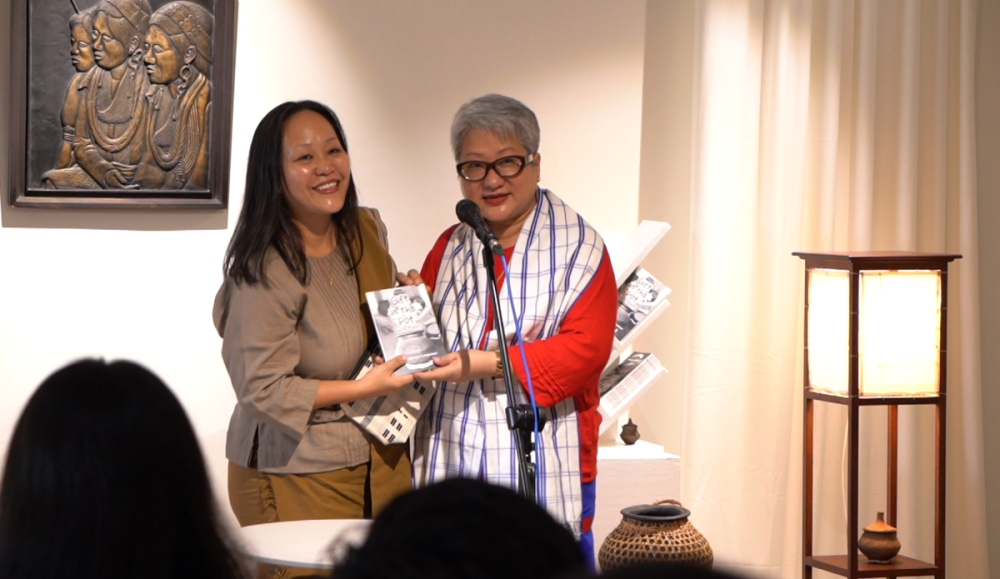
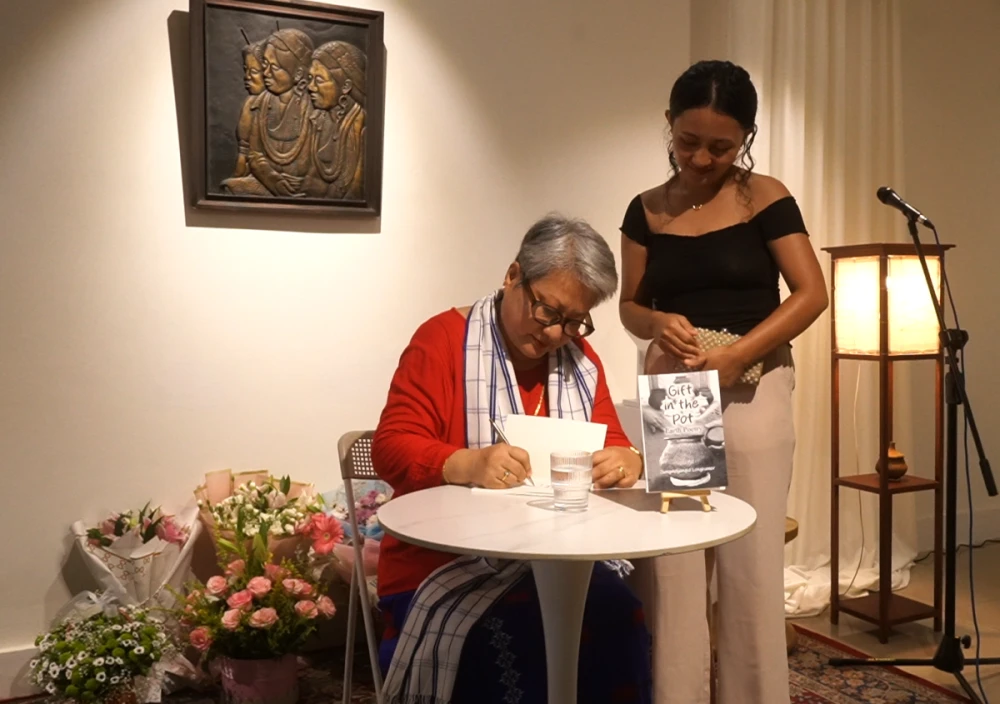
(Left) Abokali Jimomi released ‘Gift in the Pot: Earth Poetry,’ the second edition of (Right) Jungmayangla Longkumer’s poetry collection at Tia Ki Nagaland Art Space, Dimapur on September 26. (Morung Photo)
Celebrates rich heritage of women pot-makers of Changki, Longjemdang & Japu
Morung Express News
Dimapur | September 26
‘Gift in the Pot: Earth Poetry,’ the second edition of Jungmayangla Longkumer’s poetry collection, was launched by writer, researcher and entrepreneur Abokali Jimomi at Tia Ki Nagaland Art Space, Dimapur on Saturday.
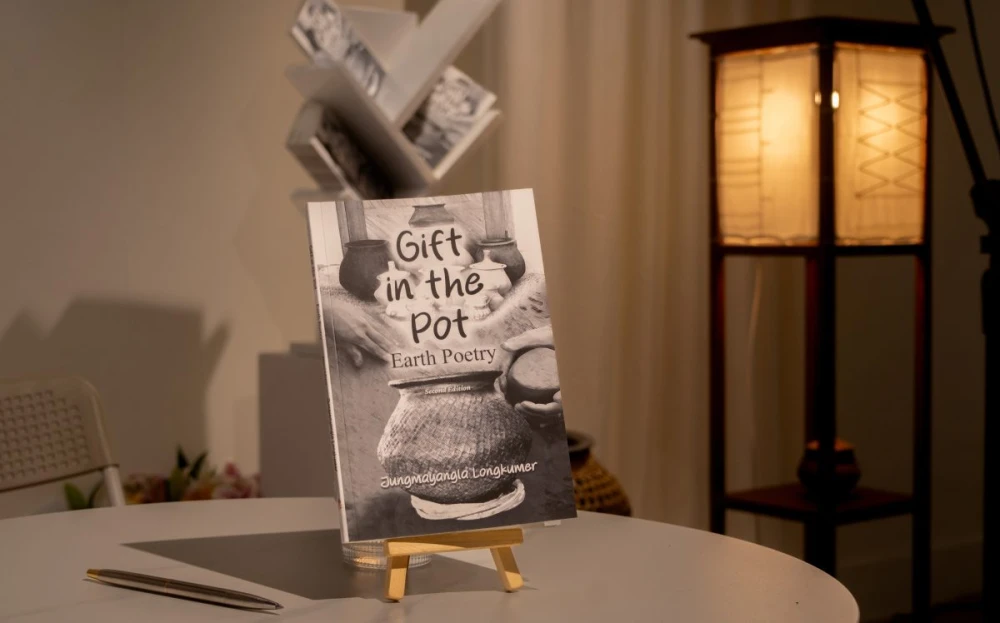
The book celebrates the rich cultural heritage of the women pot-makers of Changki, Longjemdang and Japu villages of Mokokchung district, whose craft has been passed down through generations. Priced at Rs 3OO, it was published by 6th Finger Publishers, Kohima.
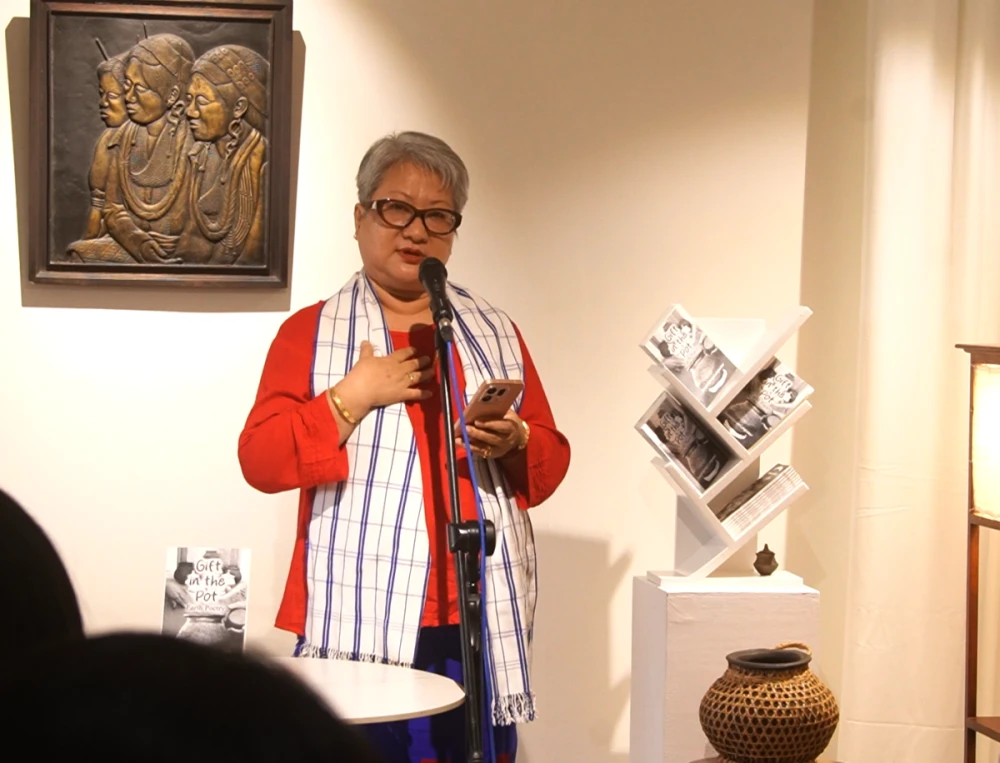
In her author’s note, Prof Longkumer said the women have ensured that pottery is not relegated to history books or museums or become merely a vague memory. “This is a living tradition that gives us a distinct identity,” she said, describing the ancient craft as “a measure of the honour bestowed to the giving earth by these women.”
She paid tribute to the grandmothers, mothers, daughters, sisters and nieces whose knowledge, hard work and resilience have kept the craft alive. Longkumer recalled that in the olden days, when pot-making was considered taboo among the Ao and headhunting was the norm, people travelled great distances through dangerous terrain to barter goods for a year’s supply of pots from these villages.
“From the digging, collection and transportation of the earth to the making of the pot, every step of the process is performed by women,” she writes in the opening lines of the book, describing the earthen pot as “a symbol of cultural identity.” She also expressed concern that the art is slowly dying out, even as the “never-say-die women” continue to keep the tradition alive.
The second edition comes 12 years after the first. Longkumer also paid tribute to the potters featured in the first edition who have since passed. They “may have left the tools behind,” but their craft lives on through the pots they made, the stories they inspired and the heritage they helped carry to the next generation.
She acknowledged her late mother, writer Temsula Ao, who launched the first edition, saying, “I would not have reached this point in life if it hadn't been for my mother.” She said her mother encouraged her to realise her talents, remain independent and resolute, and taught her that life is a celebration and that existence becomes meaningful through giving and sharing.
Longkumer is a professor in the department of Agricultural Extension Education, Nagaland University, School of Agricultural Sciences, Medziphema Campus.
Honouring generations of women artisans
In her address, Jimomi acknowledged the privilege of launching a book that celebrates women who “craft, who create, who shape the earth to nourish others by transforming the mundane extraordinary.”
She said the poems and images make visible the human behind the work, affirming that generations of women in Changki, Longjemdang and Japu lived, worked hard, nurtured their families and loved fiercely so that their descendants might survive through the things they made with their bare hands.
“These women were makers, they were also artisans, caregivers, farmers, seed keepers, weavers, mothers, and much more,” Jimomi said, while noting that their labour was often invisible, as is still true of much of the work women do today. “A woman's life cannot really be measured by a single role,” she said.
Reflecting on the lives of women who came before her, Jimomi said their work often seemed concealed under “a very heavy cloak of what I would term as irreversible irrelevance.” Their names may not have been recorded alongside celebrated warriors or those who wielded dominant power, nor appear in genealogies that often trace fathers and sons. “But we know they lived, and their lives and their work mattered,” she said.
Jimomi said ‘Gift in the Pot’ invites readers to imagine the lives of these women, their relationships with nature and one another, their hardships, fears and hopes, and the generations of daughters who learnt the craft by watching and working alongside their mothers.
She also recalled how her 10-year-old daughter, Lavi, read the book after taking it from her bag without her knowing.
“Iza, I read this book of poetry and pottery, and now I feel like touching a pot. I want to make some pots,” her daughter had told her.
“And so if even a child can understand that from the book,” Jimomi said, “I think it fittingly sums up what a powerful book you have written, Ayang.”
Earlier, the book review was delivered by Dr Inakali Assumi, an author, researcher and educator. She said in a society where men inherit hills and lands, the book offers a narrative of an inheritance that transcends material possessions.
Dr Assumi said the poet leaves an inheritance in the hands of every reader, inviting them to revisit the potters who kept the art alive and those who passed it down in the hope that there would never come a day when only the scent of the last potter remains, while the ancient pot-makers have all passed on. She thanked the author for gifting readers a work of such depth and significance.
Meanwhile, Publisher Sentimongla of 6th Finger Publishers, Kohima, congratulated the author while noting it was their first meet in person. Describing the author as fun-loving, she expressed her hope of working with her again.
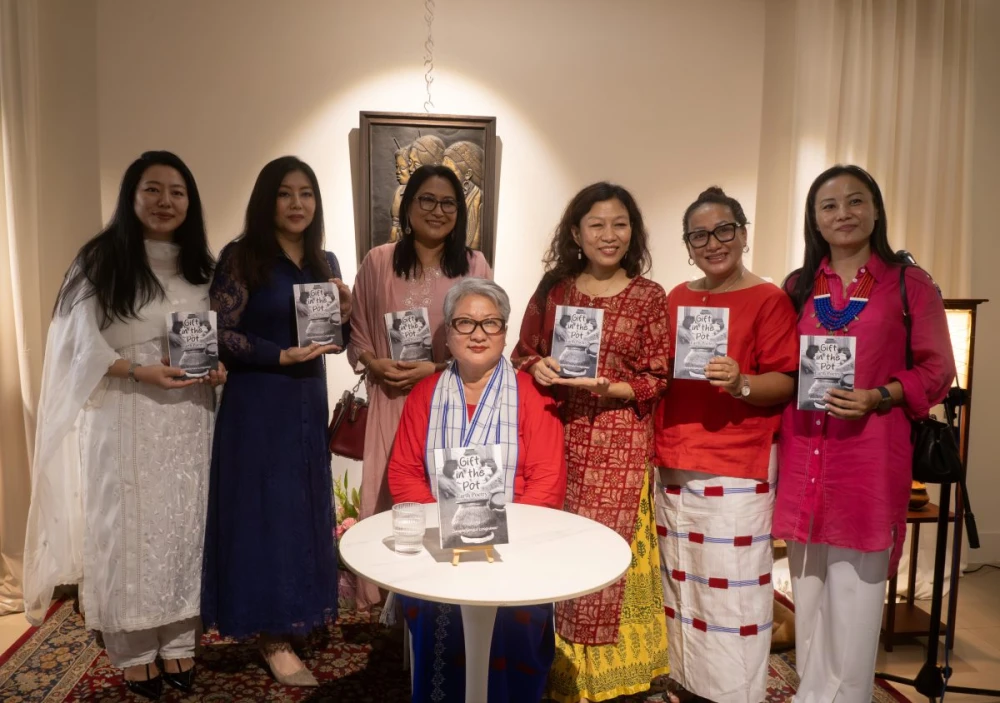
Each poem in the book is accompanied by a photograph, all contributed by the author’s husband, Temjenmenba. The intimate launch was attended by the author’s family and close friends.