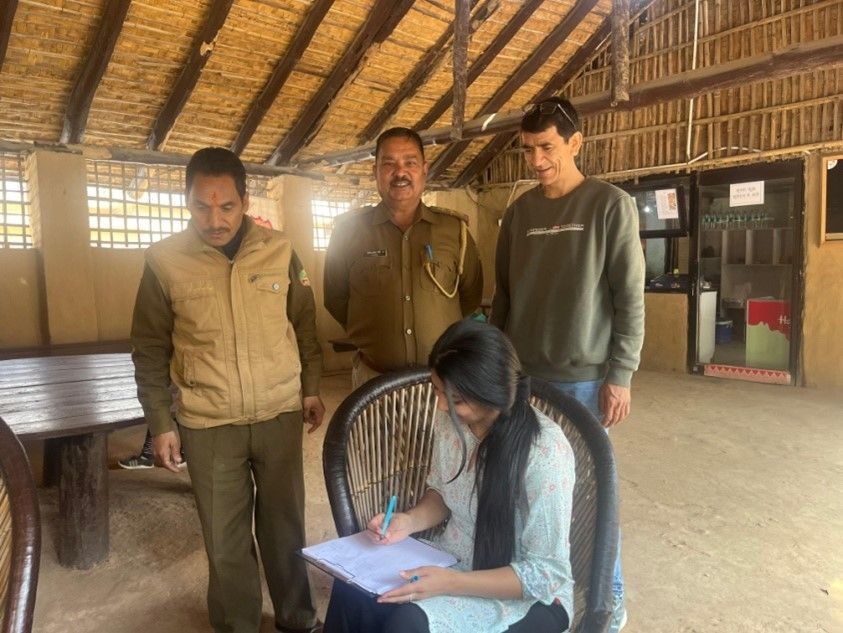
Dr Pradeep Kumar Rawat and Ananya Rawat filling up questionnaires during field work with Forest Department, Government of Uttarakhand.
Lumami, February 26 (MExN): Researchers from Nagaland University have proposed a holistic conflict mitigation approach integrating ecotourism-based measures, community participation and geospatial technology to address the rising human–tiger conflicts in Uttarakhand, particularly in the transitional buffer zones around Jim Corbett National Park.
The study noted that increasing human–wildlife conflicts, driven by ecological degradation, climate change and expanding human activities, have intensified significantly in recent years.
Calling for urgent and coordinated interventions, the research emphasised the need to combine ecological conservation, technological monitoring and active community engagement. It stated that such integrated measures are essential to prevent further escalation of human–tiger conflicts and to ensure sustainable coexistence between humans and wildlife.
Uttarakhand, known for its rich biodiversity and high tiger population, has witnessed a rise in human–tiger encounters due to habitat loss, human encroachment and mounting pressure on natural resources. These conflicts have led to loss of human lives, livestock depredation and widespread fear among local communities, particularly in the districts of Pauri, Almora and Nainital.
Focusing on the eastern transitional buffer zone of Jim Corbett National Park near Ramnagar and adjoining villages, the study analysed spatiotemporal trends in human–tiger conflicts over a 34-year period from 1991 to 2025.
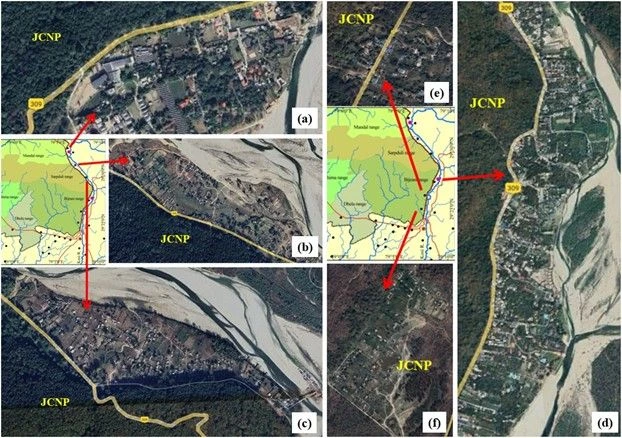
The researchers integrated two GIS-based modules—an ecological module and a human–tiger conflict module—to assess changes in land use, habitat area, population density, tourism pressure and recorded conflict incidents. Based on the analysis, the study classified the region into four categories of human–tiger conflict risk zones: low, moderate, high and very high.
A video byte of Prof M S Rawat, Department of Geography, Nagaland University, explaining the research is available online for viewing and download.
Lauding the study, Prof Jagadish K Patnaik, Vice Chancellor of Nagaland University, said the research identifies community-based ecotourism as a sustainable strategy to manage human–tiger conflicts near Jim Corbett National Park.
“The study highlights that community-based ecotourism can reduce dependency on forest resources, enhance local livelihoods and promote coexistence with wildlife. Such research reflects the university’s commitment to addressing critical environmental challenges through practical and community-oriented solutions,” he said.
The findings have been published in Springer’s Environmental Monitoring and Assessment, an international peer-reviewed scientific journal focusing on environmental monitoring systems and pollution risk assessment.
The paper was co-authored by Prof M S Rawat of Nagaland University; Ananya Rawat of Amity Institute of Forest and Wildlife, Amity University; and Dr Pradeep Kumar Rawat of the Department of Geography, Asian International University.