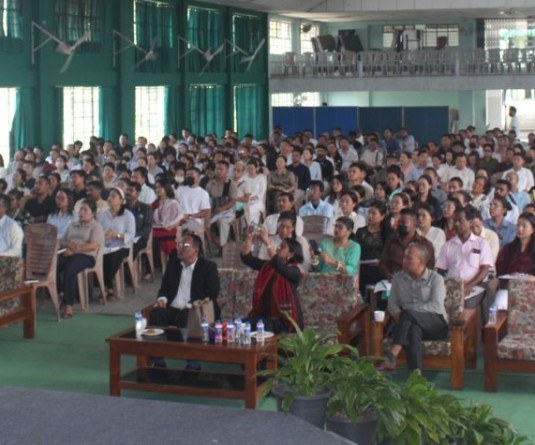
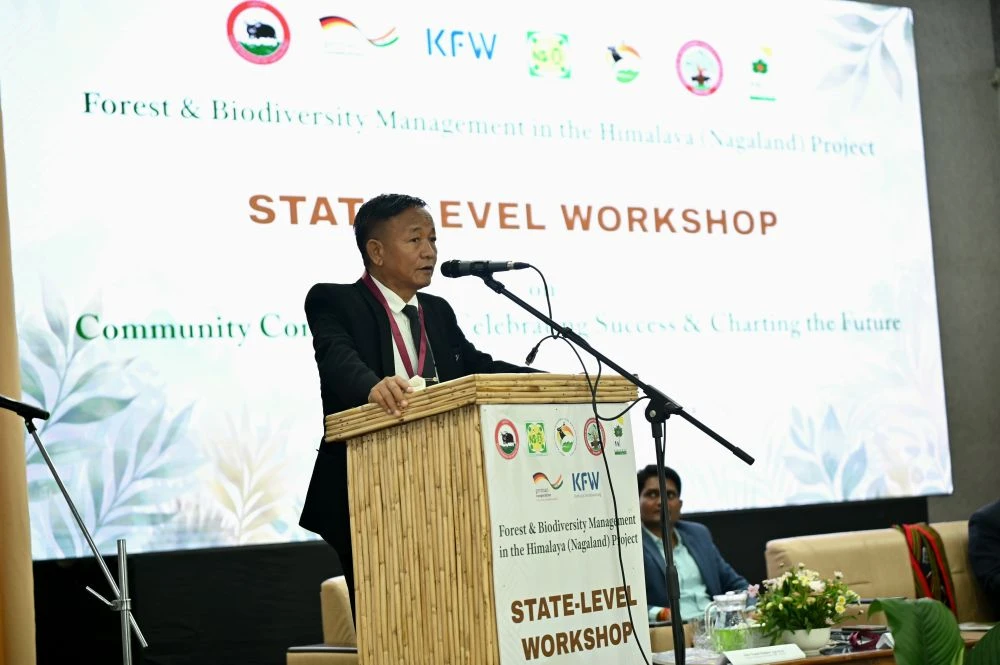
CL John and others during State Level Workshop on “Community Conservation: Celebrating success & charting the future” in Kohima on November 3. (Morung Photo)
Our Correspondent
Kohima | November 3
Nagaland Environment, Forests & Climate Change and Village Guards Minister CL John on Tuesday called for effective implementation of Wildlife Protection Act, 1972 to ensure environmental and ecological security. He stressed on the need to ensure restriction on hunting, jungle burning and promote afforestation in the respective areas.
Addressing the State Level Workshop on “Community Conservation: Celebrating success & charting the future” as part of Forest & Biodiversity Management in the Himalayan (Nagaland) Project in Kohima, the Minister urged upon the Community Conserved Areas (CCAs) across the state to intensify biodiversity conservation efforts and put collective efforts to maintain ecological balance.
The Minister encouraged all 64 project villages to ensure the judicious utilisation of project funds for tangible development within their respective CCAs.
Highlighting the Human-Elephant Conflict (HEC) as a major concern, he said that the department has been applying various mechanisms to address the issue.
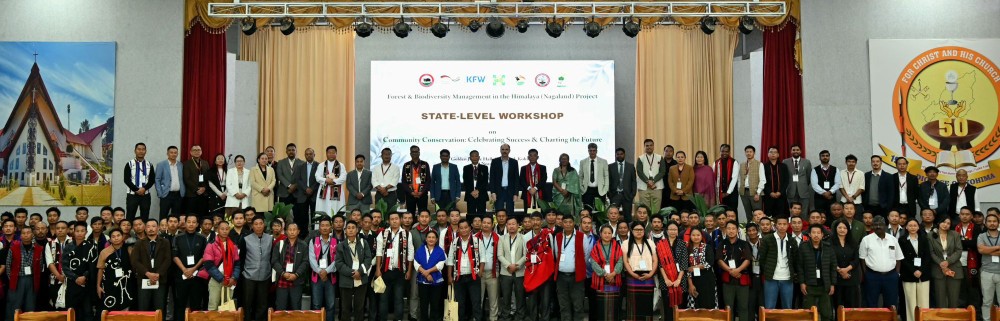
The workshop brought together over 250 government officials, conservation practitioners, community representatives and other stakeholders to deliberate on the achievements, challenges and future prospects of community-based forest and biodiversity conservation in Nagaland.
It emphasised the importance of community participation, traditional knowledge, customary institutions and collaborative governance in protecting forests and biodiversity.
It also provided a platform for sharing experiences, reviewing ongoing initiatives and discussing strategies for strengthening sustainable natural resource management.
The workshop also highlighted the relevance of FBMP's conservation initiatives in Nagaland and its national and global significance, besides its role in promoting Indo-German cooperation in India.
Collective responsibility essential for biodiversity conservation
Nand Kishore Agarwal presented on “Conservation through FBMP Nagaland and National/Global Perspectives,” highlighting community-led conservation's global significance and citing the Amur Falcon's conservation in Nagaland as a success story of community participation and government support.
He emphasised the Kunming-Montreal Global Biodiversity Framework and the need to recognize indigenous communities in conservation policy and decision-making. Nagaland has over 400 Community Conserved Areas (CCAs), while FBMP covers 64 villages and protects over 40,000 hectares of community forests. He stressed that greater recognition and financial support for CCAs are essential for sustaining biodiversity conservation and safeguarding indigenous communities' interests.
Sangeeta Agarwal, Senior Sector Specialist, Natural Resource Management, KfW, New Delhi, highlighted Indo-German cooperation's contribution to biodiversity conservation in India. She described FBMP Nagaland as a successful participatory conservation model, citing landscape-based planning, HEC mitigation, the Conservation Fund, People's Biodiversity Registers, and the Morung Experience Centre at Khonoma.
Aullen, Chairman of New Chingmei Village CCA, shared the village's biodiversity conservation experiences. Kovi Meyase, Commissioner & Secretary, Tourism and Land Resources Departments, and Team Leader, NEPED, emphasized CCAs' role in strengthening collective responsibility and empowering local communities, particularly women, in conservation decision-making. He called for sustaining project achievements and encouraging youth participation to build a lasting conservation legacy across the State.
Vedpal Singh, IFS, PCCF & HoFF, Nagaland, stressed that active community participation and collective responsibility are essential for successful biodiversity conservation. He emphasized ensuring tangible direct and indirect economic benefits for local communities to sustain conservation initiatives long-term, and developing concrete data and documentation as indicators of success.
Programme highlights included unveiling project documents, launching the FBMP project website, and inaugurating the HEC toll-free helpline 1800-2020-878. The inaugural programme also presented FBMP Nagaland Conservation Awards to three villages: Langa Village (Tuensang District) for Community Infrastructure, Thenhayan Village (Wokha District) for Sustainable Livelihood, and Mmhayan Village (Wokha District) for Community-led Conservation.
Vote of thanks was delivered by Hukato Chishi, IFS, CF (STC) and Deputy Project Director, FBMP. The inaugural session was compered by Dr Kezevituo Metha and Dr Tintoli A. Kuho.
The workshop will continue till November 4. Valedictory session will take place at 12:30 PM with Y Kikheto Sema, principal secretary, DEFCC & chairman NSBB as the special guest.
‘Forests & Biodiversity Management in Himalaya (Nagaland)’ project
Sidramappa Chalkapure, CCF (D&P) and Project Director, FBMP, said the Government of Nagaland, in association with the Government of India and the Federal Republic of Germany, conceptualized the "Forests and Biodiversity Management in Himalaya (Nagaland)" project—popularly known as "the KfW Project"—implemented through grants from the Federal Republic of Germany via KfW Development Bank.
The project operates in 64 villages across six districts: Kohima, Mokokchung, Peren, Shamator, Tuensang and Wokha. Implementation began in 2020–21 with incentivized participatory planning, followed by micro-plans and landscape management plans. Based on community input from this planning process, livelihood and community infrastructure activities were taken up in the project's initial stage.
Initially designed to conserve rich biodiversity and support the wellbeing of forest-dependent communities in Nagaland, the project has evolved to address challenges including Human-Elephant Conflict, degradation and fragmentation of community-owned forests, and reviving spring-sheds and stream-scapes. Conservation measures are being implemented over 41,000 ha of community forests.
The project is executed by the Nagaland State Biodiversity Board (NSBB) through the Forest Department and NEPED as implementing agencies. The Wildlife Institute of India, Nagaland Bio-Resources Mission, Kohima Science College Jotsoma, Nagaland CCA Forum and Foundation for Ecological Services have assisted the Project Executing Agency in Kohima with planning and implementation. The FBMP (Nagaland) project is expected to be completed by the end of next year.