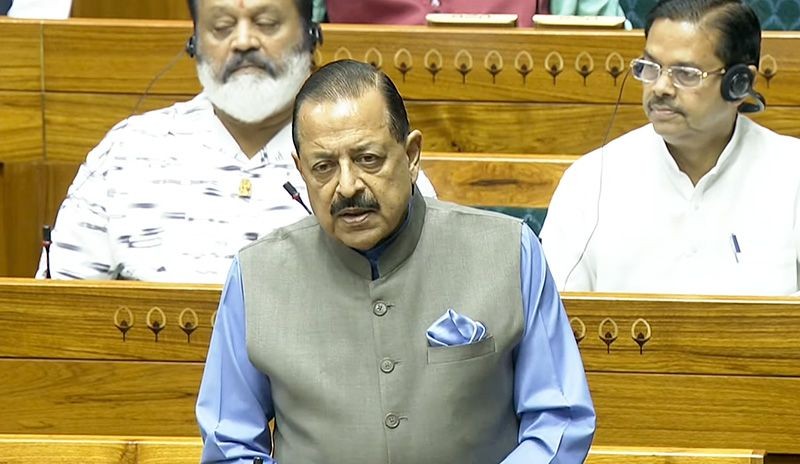
Union Minister Jitendra Singh speaks in the Lok Sabha during the Monsoon Session of Parliament in New Delhi on August 5, 2026. (: IANS/Sansad TV Photo)
New Delhi, August 6 (IANS): Union Minister of State for Science & Technology, Earth Sciences Dr. Jitendra Singh on Thursday said that the Human Rated Launch Vehicle (HLVM3) has completed the development and ground testing of all propulsion stages and structures.
India's first human spaceflight mission, Gaganyaan, has achieved major milestones in the development and validation of critical human-rating systems, the minister said in Rajya Sabha.
Outlining the mission roadmap, the minister said the first uncrewed experimental Gaganyaan mission carrying the Vyommitra half-humanoid is targeted during the fourth quarter of 2026.
It will validate technologies being developed for the first time under the programme. This will be followed by two additional uncrewed missions in the configuration of the first crewed flight, targeted by 2027, before India's maiden human orbital mission.
Singh said Bharatiya Antariksh Station (BAS) is planned to be operationalised by 2035 and that ISRO has worked out the overall configuration of the space station comprising five modules.
The government has approved the development and launch of the first module, BAS-01. Overall system engineering and technology development activities for the module are progressing across ISRO Centres and Units.
Singh informed that the propulsion systems of the Crew Module and Service Module of HLVM3 have been developed, tested and qualified.
The Engineering Model of the Environmental Control and Life Support System (ECLSS), Thermal Protection System, Deceleration System, Crew Module Up-righting System and end-to-end avionics have also been successfully developed and tested, he added.
He mentioned significant in ensuring crew safety and that all five types of motors for the Crew Escape System (CES) have been developed and successfully static tested, while all associated structures have been realised and qualified.
“He further informed that key mission infrastructure, including the Orbital Module Preparation Facility, Gaganyaan Control Centre, Crew Training Facility and modifications to the Second Launch Pad, has been established to support upcoming mission activities,” a statement from the Department of Space said.