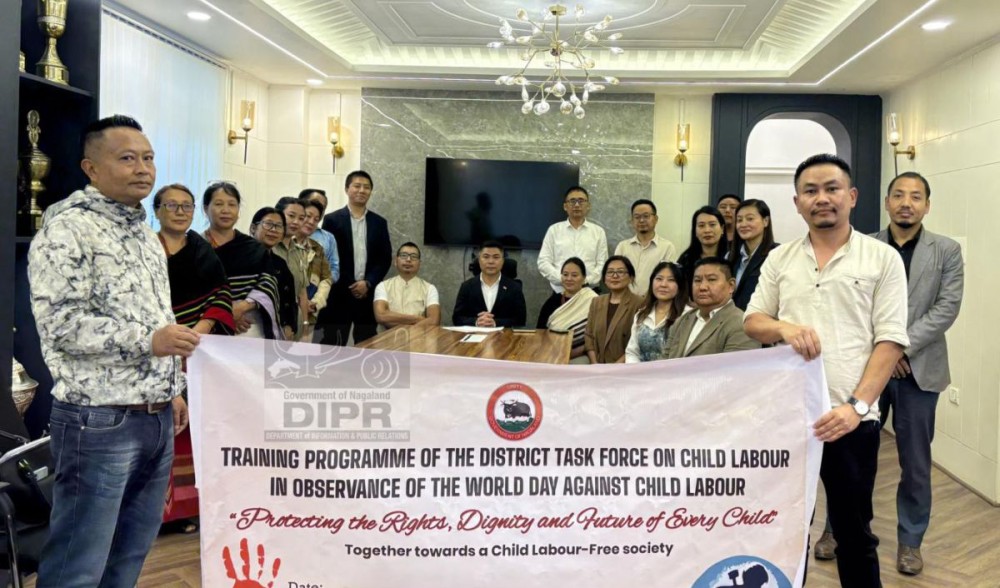
DC & Chairman, District Task Force on Child Labour, Kohima, B. Henok Buchem, with officials and others. (DIPR Photo)
Key SOP provisions
• Rescue information can come from the public, agencies, NGOs or the child.
• Rescued children must be produced before the Child Welfare Committee.
• FIRs are to be registered where offences are detected.
• Temporary shelter, care and rehabilitation measures are to be provided.
• Action against employers, including compensation and prosecution, is mandated.
• Departments are assigned specific roles for coordinated rescue and rehabilitation.
Kohima, June 23 (MExN): An orientation programme on the Standard Operating Procedure (SOP) for the rescue, rehabilitation and post-rescue management of child labourers under the Child and Adolescent Labour (Prohibition and Regulation) Act, 1986 was held at the Deputy Commissioner's Chamber, Kohima, on June 23.
According to the State DIPR, the programme brought together members of the District Task Force (DTF) on Child Labour to strengthen coordination and implementation of child protection measures.
Addressing the programme, Deputy Commissioner and Chairman of the District Task Force, Kohima, B Henok Buchem emphasised that issues concerning children require the collective responsibility of all stakeholders. He stated that every department and organisation represented in the task force has a crucial role in ensuring the protection and welfare of children.
Stressing the need for members to be fully aware of their responsibilities under the law, he called for regular coordination and quarterly meetings to formulate action plans and strengthen implementation mechanisms. The Deputy Commissioner also underscored the importance of public awareness on child protection laws and child labour issues, urging intensified Information, Education and Communication (IEC) campaigns involving government agencies, public organisations and community leaders.
Assistant Labour Commissioner Neimenuo presented the SOP and explained that it was developed to ensure a coordinated and child-centric approach among all departments involved in the rescue and rehabilitation of child labourers. She stated that the SOP aligns with the provisions of the Juvenile Justice (Care and Protection of Children) Act, 2015 and outlines the responsibilities of departments and agencies at every stage of intervention.
Labour Inspector Mhaletuonuo Keditsu highlighted provisions of the Child and Adolescent Labour (Prohibition and Regulation) Act, 1986 and relevant State rules, including penalties for violations and the responsibilities of enforcement agencies.
Representatives of the Child Welfare Committee (CWC) shared field experiences, including interventions in recent cases involving children employed by relatives and a separate case in which a child was accommodated in an open shelter following allegations of physical abuse. Police personnel from the Women Police Station also highlighted the importance of timely reporting, coordinated action and community participation in addressing child labour and child abuse.
Participants were also informed about the Child Helpline 1098 and discussed issues relating to compensation, transportation and rehabilitation support for rescued child.