Ongthan Phom of Noksosang village in Longleng district has transformed his livelihood by establishing a low-cost mushroom production unit.
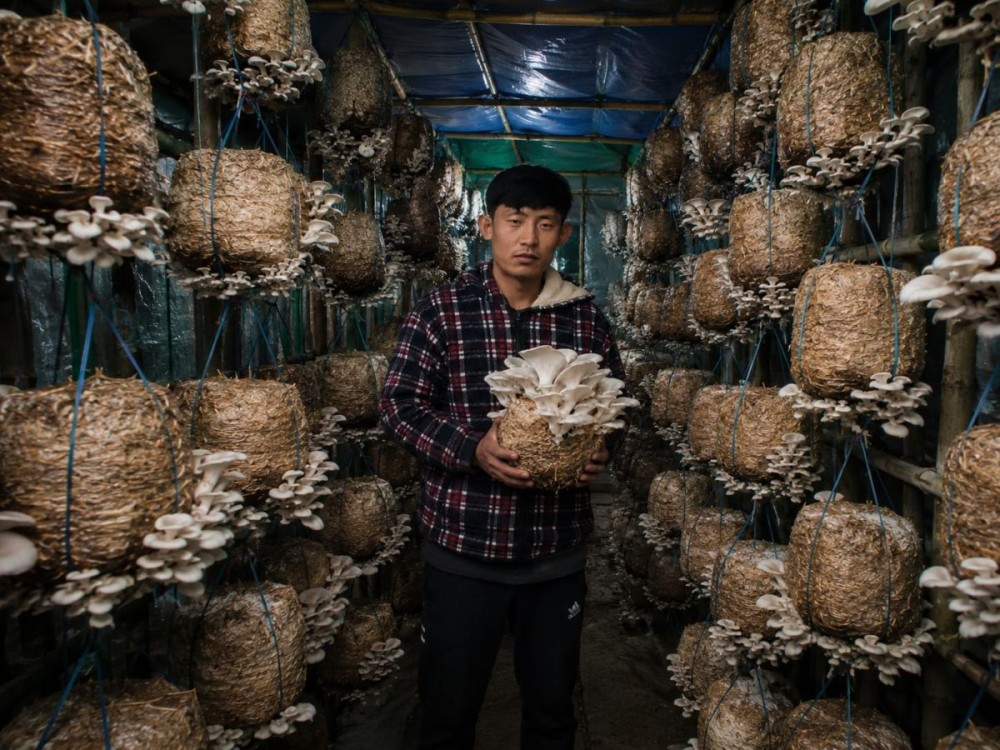
Ongthan Phom’s low-cost unit yields Rs 90,000 annual income
Longleng, June 3 (MExN): What began as a struggle for supplementary income in the remote Noksosang village of Longleng district has now turned into a replicable model of low-cost entrepreneurship, thanks to the scientific oyster mushroom cultivation techniques adopted by a progressive farmer, Ongthan Phom.
Once solely dependent on traditional farming with limited avenues for additional earnings, Ongthan Phom has transformed his livelihood by establishing a low-cost mushroom production unit under the technical guidance of the ICAR–Krishi Vigyan Kendra (KVK), Longleng. Phom, 38, of Noksosang village in Longleng district, now prepares 250-300 mushroom production bags every year, yielding 350-400 kg of fresh oyster mushrooms sold at Rs 180-250 per kg in nearby villages, local markets and Longleng town. The enterprise generates a gross annual income of Rs 70,000-90,000 and a net profit of Rs 45,000-60,000 after deducting production costs, all from an initial outlay of barely Rs 12,000-15,000.
The turnaround was made possible by the technical guidance of the ICAR-Krishi Vigyan Kendra (KVK), Longleng, whose scientists trained Phom in the end-to-end science of oyster mushroom production — from substrate preparation and spawn inoculation to disease management, harvesting and post-harvest marketing.
“Low-cost mushroom cultivation can serve as an effective enterprise for income generation, employment creation, and livelihood improvement among rural households in Longleng district,” said Dr Hari Charan Kalita, Senior Scientist and Head, KVK, Longleng in a press release.
Like most farmers in the district, Phom was earlier confined to traditional jhum (shifting) cultivation with few avenues for supplementary income. Recognising the potential of mushroom farming as a low-investment, high-return enterprise suited to local agro-climatic conditions, he enrolled in a series of skill-development and capacity-building programmes organised by the KVK.
The training covered substrate preparation using locally available paddy straw, spawn inoculation techniques, crop management, contamination control, harvesting protocols, post-harvest handling and market linkage. Continuous on-farm support was provided by Shubhendu Kumar Behera, Subject Matter Specialist (Plant Pathology), ICAR-KVK Longleng, who advised Phom on maintaining hygienic production conditions, moisture management and efficient use of locally available resources.
With this knowledge, Phom set up a low-cost production unit using locally sourced bamboo, polythene sheets, paddy straw and agricultural residues, materials that would otherwise go to waste. The mushroom growing shed was constructed without any formal construction cost, keeping overheads minimal.
Beyond income, the enterprise has created employment within the household and enabled productive recycling of farm waste. Encouraged by Phom's results, several farmers and rural youth from Noksosang village have expressed interest in replicating the model.
Phom is now recognised as a ‘resource farmer’ in the locality. His farm serves as a regular demonstration site where fellow farmers observe mushroom production techniques at different stages of the cultivation cycle. He also participates in farmer-to-farmer knowledge sharing sessions facilitated by the KVK.
The KVK network, operated by the Indian Council of Agricultural Research (ICAR) and present in nearly every district of the country has long been tasked with bridging the gap between laboratory and land. The Longleng KVK's work with Phom illustrates how targeted technical support, even on a modest budget, can produce measurable livelihood outcomes in economically marginalised regions.