Delegates who took part in the lecture.
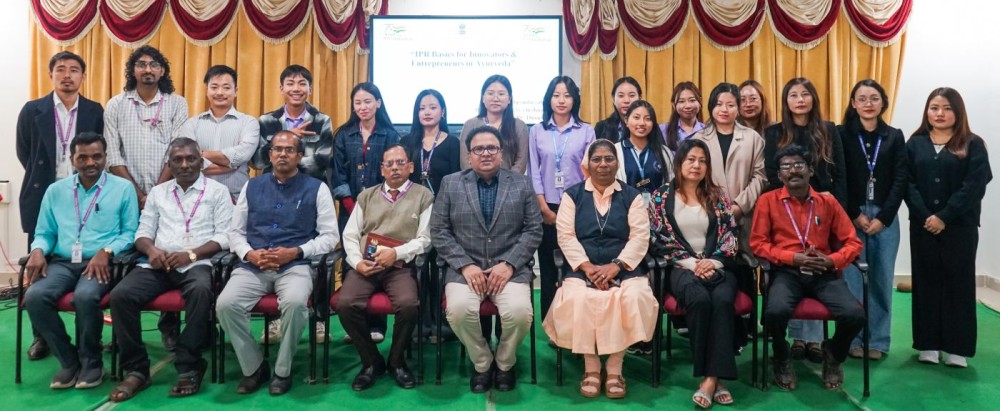
Dimapur, February 8 (MExN): The Institution’s Innovation Council (IIC), in collaboration with the Department of Botany, St. Joseph University, Nagaland, organized an expert lecture on “IPR Basics for Innovators and Entrepreneurs in Ayurveda” on February 5 at the University Seminar Hall. The programme aimed to create awareness on Intellectual Property Rights (IPR) in Ayurveda and to encourage innovation and entrepreneurship among students and researchers.
The programme commenced with an inaugural session chaired by Moachila, PhD scholar, Department of Botany. The invocation was delivered by Mharhoni C Tsanglao, PG student, Department of Botany. K. Kumar, assistant professor, Department of Botany, welcomed the gathering and introduced the resource person, highlighting the relevance of Ayurveda and IPR in today’s knowledge-driven economy.
The keynote address was delivered by Dr. Dipsundar Sahu, MD, PhD, research officer (Ay.) and in-charge of the Regional Ayurveda Research Centre, Dimapur, under the Central Council for Research in Ayurvedic Sciences (CCRAS), Ministry of AYUSH. In his lecture, Dr. Sahu provided a comprehensive overview of Ayurveda as the “science of life,” outlining its eight classical clinical specialities and its holistic approach to health and wellness. He explained that Ayurvedic lifestyle practices and interventions focus on prevention, detoxification, stress reduction, and long-term well-being.
Dr. Sahu highlighted the present status of AYUSH in India and explained the regulatory framework governing Ayurvedic drugs, medicinal plants, and herbal products. He discussed national mechanisms for quality control, safety assessment, and standardization, and introduced emerging concepts such as “Ayurveda Aahar.” He also placed special emphasis on the growing business opportunities in the AYUSH sector, including the export of herbal products, digital marketing, telemedicine, and entrepreneurship in medicinal plant cultivation and value-added formulations.
The lecture further covered ongoing research initiatives in Ayurveda, including clinical research, pharmacological studies, medicinal plant research, literary documentation, and drug development. Dr. Sahu shared insights into multi-stage clinical trials, safety screening of formulations, and the importance of IPR in protecting innovations, formulations, and research outcomes. He encouraged students to explore interdisciplinary careers combining botany, traditional medicine, and entrepreneurship.
An interactive question-and-answer session followed, during which participants raised queries on public awareness, diabetic management, detoxification concepts, OPD-based treatments, and funding opportunities for establishing medicinal plant gardens. The resource person responded in detail and motivated students to collaborate with research institutions and government agencies for technical guidance and financial support.
The programme concluded with a vote of thanks by J. Suresh Kumar, associate professor and convener, Department of Economics, followed by a benediction by Temsurenla, assistant professor, Department of Botany.